David Geffen School of Medicine at University of California, Los Angeles, USA.
Department of Anesthesiology, Vanderbilt University Medical Center, USA.
EBioMedicine. 2024 Jul;105:105206. doi: 10.1016/j.ebiom.2024.105206. Epub 2024 Jun 19.
Cerebral vasospasm (CV) is a feared complication which occurs after 20-40% of subarachnoid haemorrhage (SAH). It is standard practice to admit patients with SAH to intensive care for an extended period of resource-intensive monitoring. We used machine learning to predict CV requiring verapamil (CVRV) in the largest and only multi-center study to date.
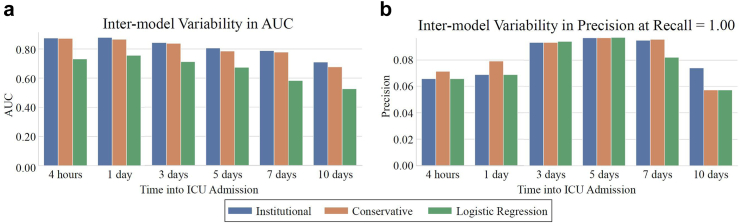
Patients with SAH admitted to UCLA from 2013 to 2022 and a validation cohort from VUMC from 2018 to 2023 were included. For each patient, 172 unique intensive care unit (ICU) variables were extracted through the primary endpoint, namely first verapamil administration or no verapamil. At each institution, a light gradient boosting machine (LightGBM) was trained using five-fold cross validation to predict the primary endpoint at various hospitalization timepoints.
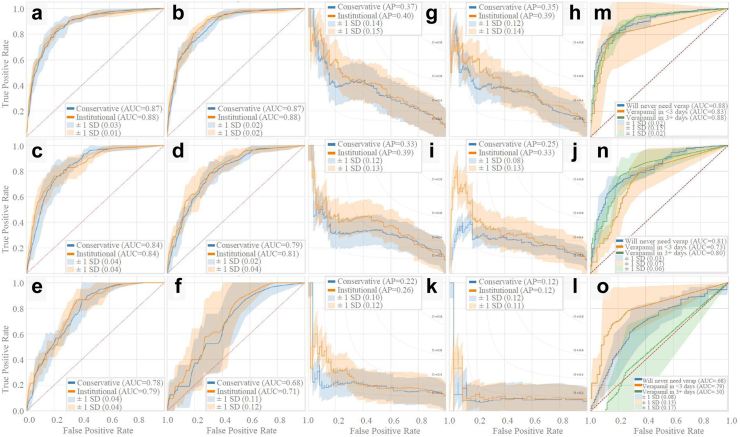
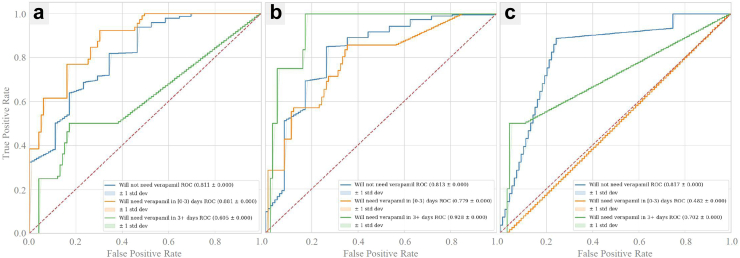
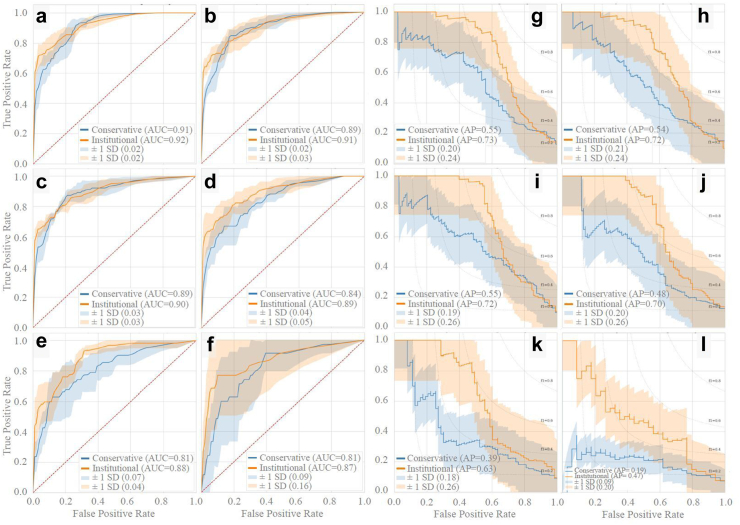
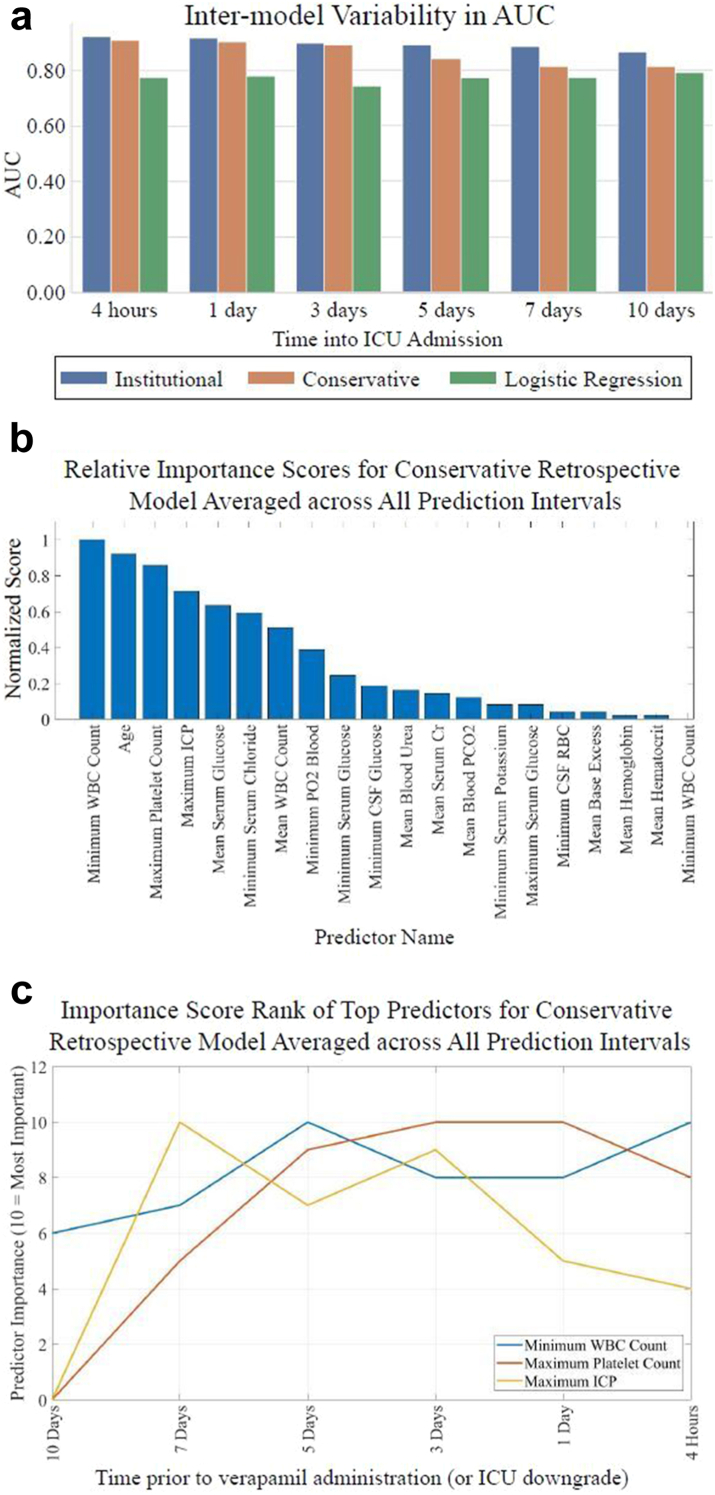
A total of 1750 patients were included from UCLA, 125 receiving verapamil. LightGBM achieved an area under the ROC (AUC) of 0.88 > 1 week in advance and ruled out 8% of non-verapamil patients with zero false negatives. Our models predicted "no CVRV" vs "CVRV within three days" vs "CVRV after three days" with AUCs = 0.88, 0.83, and 0.88, respectively. From VUMC, 1654 patients were included, 75 receiving verapamil. VUMC predictions averaged within 0.01 AUC points of UCLA predictions.
We present an accurate and early predictor of CVRV using machine learning with multi-center validation. This represents a significant step towards optimized clinical management and resource allocation in patients with SAH.
Robert E. Freundlich is supported by National Center for Advancing Translational Sciences federal grant UL1TR002243 and National Heart, Lung, and Blood Institute federal grant K23HL148640; these funders did not play any role in this study. The National Institutes of Health supports Vanderbilt University Medical Center which indirectly supported these research efforts. Neither this study nor any other authors personally received financial support for the research presented in this manuscript. No support from pharmaceutical companies was received.
脑血管痉挛(CV)是蛛网膜下腔出血(SAH)后 20-40%患者会出现的一种可怕并发症。将 SAH 患者收入重症监护病房进行长时间的资源密集型监测是标准做法。我们使用机器学习来预测迄今为止最大且唯一的多中心研究中需要维拉帕米治疗的 CV(CVRV)。
纳入 2013 年至 2022 年期间在加州大学洛杉矶分校(UCLA)就诊的 SAH 患者,以及 2018 年至 2023 年期间在范德堡大学医学中心(VUMC)的验证队列。对于每位患者,通过主要终点提取了 172 个独特的重症监护病房(ICU)变量,主要终点为首次给予维拉帕米或未给予维拉帕米。在每个机构,使用五重交叉验证训练轻梯度提升机(LightGBM)来预测不同住院时间点的主要终点。
从 UCLA 纳入 1750 例患者,其中 125 例接受维拉帕米治疗。LightGBM 在提前一周获得 0.88 以上的ROC 曲线下面积(AUC),并排除了 8%无维拉帕米治疗的患者,且无假阴性。我们的模型预测“无 CVRV”、“CVRV 发生在三天内”和“CVRV 发生在三天后”的 AUC 值分别为 0.88、0.83 和 0.88。从 VUMC 纳入 1654 例患者,其中 75 例接受维拉帕米治疗。VUMC 的预测平均与 UCLA 的预测相差 0.01 AUC 点。
我们使用机器学习和多中心验证呈现了一种准确且早期预测 CVRV 的方法。这代表着在优化 SAH 患者的临床管理和资源分配方面迈出了重要一步。
Robert E. Freundlich 得到了国家转化医学高级研究中心联邦拨款 UL1TR002243 和美国国立心肺血液研究所联邦拨款 K23HL148640 的支持;这些资助者在这项研究中没有发挥任何作用。国立卫生研究院支持范德堡大学医学中心,后者间接支持了这些研究工作。本研究或任何其他作者个人均未因本文所述研究获得经济支持。没有得到制药公司的支持。