Cooper Zachary A, Frederick Dennie T, Juneja Vikram R, Sullivan Ryan J, Lawrence Donald P, Piris Adriano, Sharpe Arlene H, Fisher David E, Flaherty Keith T, Wargo Jennifer A
Department of Surgical Oncology; University of Texas MD Anderson Cancer Center; Houston, TX USA ; Department of Genomic Medicine; University of Texas MD Anderson Cancer Center; Houston, TX USA.
Oncoimmunology. 2013 Oct 1;2(10):e26615. doi: 10.4161/onci.26615. Epub 2013 Oct 15.
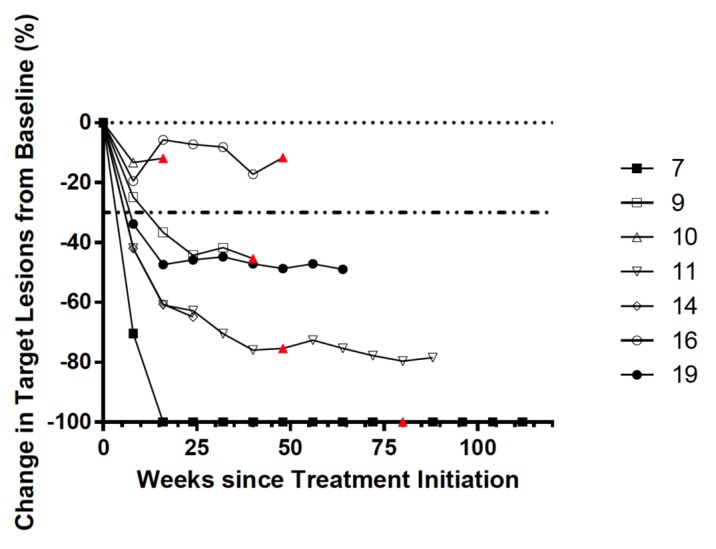
There have been significant advances with regard to BRAF-targeted therapies against metastatic melanoma. However, the majority of patients receiving BRAF inhibitors (BRAFi) manifest disease progression within a year. We have recently shown that melanoma patients treated with BRAFi exhibit an increase in melanoma-associated antigens and in CD8+ tumor-infiltrating lymphocytes in response to therapy. To characterize such a T-cell infiltrate, we analyzed the complementarity-determining region 3 (CDR3) of rearranged T-cell receptor (TCR) β chain-coding genes in tumor biopsies obtained before the initiation of BRAFi and 10-14 d later. We observed an increase in the clonality of tumor-infiltrating lymphocytes in 7 of 8 patients receiving BRAFi, with a statistically significant 21% aggregate increase in clonality. Over 80% of individual T-cell clones detected after initiation of BRAFi treatment were new clones. Interestingly, the comparison of tumor infiltrates with clinical responses revealed that patients who had a high proportion of pre-existing dominant clones after the administration of BRAFi responded better to therapy than patients who had a low proportion of such pre-existing dominant clones following BRAFi. These data suggest that although the inhibition of BRAF in melanoma patients results in tumor infiltration by new lymphocytes, the response to treatment appears to be related to the presence of a pre-existing population of tumor-infiltrating T-cell clones.
针对转移性黑色素瘤的BRAF靶向疗法已取得显著进展。然而,大多数接受BRAF抑制剂(BRAFi)治疗的患者在一年内会出现疾病进展。我们最近发现,接受BRAFi治疗的黑色素瘤患者在治疗后黑色素瘤相关抗原和CD8 +肿瘤浸润淋巴细胞数量增加。为了表征这种T细胞浸润情况,我们分析了在开始使用BRAFi之前以及10 - 14天后获取的肿瘤活检组织中重排的T细胞受体(TCR)β链编码基因的互补决定区3(CDR3)。我们观察到,在8名接受BRAFi治疗的患者中,有7名患者的肿瘤浸润淋巴细胞克隆性增加,克隆性总体增加了21%,具有统计学意义。在开始BRAFi治疗后检测到的个体T细胞克隆中,超过80%是新克隆。有趣的是,将肿瘤浸润情况与临床反应进行比较发现,在使用BRAFi后预先存在的优势克隆比例高的患者比预先存在的优势克隆比例低的患者对治疗的反应更好。这些数据表明,虽然黑色素瘤患者中BRAF的抑制会导致新淋巴细胞浸润肿瘤,但治疗反应似乎与预先存在的肿瘤浸润T细胞克隆群体有关。