Department of Dermatology, Venereology & Allergology, Medical University of Innsbruck, Innsbruck, Austria.
Department of Medicine and Biochemistry, Geisel School of Medicine at Dartmouth, Norris Cotton Cancer Center, Lebanon, NH.
Int J Cancer. 2020 Mar 1;146(5):1409-1420. doi: 10.1002/ijc.32777. Epub 2019 Dec 4.
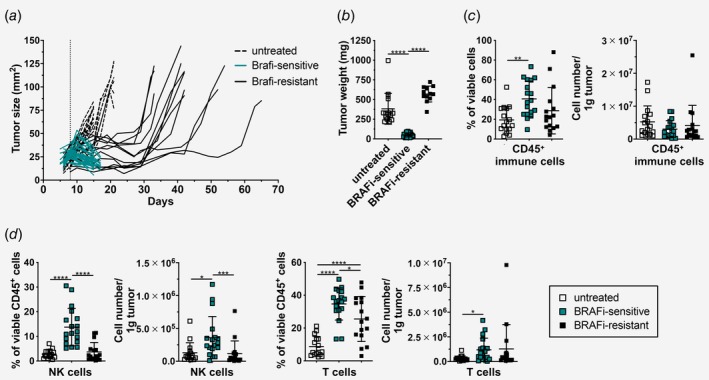
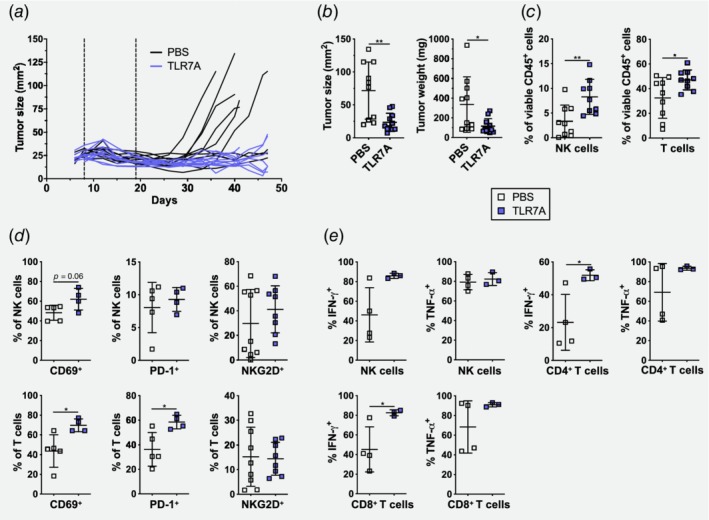
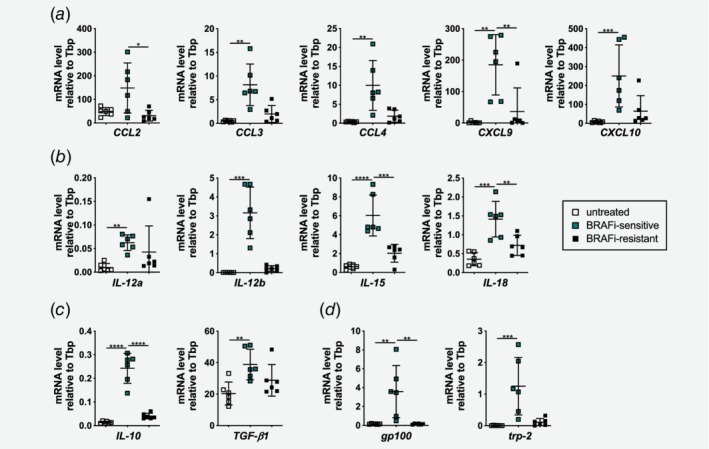
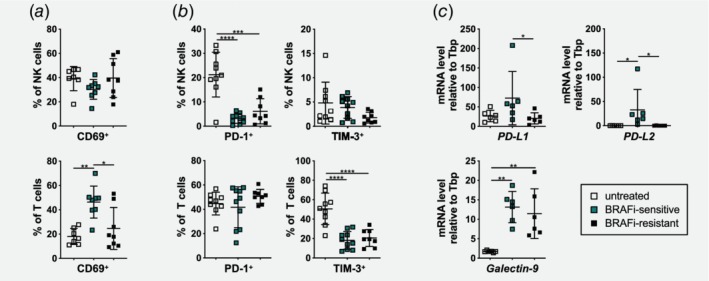
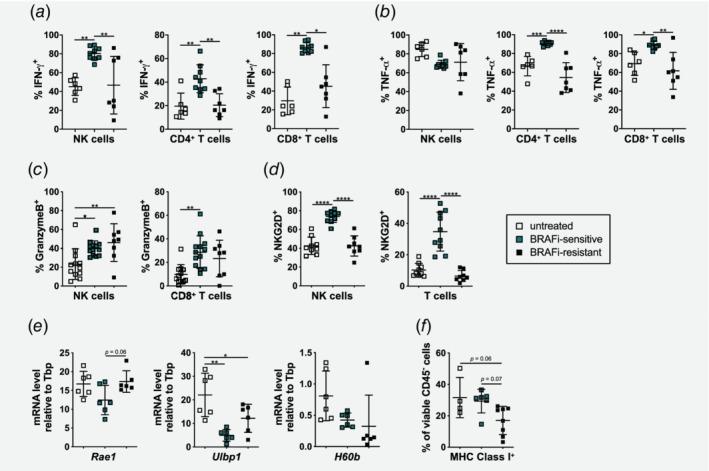
Therapeutic success of targeted therapy with BRAF inhibitors (BRAFi) for melanoma is limited by resistance development. Observations from preclinical mouse models and recent insights into the immunological effects caused by BRAFi give promise for future development of combination therapy for human melanoma. In our study, we used the transplantable D4M melanoma mouse model with the BRAF mutation and concomitant PTEN loss in order to characterize alterations in tumor-infiltrating effector immune cells when tumors become resistant to BRAFi. We found that BRAFi-sensitive tumors displayed a pronounced inflammatory milieu characterized by high levels of cytokines and chemokines accompanied by an infiltration of T and NK cells. The tumor-infiltrating effector cells were activated and produced high levels of IFN-γ, TNF-α and granzyme B. When tumors became resistant and progressively grew, they reverted to a low immunogenic state similar to untreated tumors as reflected by low mRNA levels of proinflammatory cytokines and chemokines and fewer tumor-infiltrating T and NK cells. Moreover, these T and NK cells were functionally impaired in comparison to their counterparts in BRAFi-sensitive tumors. Their effector cell function could be restored by additional peritumoral treatment with the TLR7 agonist imiquimod, a clinically approved agent for nonmelanoma skin cancer. Indeed, resistance to BRAFi therapy was delayed and accompanied by high numbers of activated T and NK cells in tumors. Thus, combining BRAFi with an immune stimulating agent such as a TLR ligand could be a promising alternative approach for the treatment of melanoma.
靶向治疗 BRAF 抑制剂(BRAFi)治疗黑色素瘤的疗效受到耐药性发展的限制。临床前小鼠模型的观察结果和对 BRAFi 引起的免疫效应的最新认识,为人类黑色素瘤的联合治疗提供了未来的发展前景。在我们的研究中,我们使用了携带 BRAF 突变和同时伴有 PTEN 缺失的可移植 D4M 黑色素瘤小鼠模型,以研究当肿瘤对 BRAFi 产生耐药性时肿瘤浸润效应免疫细胞的变化。我们发现,BRAFi 敏感的肿瘤显示出明显的炎症环境,其特点是高水平的细胞因子和趋化因子,并伴有 T 和 NK 细胞的浸润。肿瘤浸润效应细胞被激活并产生高水平的 IFN-γ、TNF-α 和颗粒酶 B。当肿瘤变得耐药并逐渐生长时,它们恢复到类似于未治疗肿瘤的低免疫原性状态,表现为促炎细胞因子和趋化因子的 mRNA 水平较低,以及较少的肿瘤浸润 T 和 NK 细胞。此外,与 BRAFi 敏感肿瘤中的相应细胞相比,这些 T 和 NK 细胞的功能受损。其效应细胞功能可以通过额外的肿瘤周围 TLR7 激动剂咪喹莫特治疗来恢复,咪喹莫特是一种用于非黑色素瘤皮肤癌的临床批准药物。事实上,BRAFi 治疗的耐药性被延迟,并伴有肿瘤中大量激活的 T 和 NK 细胞。因此,将 BRAFi 与免疫刺激剂(如 TLR 配体)联合使用可能是治疗黑色素瘤的一种很有前途的替代方法。