Department of Psychiatry, University of Utah School of Medicine, Salt Lake City, UT, USA.
Transl Psychiatry. 2013 Nov 19;3(11):e325. doi: 10.1038/tp.2013.100.
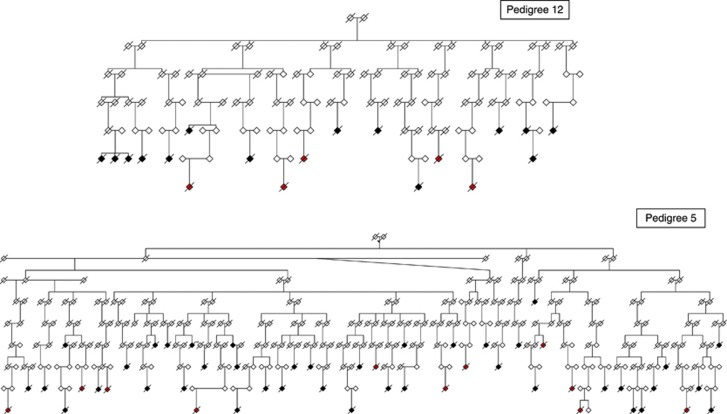
We have used unique population-based data resources to identify 22 high-risk extended pedigrees that show clustering of suicide over twice that expected from demographically adjusted incidence rates. In this initial study of genetic risk factors, we focused on two high-risk pedigrees. In the first of these (pedigree 12), 10/19 (53%) of the related suicides were female, and the average age at death was 30.95. In the second (pedigree 5), 7/51 (14%) of the suicides were female and the average age at death was 36.90. Six decedents in pedigree 12 and nine in pedigree 5 were genotyped with the Illumina HumanExome BeadChip. Genotypes were analyzed using the Variant Annotation, Analysis, and Search program package that computes likelihoods of risk variants using the functional impact of the DNA variation, aggregative scoring of multiple variants across each gene and pedigree structure. We prioritized variants that were: (1) shared across pedigree members, (2) rare in other Utah suicides not related to these pedigrees, (3) < or = 5% in genotyping data from 398 other Utah population controls and (4) < or = 5% frequency in publicly available sequence data from 1358 controls and/or in dbSNP. Results included several membrane protein genes (ANO5, and TMEM141 for pedigree 12 and FAM38A and HRCT1 for pedigree 5). Other genes with known neuronal involvement and/or previous associations with psychiatric conditions were also identified, including NFKB1, CASP9, PLXNB1 and PDE11A in pedigree 12, and THOC1, and AUTS2 in pedigree 5. Although the study is limited to variants included on the HumanExome BeadChip, these findings warrant further exploration, and demonstrate the utility of this high-risk pedigree resource to identify potential genes or gene pathways for future development of targeted interventions.
我们利用独特的基于人群的数据资源,确定了 22 个高风险的扩展家系,这些家系的自杀率比人口统计学调整后的发病率高出两倍以上。在这项遗传风险因素的初步研究中,我们集中研究了两个高风险的家系。在第一个家系(家系 12)中,19 个相关自杀者中有 10 个(53%)为女性,平均死亡年龄为 30.95 岁。在第二个家系(家系 5)中,51 个自杀者中有 7 个(14%)为女性,平均死亡年龄为 36.90 岁。家系 12 中有 6 个死者和家系 5 中有 9 个死者的基因型用 Illumina HumanExome BeadChip 进行了检测。使用 Variant Annotation、Analysis 和 Search 程序包分析基因型,该程序包使用 DNA 变异的功能影响、每个基因和家系结构的多个变异的聚集评分来计算风险变异的可能性。我们优先考虑以下变异:(1)在家族成员中共享,(2)在与这些家系无关的其他犹他州自杀者中罕见,(3)在来自 398 名其他犹他州人群对照的基因分型数据中<或=5%,以及(4)在来自 1358 名对照者的公开序列数据中和/或在 dbSNP 中<或=5%的频率。结果包括几个膜蛋白基因(ANO5 和 TMEM141 用于家系 12,FAM38A 和 HRCT1 用于家系 5)。还确定了其他与神经元参与和/或先前与精神疾病相关的基因,包括家系 12 中的 NFKB1、CASP9、PLXNB1 和 PDE11A,以及家系 5 中的 THOC1 和 AUTS2。尽管该研究仅限于 HumanExome BeadChip 上包含的变异,但这些发现值得进一步探讨,并证明了这种高风险家系资源识别潜在基因或基因途径的实用性,以便为未来有针对性的干预措施的发展提供依据。