Hwang Okchul, Ha Kyungjin, Choi Seungjun
College of Arts, School of Sports and Health, Kyungsung University.
J Phys Ther Sci. 2013 Jul;25(7):839-41. doi: 10.1589/jpts.25.839. Epub 2013 Aug 20.
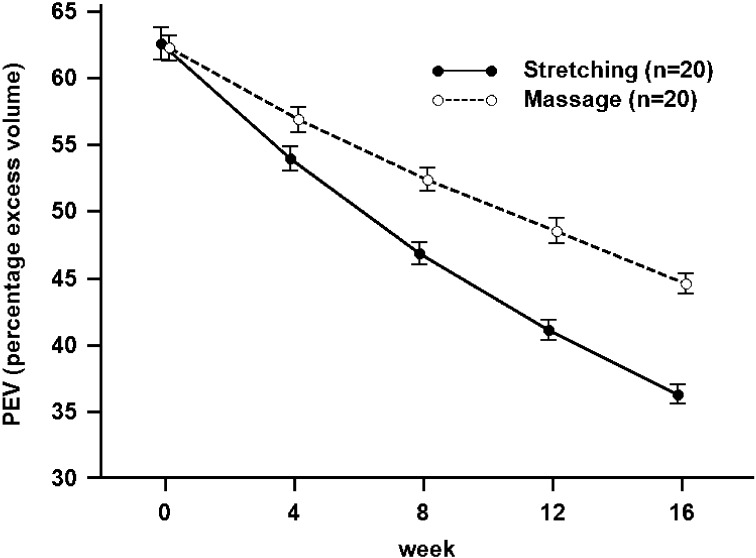
[Purpose] The purpose of this study were to identify whether painless dynamic PNF techniques can reduce lymphedema, and to provide basic reference data for use in the treatment of lymphedema patients. [Subjects] This experiment was conducted from March 2012 to July 2012 at Busan University Hospital D. The subjects were upper extremity lymphedema patients who were receiving rehabilitation treatment. Those with dual lymphedema site pain or who did not want to participate in the experiment were excluded. [Methods] A total of 40 women participated in this study, and they received PNF techniques before the application of lymph compression bandages. Group 1 of 20 subjects were adminstered PNF techniques three times a week for 30 minutes each time. Group 2 of 20 subjects only edema reducing massage for 30 minutes. [Results] The interaction between treatment method and treatment time was significant, which indicates that the change in edema at different measurement times was different according to treatment methods. In this study, Group 1 had a steeper rate of decline in edema than Group 2. [Conclusion] In conclusion, both massage and PNF techniques helped to lower edema rates. Four weeks after the beginning of treatment, a larger degree of decline in edema was exhibited in the PNF group than in the massage group.
[目的] 本研究旨在确定无痛动态本体感觉神经肌肉促进法(PNF)技术是否能减轻淋巴水肿,并为淋巴水肿患者的治疗提供基础参考数据。[对象] 本实验于2012年3月至2012年7月在釜山大学医院D进行。对象为正在接受康复治疗的上肢淋巴水肿患者。排除双部位淋巴水肿疼痛或不愿参与实验者。[方法] 共有40名女性参与本研究,她们在使用淋巴压迫绷带前接受PNF技术。20名对象的第1组每周接受3次PNF技术,每次30分钟。20名对象的第2组仅进行30分钟的减轻水肿按摩。[结果] 治疗方法与治疗时间之间的交互作用显著,这表明不同测量时间的水肿变化因治疗方法而异。在本研究中,第1组的水肿下降速率比第2组更陡。[结论] 总之,按摩和PNF技术均有助于降低水肿率。治疗开始四周后,PNF组的水肿下降程度大于按摩组。