Aponte-González Johanna, Fajardo-Bernal Luisa, Diaz Jorge, Eslava-Schmalbach Javier, Gamboa Oscar, Hay Joel W
Clinical Research Institute, Clinical Epidemiology Department, School of Medicine, Universidad Nacional de Colombia, Bogotá, Colombia.
PLoS One. 2013 Nov 18;8(11):e80639. doi: 10.1371/journal.pone.0080639. eCollection 2013.
To compare costs and effectiveness of three strategies used against cervical cancer (CC) and genital warts: (i) Screening for CC; (ii) Bivalent Human Papillomavirus (HPV) 16/18 vaccine added to screening; (iii) Quadrivalent HPV 6/11/16/18 vaccine added to screening.
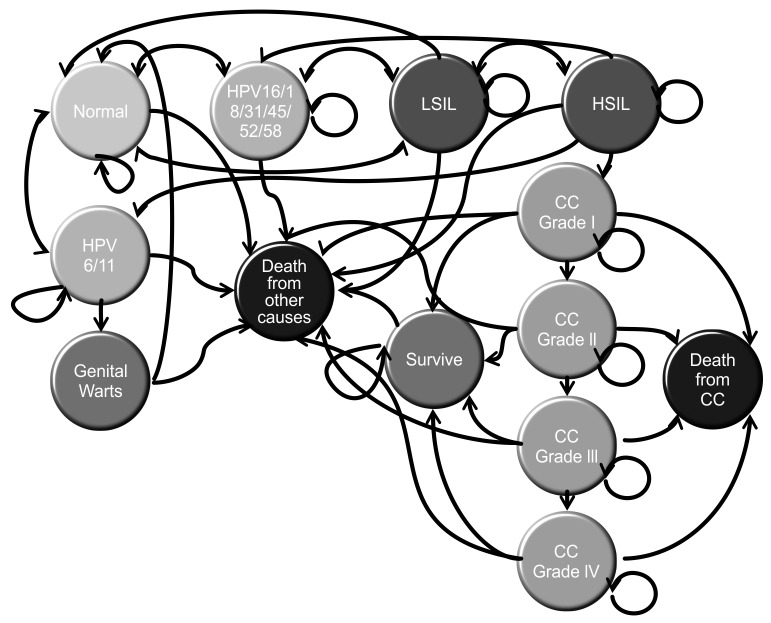
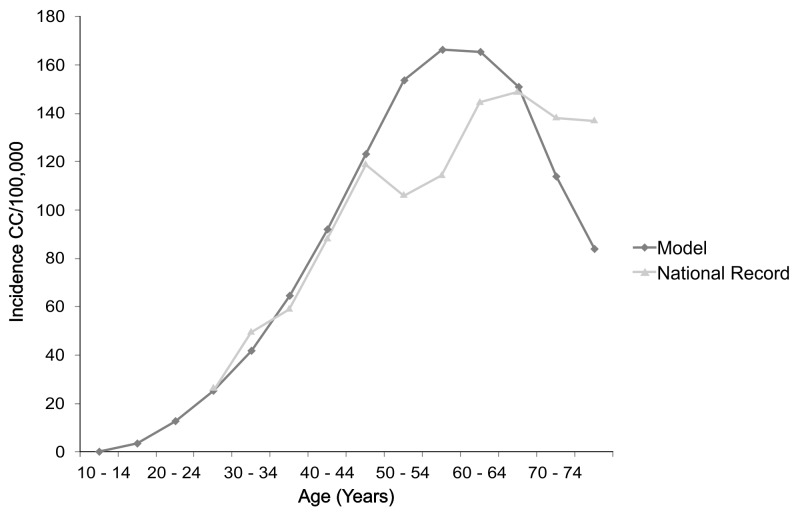
A Markov model was designed in order to simulate the natural history of the disease from 12 years of age (vaccination) until death. Transition probabilities were selected or adjusted to match the HPV infection profile in Colombia. A systematic review was undertaken in order to derive efficacy values for the two vaccines as well as for the operational characteristics of the cytology test. The societal perspective was used. Effectiveness was measured in number of averted Disability Adjusted Life Years (DALYS).
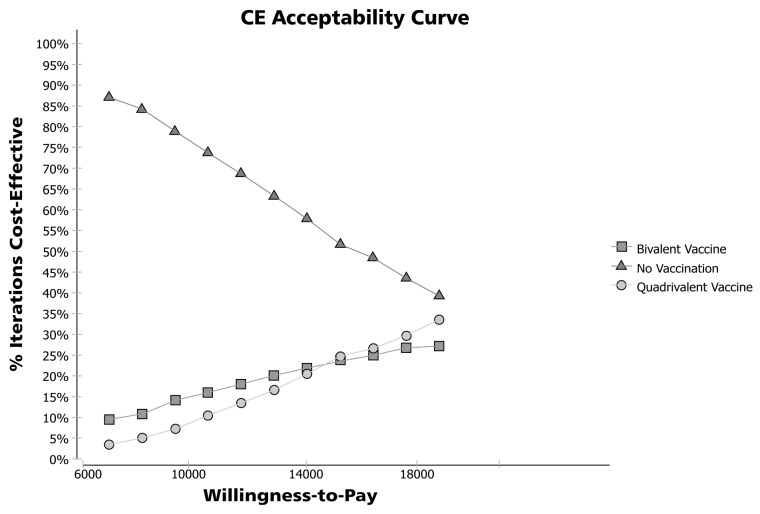
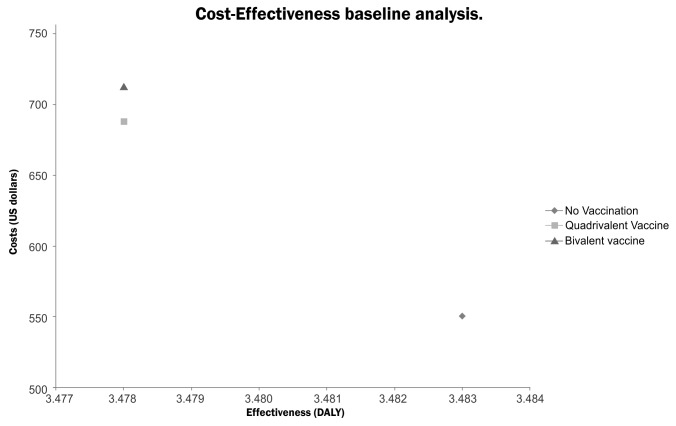
At commercial prices reported for 2010 the two vaccines were shown to be non-cost-effective alternatives when compared with the existing screening strategy. Sensitivity analyses showed that results are affected by the cost of vaccines and their efficacy values, making it difficult to determine with certainty which of the two vaccines has the best cost-effectiveness profile. To be 'cost-effective' vaccines should cost between 141 and 147 USD (Unite States Dollars) per vaccinated girl at the most. But at lower prices such as those recommended by WHO or the price of other vaccines in Colombia, HPV vaccination could be considered very cost-effective.
HPV vaccination could be a convenient alternative for the prevention of CC in Colombia. However, the price of the vaccine should be lower for this vaccination strategy to be cost-effective. It is also important to take into consideration the willingness to pay, budgetary impact, and program implications, in order to determine the relevance of a vaccination program in this country, as well as which vaccine should be selected for use in the program.
比较三种预防宫颈癌(CC)和尖锐湿疣的策略的成本和效果:(i)宫颈癌筛查;(ii)在筛查基础上添加二价人乳头瘤病毒(HPV)16/18疫苗;(iii)在筛查基础上添加四价HPV 6/11/16/18疫苗。
设计了一个马尔可夫模型,以模拟从12岁(接种疫苗)到死亡的疾病自然史。选择或调整转移概率以匹配哥伦比亚的HPV感染情况。进行了一项系统评价,以得出两种疫苗的疗效值以及细胞学检测的操作特征。采用社会视角。以避免的伤残调整生命年(DALYs)数量来衡量效果。
按照2010年报告的商业价格,与现有的筛查策略相比,这两种疫苗显示为不具有成本效益的替代方案。敏感性分析表明,结果受疫苗成本及其疗效值的影响,难以确定这两种疫苗中哪一种具有最佳的成本效益。要“具有成本效益”,疫苗每位接种女孩的成本最高应为141至147美元(美元)。但以较低价格,如世界卫生组织推荐的价格或哥伦比亚其他疫苗的价格,HPV疫苗接种可被视为非常具有成本效益。
HPV疫苗接种可能是哥伦比亚预防宫颈癌的一种便捷替代方案。然而,为使这种疫苗接种策略具有成本效益,疫苗价格应更低。考虑支付意愿、预算影响和项目影响也很重要,以便确定该国疫苗接种项目的相关性,以及应选择哪种疫苗用于该项目。