Hohenadel M G, Thearle M S, Grice B A, Huang H, Dai M-H, Tao Y-X, Hunter L A, Palaguachi G I, Mou Z, Kim R C, Tsang M M, Haack K, Voruganti V S, Cole S A, Butte N F, Comuzzie A G, Muller Y L, Baier L J, Krakoff J, Knowler W C, Yanovski J A, Han J C
National Institute of Diabetes and Digestive and Kidney Diseases, National Institutes of Health (NIH), Phoenix, AZ, USA.
Department of Anatomy, Physiology and Pharmacology, College of Veterinary Medicine, Auburn University, Auburn, AL, USA.
Int J Obes (Lond). 2014 Aug;38(8):1068-74. doi: 10.1038/ijo.2013.221. Epub 2013 Nov 26.
In rodents, hypothalamic brain-derived neurotrophic factor (BDNF) expression appears to be regulated by melanocortin-4 receptor (MC4R) activity. The impact of MC4R genetic variation on circulating BDNF in humans is unknown.
The objective of this study is to compare BDNF concentrations of subjects with loss-of-function (LOF) and gain-of-function (GOF) MC4R variants with those of controls with common sequence MC4R.
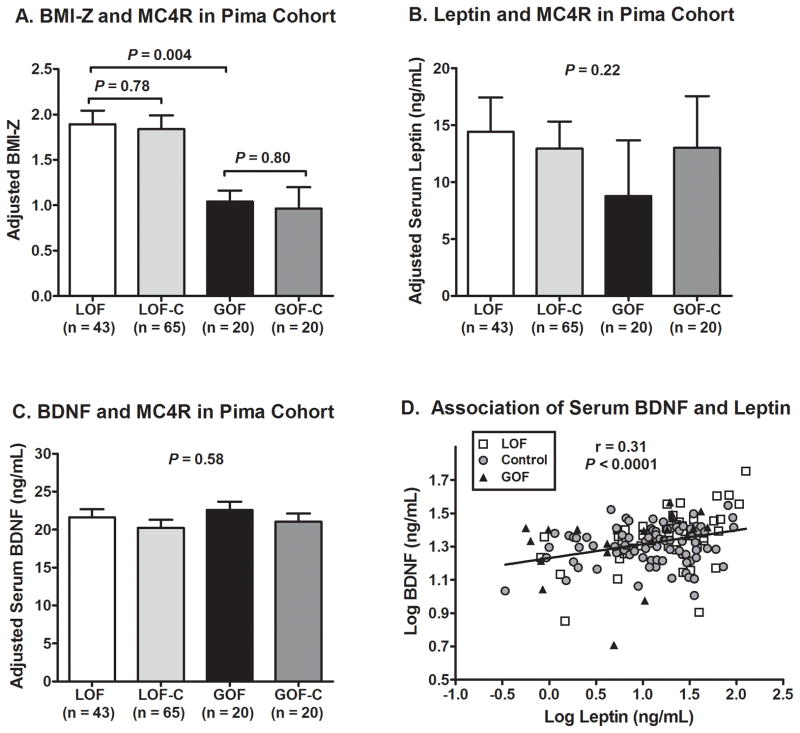
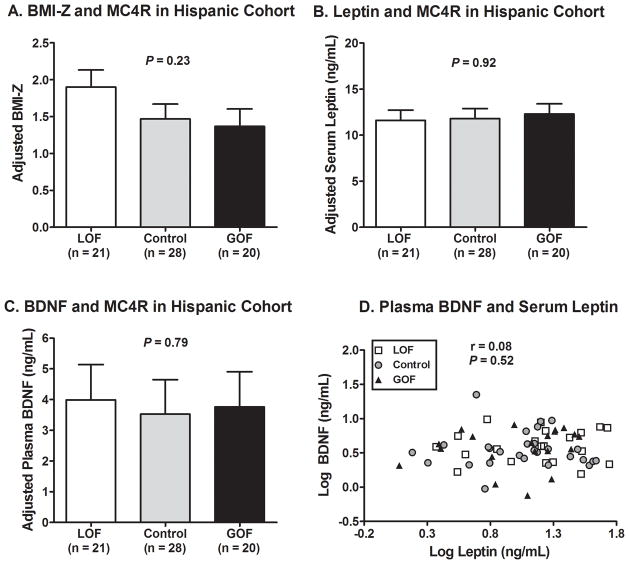
Circulating BDNF was measured in two cohorts with known MC4R sequence: 148 subjects of Pima Indian heritage ((mean±s.d.): age, 15.7±6.5 years; body mass index z-scores (BMI-Z), 1.63±1.03) and 69 subjects of Hispanic heritage (10.8±3.6 years; BMI-Z, 1.57±1.07). MC4R variants were characterized in vitro by cell surface expression, receptor binding and cyclic AMP response after agonist administration. BDNF single-nucleotide polymorphisms (SNPs) rs12291186, rs6265 and rs7124442 were also genotyped.
In the Pima cohort, no significant differences in serum BDNF was observed for 43 LOF subjects versus 65 LOF-matched controls (age, sex and BMI matched; P=0.29) or 20 GOF subjects versus 20 GOF-matched controls (P=0.40). Serum BDNF was significantly associated with genotype for BDNF rs12291186 (P=0.006) and rs6265 (P=0.009), but not rs7124442 (P=0.99); BDNF SNPs did not interact with MC4R status to predict serum BDNF. In the Hispanic cohort, plasma BDNF was not significantly different among 21 LOF subjects, 20 GOF subjects and 28 controls (P=0.79); plasma BDNF was not predicted by BDNF genotype or BDNF-x-MC4R genotype interaction.
Circulating BDNF concentrations were not significantly associated with MC4R functional status, suggesting that peripheral BDNF does not directly reflect hypothalamic BDNF secretion and/or that MC4R signaling is not a significant regulator of the bulk of BDNF expression in humans.
在啮齿动物中,下丘脑脑源性神经营养因子(BDNF)的表达似乎受黑皮质素-4受体(MC4R)活性调控。MC4R基因变异对人类循环BDNF的影响尚不清楚。
本研究旨在比较携带功能丧失(LOF)和功能获得(GOF)型MC4R变异的受试者与具有常见序列MC4R的对照组受试者的BDNF浓度。
在两个已知MC4R序列的队列中测量循环BDNF:148名皮马印第安人后裔受试者((均值±标准差):年龄,15.7±6.5岁;体重指数z评分(BMI-Z),1.63±1.03)和69名西班牙裔受试者(10.8±3.6岁;BMI-Z,1.57±1.07)。通过细胞表面表达、受体结合以及激动剂给药后的环磷酸腺苷反应对体外MC4R变异进行特征分析。还对BDNF单核苷酸多态性(SNP)rs12291186、rs6265和rs7124442进行基因分型。
在皮马队列中,43名LOF受试者与65名匹配的LOF对照(年龄、性别和BMI匹配;P = 0.29)或20名GOF受试者与20名匹配的GOF对照相比,血清BDNF无显著差异(P = 0.40)。血清BDNF与BDNF rs12291186(P = 0.006)和rs6265(P = 0.009)的基因型显著相关,但与rs7124442无关(P = 0.99);BDNF SNP与MC4R状态之间不存在相互作用以预测血清BDNF。在西班牙裔队列中,21名LOF受试者、20名GOF受试者和28名对照之间的血浆BDNF无显著差异(P = 0.79);血浆BDNF无法通过BDNF基因型或BDNF - x - MC4R基因型相互作用预测。
循环BDNF浓度与MC4R功能状态无显著相关性,提示外周BDNF不能直接反映下丘脑BDNF分泌和/或MC4R信号传导不是人类BDNF大量表达的重要调节因子。