Plant Breeding, Genetics, and Biotechnology Division, International Rice Research Institute, DAPO Box 7777, Metro Manila, Philippines.
Rice (N Y). 2013 Feb 8;6(1):5. doi: 10.1186/1939-8433-6-5.
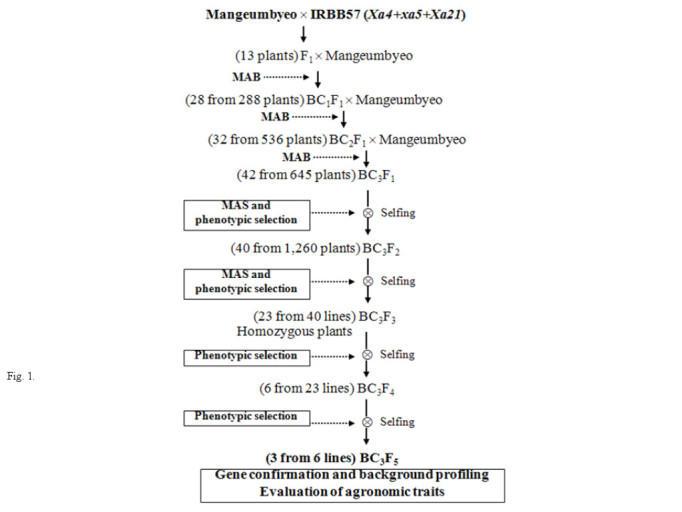
The development of resistant cultivars has been the most effective and economical strategy to control bacterial leaf blight (BB) disease of rice caused by Xanthomonas oryzae pv. oryzae (Xoo). Molecular markers have made it possible to identify and pyramid valuable genes of agronomic importance in resistance rice breeding. In this study, three resistance genes (Xa4 + xa5 + Xa21) were transferred from an indica donor (IRBB57), using a marker-assisted backcrossing (MAB) breeding strategy, into a BB-susceptible elite japonica rice cultivar, Mangeumbyeo, which is high yielding with good grain quality.
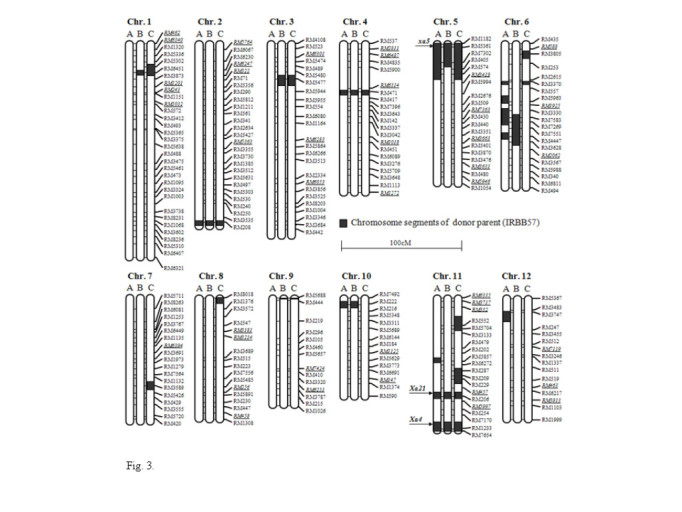
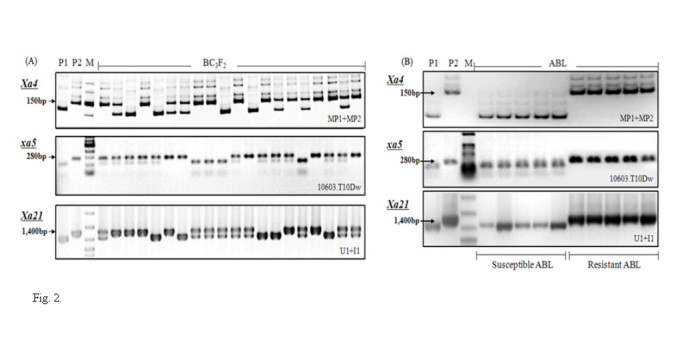
Our analysis led to the development of three elite advanced backcross breeding lines (ABL) with three resistance genes by foreground and phenotypic selection in a japonica genetic background without linkage drag. The background genome recovery of the ABL expressed more than 92.1% using genome-wide SSR marker analysis. The pathogenicity assays of three resistance-gene-derived ABL were conducted under glasshouse conditions with the 18 isolates of Xoo prevalent in Korea. The ABL exhibited very small lesion lengths, indicating a hypersensitive reaction to all 18 isolates of Xoo, with agronomic and grain quality traits similar to those of the recurrent parent. Pyramiding the resistance genes Xa4, xa5 and Xa21 provided a higher resistance to Xoo than the introduction of the individual resistance genes. Additionally, the combination of two dominant and one recessive BB resistance gene did not express any negative effect on agronomic traits in the ABL.
The strategy of simultaneous foreground and phenotypic selection to introduce multiple R genes is very useful to reduce the cost and the time required for the isolation of desirable recombinants with target resistance genes in rice. The resistance-gene-derived ABL have practical breeding value without a yield penalty by providing broad-spectrum resistance against most of the existing isolates of BB in South Korea and will have a high impact on the yield stability and sustainability of rice productivity.
培育抗性品种是防治由稻黄单胞菌(Xoo)引起的水稻细菌性条斑病(BB)最有效和经济的策略。分子标记使得在抗性水稻育种中鉴定和聚合有价值的农艺重要基因成为可能。本研究利用标记辅助回交(MAB)育种策略,将来自籼稻供体(IRBB57)的三个抗性基因(Xa4+xa5+Xa21)转移到易感 BB 的粳稻品种满穗白中,该品种产量高,米质好。
我们的分析导致了三个具有三个抗性基因的精英先进回交系(ABL)的发展,这些基因是在粳稻遗传背景下通过前景和表型选择得到的,没有连锁拖曳。利用全基因组 SSR 标记分析,ABL 的背景基因组恢复率超过 92.1%。在韩国流行的 18 个 Xoo 分离物的温室条件下,对三个抗性基因衍生的 ABL 进行了致病性测定。ABL 对所有 18 个 Xoo 分离物表现出非常小的病斑长度,表明对所有 18 个 Xoo 分离物均表现出过敏反应,其农艺和粒质性状与轮回亲本相似。同时导入 Xa4、xa5 和 Xa21 三个抗性基因比导入单个抗性基因提供了更高的抗 Xoo 性。此外,两个显性和一个隐性 BB 抗性基因的组合在 ABL 中对农艺性状没有表现出任何负面影响。
同时进行前景和表型选择以引入多个 R 基因的策略在水稻中非常有用,可以降低成本和所需时间,以分离具有目标抗性基因的理想重组体。抗性基因衍生的 ABL 具有实用的育种价值,不会对韩国大多数现有的 BB 分离物造成产量损失,并将对水稻生产力的产量稳定性和可持续性产生重大影响。