Department of Internal Medicine (DJD), the Department of Family Medicine (DHK), the Department of Public Health Sciences (PJN), Medical University of South Carolina, Charleston, South Carolina; and Department of Anesthesia (MDM, LAA), Vanderbilt University School of Medicine, Nashville, Tennessee.
Am J Med Sci. 2014 Jun;347(6):452-6. doi: 10.1097/MAJ.0b013e3182a562d7.
It has been noted that increased focus on learning acute care skills is needed in undergraduate medical curricula. This study investigated whether a simulation-based curriculum improved a senior medical student's ability to manage acute coronary syndrome as measured during a clinical performance examination (CPX). The authors hypothesized that simulation training would improve overall performance when compared with targeted didactics or historical controls.
All 4th-year medical students (n = 291) over 2 years at the authors' institution were included in this study. In the 3rd year of medical school, the "control" group received no intervention, the "didactic" group received a targeted didactic curriculum, and the "simulation" group participated in small group simulation training and the didactic curriculum. For intergroup comparison on the CPX, the authors calculated the percentage of correct actions completed by the student. Data are presented as mean ± standard deviation with significance defined as P < 0.05.
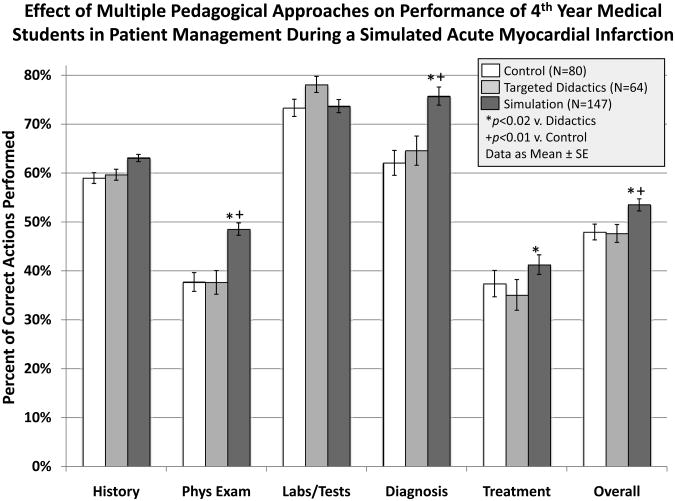
There was a significant improvement in overall performance with simulation versus both didactics and control (P < 0.001). Performance on the physical examination component was significantly better in simulation versus both didactics and control, as was for diagnosis: simulation versus both didactics and control (P < 0.02 for all comparisons).
Simulation training had a modest impact on overall CPX performance in the management of a simulated acute coronary syndrome. Additional studies are needed to evaluate how to further improve curricula regarding unstable patients.
人们已经注意到,在本科医学课程中需要更加关注学习急性护理技能。本研究调查了基于模拟的课程是否可以提高高年级医学生在临床绩效考试(CPX)中管理急性冠状动脉综合征的能力。作者假设模拟培训将与针对性教学或历史对照相比,提高整体表现。
作者所在机构的所有 2 年 4 年级医学生(n = 291)均纳入本研究。在医学生的第 3 年,“对照组”未接受干预,“教学组”接受了有针对性的教学课程,“模拟组”则参加了小组模拟培训和教学课程。为了在 CPX 上进行组间比较,作者计算了学生完成的正确动作的百分比。数据以平均值 ±标准差表示,P < 0.05 定义为差异具有统计学意义。
与教学组和对照组相比,模拟组的整体表现有显著改善(P < 0.001)。与教学组和对照组相比,模拟组在体格检查部分的表现明显更好,在诊断方面也是如此:模拟组与教学组和对照组相比(所有比较的 P < 0.02)。
模拟培训对模拟急性冠状动脉综合征管理的 CPX 整体表现有一定影响。需要进一步研究如何进一步改进不稳定患者的课程。