Translational Obstetrics Group, Department of Obstetrics and Gynaecology, Mercy Hospital for Women, Heidelberg, Victoria, Australia.
PLoS One. 2013 Nov 25;8(11):e78487. doi: 10.1371/journal.pone.0078487. eCollection 2013.
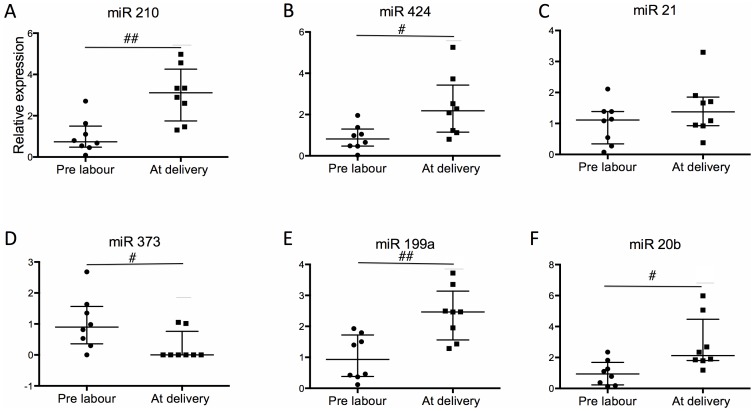
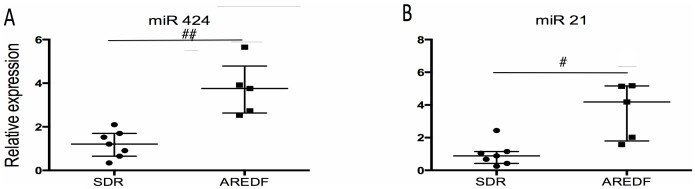
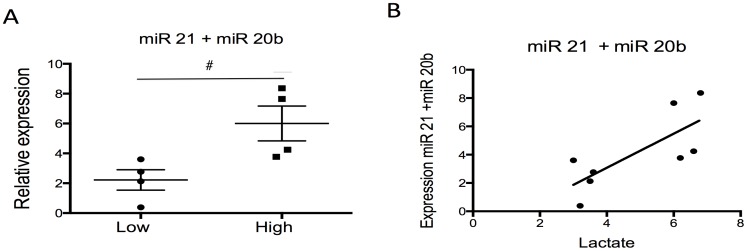
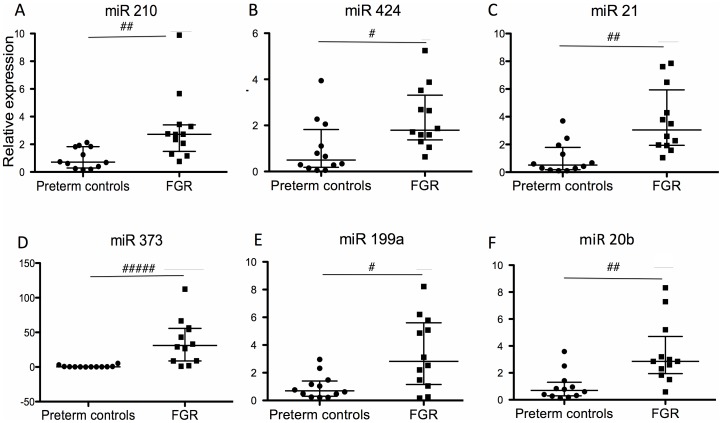
Stillbirth affects 1 in 200 pregnancies and commonly arises due to a lack of oxygen supply to the fetus. Current tests to detect fetal hypoxia in-utero lack the sensitivity to identify many babies at risk. Emerging evidence suggests that microRNAs derived from the placenta circulate in the maternal blood during pregnancy and may serve as non-invasive biomarkers for pregnancy complications. In this study, we examined the expression of miRs known to be regulated by hypoxia in two clinical settings of significant fetal hypoxia: 1) labour and 2) fetal growth restriction. Six miRs (miR 210, miR 21, miR 424, miR 199a, miR 20b, and miR 373) were differentially expressed in pregnancies complicated by fetal hypoxia. In healthy term pregnancies there was a 4.2 fold increase in miR 210 (p<0.01), 2.7 fold increase in miR 424 (p<0.05), 2.6 fold increase in miR 199a (p<0.01) and 2.3 fold increase in miR 20b (p<0.05) from prior to labour to delivery of the fetus. Furthermore, the combined expression of miR 21 and miR 20b correlated with the degree of fetal hypoxia at birth determined by umbilical cord lactate delivery (r = 0.79, p = 0.03). In pregnancies complicated by severe preterm fetal growth restriction there was upregulation of the hypoxia-regulated miRs compared to gestation-matched controls: 3.6 fold in miR 210 (p<0.01), 3.6 fold in miR 424 (p<0.05), 5.9 fold in miR 21 (p<0.01), 3.8 fold in miR 199a (p<0.01) and 3.7 fold in miR 20b (p<0.01). Interestingly, the expression of miR 373 in gestation matched controls was very low, but was very highly expressed in FGR (p<0.0001). Furthermore, the expression increased in keeping with the degree of in-utero hypoxia estimated by fetal Doppler velocimetry. We conclude quantifying hypoxia-regulated miRs in the maternal blood may identify pregnancies at risk of fetal hypoxia, enabling early intervention to improve perinatal outcomes.
死产影响 200 次妊娠中的 1 次,通常是由于胎儿供氧不足引起的。目前用于检测宫内胎儿缺氧的检测方法缺乏敏感性,无法识别许多处于危险中的婴儿。新出现的证据表明,来源于胎盘的 microRNAs 在妊娠期间会在母体血液中循环,并可能作为妊娠并发症的非侵入性生物标志物。在这项研究中,我们在两个具有显著胎儿缺氧的临床环境中检查了已知受缺氧调节的 microRNAs 的表达:1)分娩;2)胎儿生长受限。在胎儿缺氧的情况下,6 个 microRNAs(miR-210、miR-21、miR-424、miR-199a、miR-20b 和 miR-373)的表达存在差异。在健康的足月妊娠中,miR-210 的表达增加了 4.2 倍(p<0.01),miR-424 的表达增加了 2.7 倍(p<0.05),miR-199a 的表达增加了 2.6 倍(p<0.01),miR-20b 的表达增加了 2.3 倍(p<0.05),从分娩前到分娩时。此外,miR-21 和 miR-20b 的联合表达与脐带乳酸输送所决定的出生时胎儿缺氧程度相关(r=0.79,p=0.03)。在严重的早产胎儿生长受限的妊娠中,与胎龄匹配的对照组相比,缺氧调节的 microRNAs 上调:miR-210 上调 3.6 倍(p<0.01),miR-424 上调 3.6 倍(p<0.05),miR-21 上调 5.9 倍(p<0.01),miR-199a 上调 3.8 倍(p<0.01),miR-20b 上调 3.7 倍(p<0.01)。有趣的是,胎龄匹配对照组中 miR-373 的表达非常低,但在 FGR 中表达非常高(p<0.0001)。此外,其表达随着胎儿多普勒血流速度估计的宫内缺氧程度而增加。我们得出结论,定量检测母体血液中的缺氧调节 microRNAs 可以识别有胎儿缺氧风险的妊娠,从而能够早期干预以改善围产结局。