Arthritis Res Ther. 2013 Oct 3;15(5):R143. doi: 10.1186/ar4326.
Interferon alpha (IFN-α) has a complex role in autoimmunity, in that it may both enhance and prevent inflammation. We have previously shown that the presence of IFN-α at sensitization protects against subsequent antigen-triggered arthritis. To understand this tolerogenic mechanism, we performed a descriptive, hypothesis-generating study of cellular and humoral responses associated with IFN-α-mediated protection against arthritis.
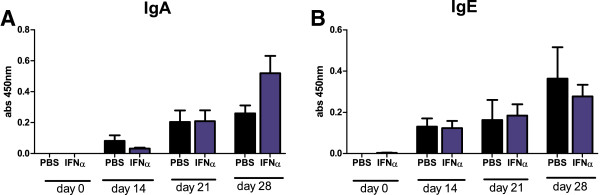
Arthritis was evaluated at day 28 in mice given a subcutaneous injection of methylated bovine serum albumin (mBSA), together with Freund adjuvant and 0 to 5,000 U IFN-α at days 1 and 7, followed by intraarticular injection of mBSA alone at day 21. The effect of IFN-α on mBSA-specific IgG1, IgG2a, IgG2b, IgA, and IgE was evaluated by enzyme-linked immunosorbent assay (ELISA). Cytokines in circulation and in ex vivo cultures on mBSA restimulation was evaluated with ELISA and Luminex, and the identity of cytokine-producing cells by fluorescence-activated cell sorting (FACS) analysis.
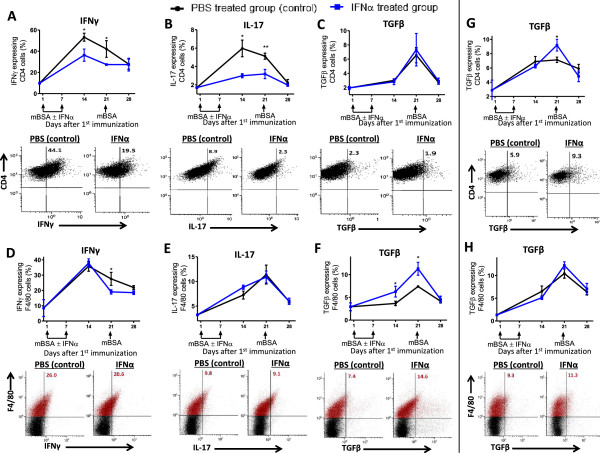
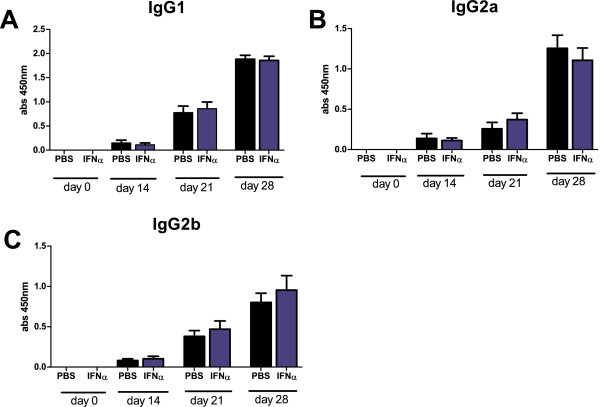
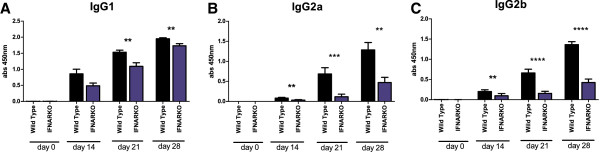
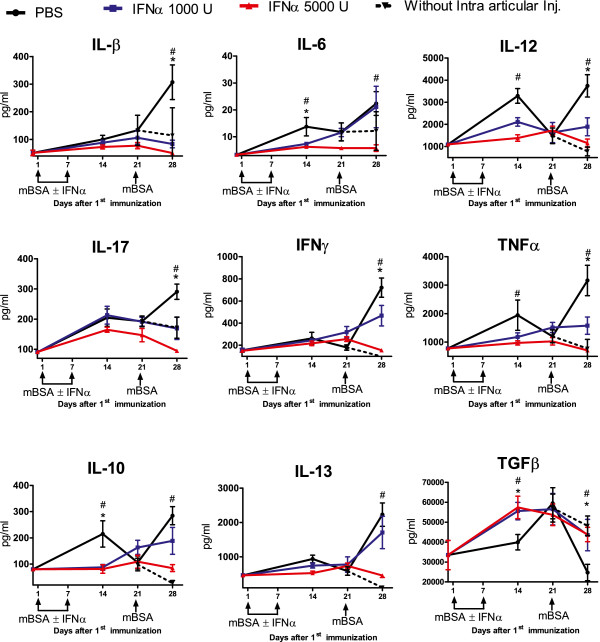
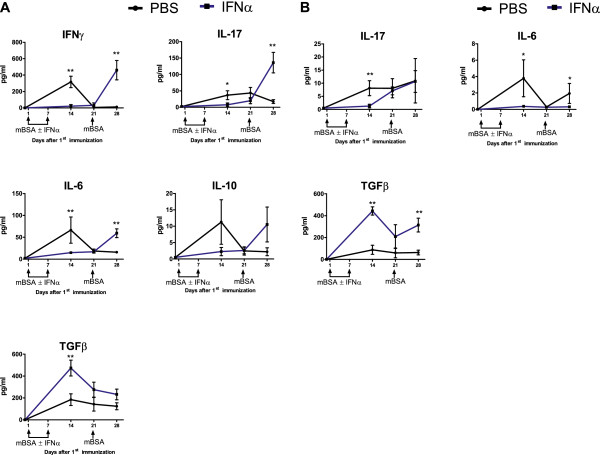
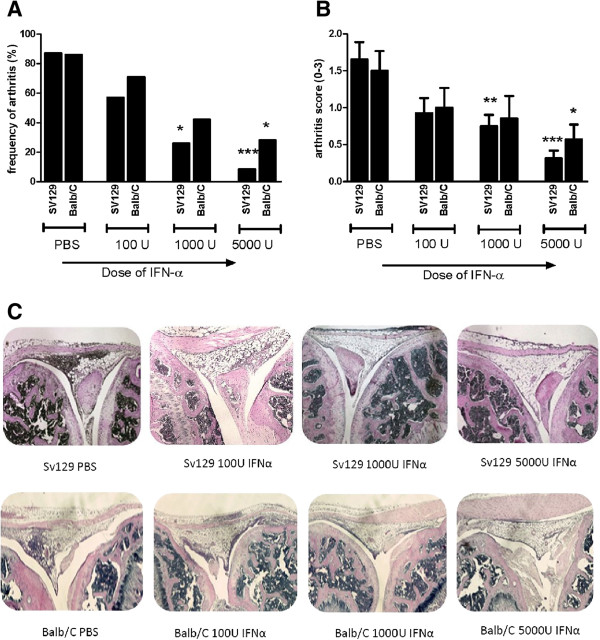
Administration of IFN-α protected mice from arthritis in a dose-dependent manner but had no effect on antigen-specific antibody levels. However, IFN-α did inhibit the initial increase of IL-6, IL-10, IL-12, and TNF, and the recall response induced by intraarticular mBSA challenge of IL-1β, IL-10, IL-12, TNF, IFN-γ, and IL-17 in serum. IFN-α decreased both macrophage and CD4+ T cell-derived IFN-γ production, whereas IL-17 was decreased only in CD4+ T cells. Ex vivo, in mBSA-restimulated spleen and lymph node cell cultures, the inhibitory effect of in vivo administration of IFN-α on proinflammatory cytokine production was clearly apparent, but had a time limit. An earlier macrophage-derived, and stronger activation of the antiinflammatory cytokine transforming growth factor beta (TGF-β) was observed in IFN-α-treated animals, combined with an increase in CD4+ T cells producing TGF-β when arthritis was triggered by mBSA (day 21). Presence of IFN-α at immunizations also prevented the reduction in TGF-β production, which was induced by the intraarticular mBSA injection triggering arthritis in control animals.
Administration of IFN-α has a profound effect on the cellular response to mBSA plus adjuvant, but does not affect antigen-specific Ig production. By including IFN-α at immunizations, spleen and lymph node cells inhibit their repertoire of antigen-induced proinflammatory cytokines while enhancing antiinflammatory TGF-β production, first in macrophages, and later also in CD4+ T cells. On intraarticular antigen challenge, this antiinflammatory state is reenforced, manifested as inhibition of proinflammatory recall responses and preservation of TGF-β levels. This may explain why IFN-α protects against antigen-induced arthritis.
干扰素 α(IFN-α)在自身免疫中具有复杂的作用,因为它既可以增强也可以预防炎症。我们之前已经表明,在致敏时存在 IFN-α 可防止随后的抗原触发关节炎。为了理解这种耐受机制,我们对与 IFN-α 介导的关节炎保护相关的细胞和体液反应进行了描述性的、产生假说的研究。
在给小鼠皮下注射甲基化牛血清白蛋白(mBSA)的同时,给予弗氏佐剂和 0 至 5000U IFN-α 于第 1 天和第 7 天,然后在第 21 天单独给予关节内 mBSA 注射,在第 28 天评估关节炎。通过酶联免疫吸附试验(ELISA)评估 IFN-α 对 mBSA 特异性 IgG1、IgG2a、IgG2b、IgA 和 IgE 的影响。通过 ELISA 和 Luminex 评估循环和 mBSA 再刺激的体外培养物中的细胞因子,并通过荧光激活细胞分选(FACS)分析鉴定细胞因子产生细胞。
IFN-α 以剂量依赖性方式保护小鼠免受关节炎,但对抗原特异性抗体水平没有影响。然而,IFN-α 确实抑制了 IL-6、IL-10、IL-12 和 TNF 的初始增加,以及关节内 mBSA 挑战诱导的血清中 IL-1β、IL-10、IL-12、TNF、IFN-γ 和 IL-17 的回忆反应。IFN-α 减少了巨噬细胞和 CD4+T 细胞衍生的 IFN-γ 产生,而 IL-17 仅在 CD4+T 细胞中减少。在 mBSA 刺激的脾和淋巴结细胞培养物中,体内给予 IFN-α 对促炎细胞因子产生的抑制作用在体外明显,但具有时间限制。在 IFN-α 治疗的动物中,观察到更早的巨噬细胞衍生的、更强的抗炎细胞因子转化生长因子 β(TGF-β)激活,同时在 mBSA 触发关节炎时 CD4+T 细胞产生 TGF-β 增加(第 21 天)。在免疫接种时加入 IFN-α 还可以防止在对照动物中关节内 mBSA 注射触发关节炎时诱导的 TGF-β 产生减少。
IFN-α 对 mBSA 加佐剂的细胞反应具有深远的影响,但不影响抗原特异性 Ig 产生。通过在免疫接种时包含 IFN-α,脾和淋巴结细胞抑制其抗原诱导的促炎细胞因子谱,同时增强抗炎 TGF-β 产生,首先在巨噬细胞中,然后在 CD4+T 细胞中。在关节内抗原挑战时,这种抗炎状态得到加强,表现为抑制促炎回忆反应和维持 TGF-β 水平。这可能解释了为什么 IFN-α 可以预防抗原诱导的关节炎。