Rasheed Humaira, Phipps-Green Amanda, Topless Ruth, Hollis-Moffatt Jade E, Hindmarsh Jennie Harré, Franklin Christopher, Dalbeth Nicola, Jones Peter B, White Douglas H N, Stamp Lisa K, Merriman Tony R
Arthritis Res Ther. 2013 Nov 4;15(6):R177. doi: 10.1186/ar4366.
The T allele of a single nucleotide polymorphism (SNP: rs2544390) in lipoprotein receptor-related protein 2 (LRP2) is associated with higher serum urate and risk of gout in Japanese individuals. SNP rs2544390 also interacts with alcohol consumption in determining hyperuricemia in this population. We investigated the association of rs2544390 with gout, and interaction with all types of alcohol consumption in European and New Zealand (NZ) Māori and Pacific subjects, and a Māori study cohort from the East Coast region of NZ's North Island.
Rs2544390 was genotyped by Taqman®. From NZ a total of 1205 controls and 1431 gout cases clinically ascertained were used. Publicly available genotype and serum urate data were utilized from the Atherosclerosis Risk in Communities (ARIC) study and the Framingham Heart Study (FHS). Alcohol consumption data were obtained by consumption frequency questions in all study cohorts. Multivariate adjusted logistic regression was done using STATA.
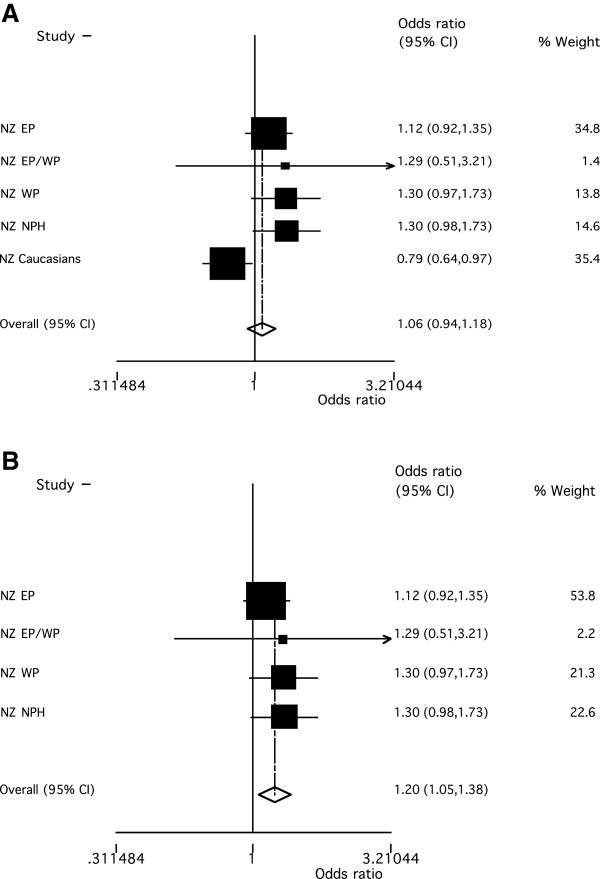
The T allele of rs2544390 was associated with increased risk of gout in the combined Māori and Pacific Island cohort (OR = 1.20, P = 0.009), and associated with gout in the European subjects, but with a protective effect (OR = 0.79, PUnadjusted = 0.02). Alcohol consumption was positively associated with risk of gout in Māori and Pacific subjects (0.2% increased risk/g/week, P = 0.004). There was a non-additive interaction between any alcohol intake and the risk of gout in the combined Māori and Pacific cohorts (PInteraction = 0.001), where any alcohol intake was associated with a 4.18-fold increased risk in the CC genotype group (P = 6.6x10⁻⁵), compared with a 1.14-fold increased risk in the CT/TT genotype group (P = 0.40). These effects were not observed in European subjects.
Association of the T-allele with gout risk in the Māori and Pacific subjects was consistent with this allele increasing serum urate in Japanese individuals. The non-additive interaction in the Māori and Pacific subjects showed that alcohol consumption over-rides any protective effect conferred by the CC genotype. Further exploration of the mechanism underlying this interaction should generate new understanding of the biological role of alcohol in gout, in addition to strengthening the evidence base for reduction of alcohol consumption in the management of gout.
脂蛋白受体相关蛋白2(LRP2)单核苷酸多态性(SNP:rs2544390)的T等位基因与日本人群中较高的血清尿酸水平及痛风风险相关。在该人群中,SNP rs2544390在决定高尿酸血症方面也与饮酒存在相互作用。我们研究了rs2544390与痛风的关联,以及在欧洲、新西兰(NZ)毛利人和太平洋岛民受试者以及来自NZ北岛东海岸地区的一个毛利人研究队列中与各类饮酒的相互作用。
采用Taqman®技术对rs2544390进行基因分型。使用了来自NZ的总共1205名对照和1431例经临床确诊的痛风病例。利用了社区动脉粥样硬化风险(ARIC)研究和弗雷明汉心脏研究(FHS)中公开可得的基因型和血清尿酸数据。通过所有研究队列中的饮酒频率问题获取饮酒数据。使用STATA进行多变量调整后的逻辑回归分析。
rs2544390的T等位基因与毛利人和太平洋岛民联合队列中痛风风险增加相关(OR = 1.20,P = 0.009),在欧洲受试者中也与痛风相关,但具有保护作用(OR = 0.79,未调整P = 0.02)。饮酒与毛利人和太平洋岛民受试者的痛风风险呈正相关(每克/周风险增加0.2%,P = 0.004)。在毛利人和太平洋岛民联合队列中,任何饮酒与痛风风险之间存在非相加性相互作用(相互作用P = 0.001),其中在CC基因型组中任何饮酒与风险增加4.18倍相关(P = 6.6×10⁻⁵),而在CT/TT基因型组中风险增加1.14倍(P = 0.40)。在欧洲受试者中未观察到这些效应。
毛利人和太平洋岛民受试者中T等位基因与痛风风险的关联与该等位基因在日本个体中增加血清尿酸水平一致。毛利人和太平洋岛民受试者中的非相加性相互作用表明,饮酒抵消了CC基因型赋予的任何保护作用。对这种相互作用潜在机制的进一步探索,除了加强痛风管理中减少饮酒的证据基础外,还应能使人们对酒精在痛风中的生物学作用有新的认识。