School of Public Health, Tianjin Medical University, Qixiangtai Road 22, Heping District, 300070, Tianjin, China.
Public Health Science and Engineering College, Tianjin University of Traditional Chinese Medicine, Tianjin, China.
BMC Med. 2022 Apr 29;20(1):138. doi: 10.1186/s12916-022-02341-0.
Risk genes linked to the development of gout have been identified, and lifestyle factors are related to gout risk. It remains unclear whether healthy lifestyle factors can mitigate the genetic risk of gout. Therefore, we aimed to explore whether and to what extent a healthy lifestyle can mitigate the risk of gout related to genetic factors.
Within the UK Biobank, 416,481 gout-free participants (aged 37-74) were identified at baseline. Polygenic risk for gout was assessed and categorized as low (lowest tertile), middle (tertile 2), and high (highest tertile). Healthy lifestyle factors included no/moderate alcohol consumption, no smoking, physical activity, and a healthy diet. Participants were categorized into three groups according to their number of healthy lifestyle factors: unfavorable (0 or 1), intermediate (any 2), and favorable (3 or 4). Data were analyzed using Cox proportional hazard models.
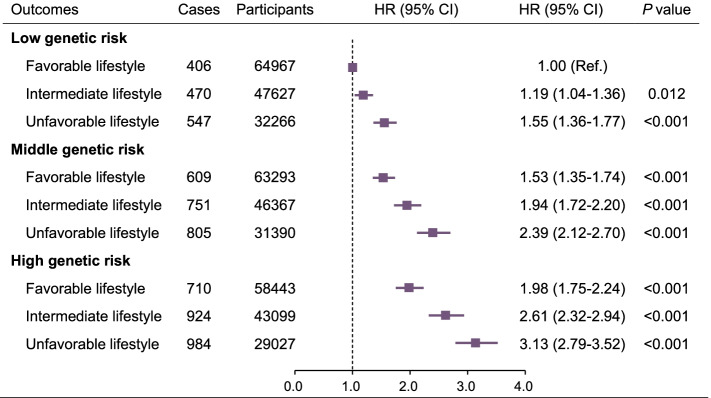
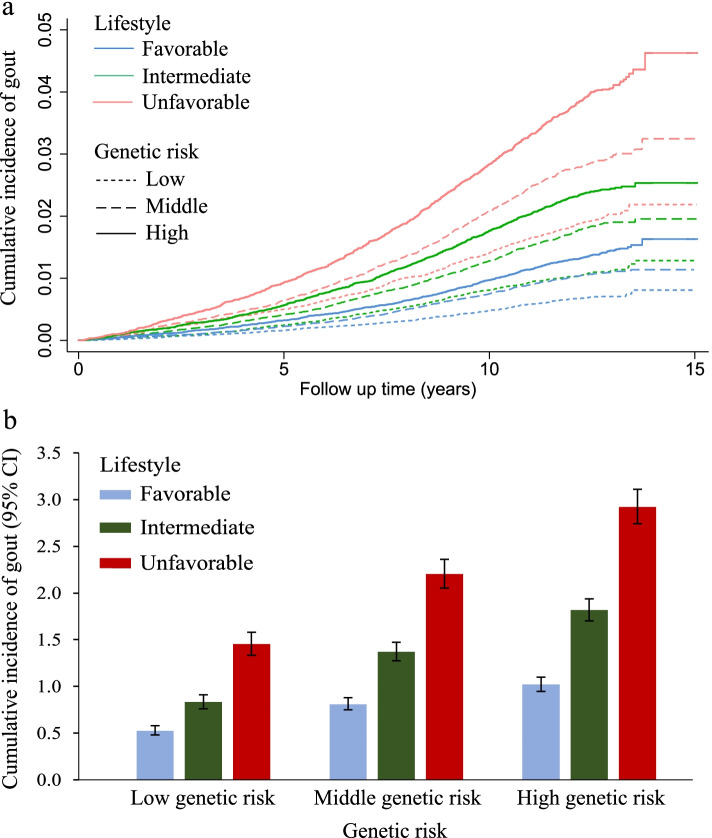
Over the follow-up (median: 12.1 years), 6206 participants developed gout. Compared to low genetic risk, the hazard ratios (HRs) and 95% confidence intervals (CIs) of gout was 1.44 (1.35-1.54) for middle and 1.77 (1.66-1.89) for high genetic risk. The HRs (95% CIs) of gout were 0.63 (0.59-0.67) for a favorable lifestyle and 0.79 (0.75-0.85) for an intermediate lifestyle, compared to an unfavorable lifestyle. In joint effect analysis, compared to participants with low genetic predisposition and a favorable lifestyle, the HRs (95% CIs) of gout were 2.39 (2.12-2.70)/3.12 (2.79-3.52) in those with middle and high genetic predisposition plus unfavorable lifestyle profiles, and 1.53 (1.35-1.74)/1.98 (1.75-2.24) for those with middle and high genetic predisposition plus favorable lifestyle profiles, respectively. Moreover, compared to an unfavorable lifestyle, the HRs of gout related to a favorable lifestyle was 0.64 (95% CI, 0.56-0.73) for low genetic risk, 0.65 (95% CI, 0.58-0.72) for middle genetic risk, and 0.62 (95% CI, 0.57-0.69) for high genetic risk. There was a significant additive interaction between unfavorable lifestyle and high genetic risk on gout.
Healthy lifestyle was associated with a lower risk of gout and may attenuate the risk of gout related to genetic factors by almost a third.
与痛风发病相关的风险基因已经被鉴定出来,生活方式因素也与痛风风险相关。目前尚不清楚健康的生活方式因素是否可以减轻痛风的遗传风险。因此,我们旨在探讨健康的生活方式是否以及在何种程度上可以减轻与遗传因素相关的痛风风险。
在英国生物库中,在基线时确定了 416481 名无痛风的参与者(年龄 37-74 岁)。评估痛风的多基因风险,并分为低(最低三分位)、中(三分位 2)和高(最高三分位)。健康的生活方式因素包括不饮酒或适度饮酒、不吸烟、身体活动和健康饮食。根据健康生活方式因素的数量将参与者分为三组:不利(0 或 1)、中等(任何 2 个)和有利(3 或 4)。使用 Cox 比例风险模型分析数据。
在随访期间(中位数:12.1 年),有 6206 名参与者患上了痛风。与低遗传风险相比,中遗传风险和高遗传风险的痛风风险比(HRs)和 95%置信区间(CIs)分别为 1.44(1.35-1.54)和 1.77(1.66-1.89)。与不利的生活方式相比,有利生活方式的 HRs(95% CIs)为 0.63(0.59-0.67),中等生活方式为 0.79(0.75-0.85)。在联合效应分析中,与低遗传易感性和有利生活方式的参与者相比,中遗传易感性和不利生活方式的参与者的痛风 HRs(95% CIs)分别为 2.39(2.12-2.70)/3.12(2.79-3.52),中遗传易感性和有利生活方式的参与者的 HRs(95% CIs)分别为 1.53(1.35-1.74)/1.98(1.75-2.24)。此外,与不利的生活方式相比,与有利的生活方式相关的痛风风险 HRs 分别为低遗传风险的 0.64(95%CI,0.56-0.73)、中遗传风险的 0.65(95%CI,0.58-0.72)和高遗传风险的 0.62(95%CI,0.57-0.69)。不利的生活方式和高遗传风险之间存在显著的相加交互作用。
健康的生活方式与痛风风险较低相关,并且可能将与遗传因素相关的痛风风险降低近三分之一。