Pharmerit International , Bethesda, MD , USA.
Acta Orthop. 2013 Dec;84(6):571-8. doi: 10.3109/17453674.2013.865097. Epub 2013 Nov 29.
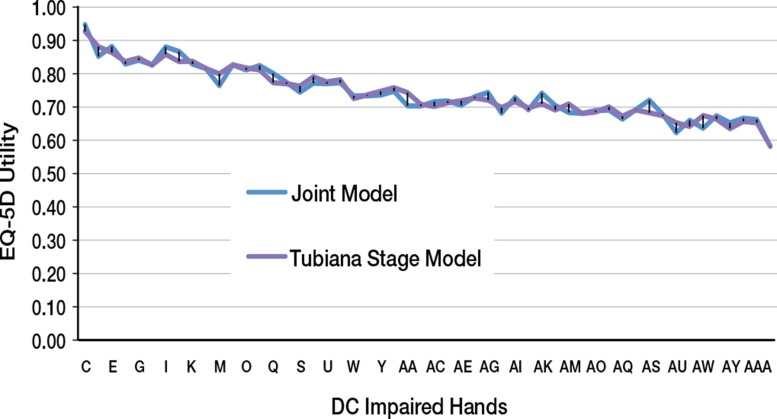
An internet-based discrete choice experiment (DCE) was conducted to elicit preferences for a wide range of Dupuytren's contracture (DC)-related health states. An algorithm was subsequently developed to convert these preferences into health state utilities that can be used to assess DC's impact on quality of life and the value of its treatments.
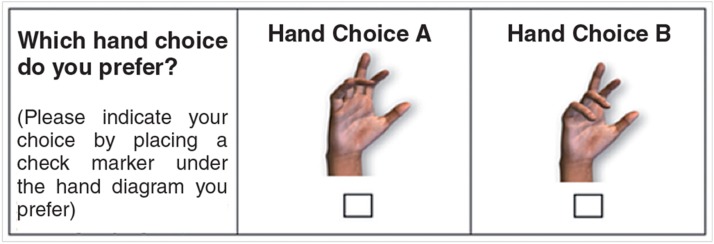
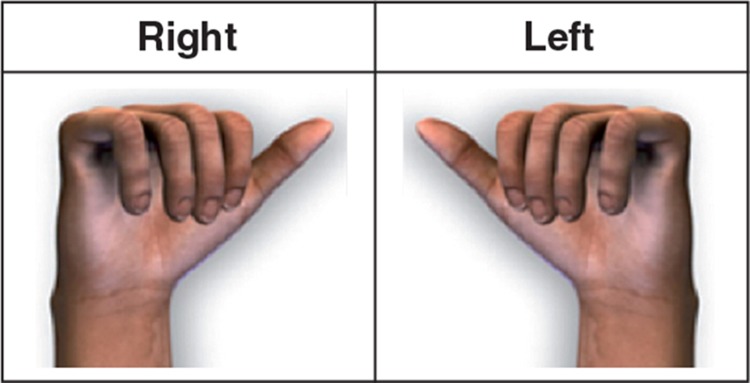
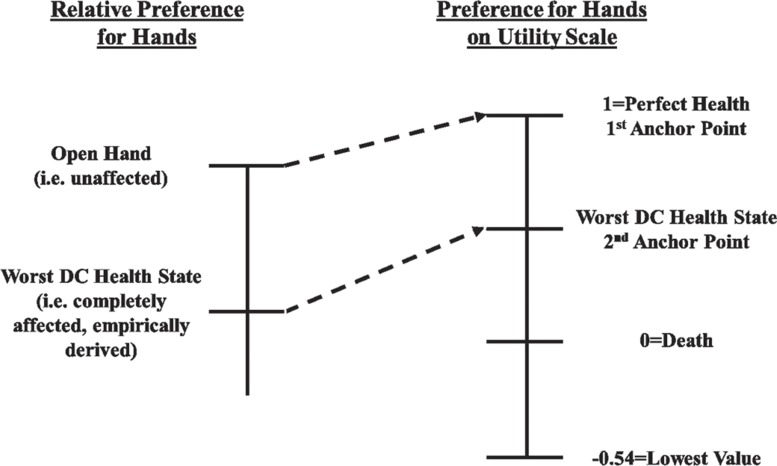
Health state preferences for varying levels of DC hand severity were elicited via an internet survey from a sample of the UK adult population. Severity levels were defined using a combination of contractures (0, 45, or 90 degrees) in 8 proximal interphalangeal and metacarpophalangeal joints of the index, middle, ring, and little fingers. Right-handed, left-handed, and ambidextrous respondents indicated which hand was preferable in each of the 10 randomly-selected hand-pairings comparing different DC severity levels. For consistency across comparisons, anatomically precise digital hand drawings were used. To anchor preferences onto the traditional 0-1 utility scale used in health economic evaluations, unaffected hands were assigned a utility of 1.0 whereas the utility for a maximally affected hand (i.e., all 8 joints set at 90 degrees of contracture) was derived by asking respondents to indicate what combination of attributes and levels of the EQ-5D-5L profile most accurately reflects the impact of living with such hand. Conditional logistic models were used to estimate indirect utilities, then rescaled to the anchor points on the EQ-5D-5L.
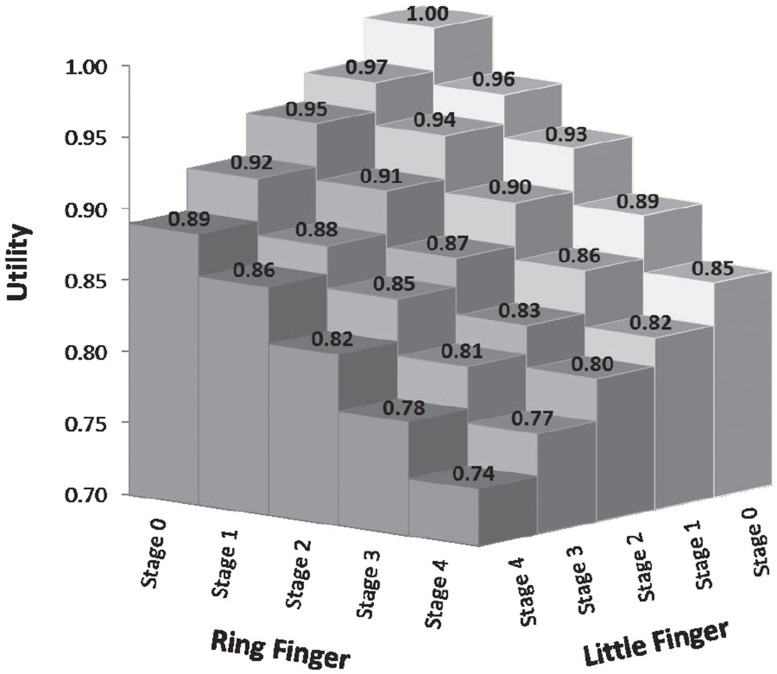
Estimated utilities based on the responses of 1,745 qualified respondents were 0.49, 0.57, and 0.63 for completely affected dominant hands, non-dominant hands, or ambidextrous hands, respectively. Utility for a dominant hand with 90-degree contracture in t h e metacarpophalangeal joints of the ring and little fingers was estimated to be 0.89. Separately, reducing the contracture of metacarpophalangeal joint for a little finger from 50 to 12 degrees would improve utility by 0.02.
DC is associated with substantial utility decrements. The algorithms presented herein provide a robust and flexible framework to assess utility for varying degrees of DC severity.
我们开展了一项基于互联网的离散选择实验(DCE),以了解人们对各种程度的掌腱膜挛缩(Dupuytren's contracture,DC)相关健康状况的偏好。随后,我们开发了一种算法,将这些偏好转化为健康状态效用,可用于评估 DC 对生活质量的影响以及其治疗方法的价值。
我们通过互联网调查从英国成年人群体中抽取样本,调查了不同程度 DC 手部严重程度的健康状况偏好。严重程度使用第 2、3、4 指的近端指间关节和掌指关节的 8 个掌腱膜挛缩(0、45 或 90 度)的组合来定义。右利手、左利手和双手利手的受访者在 10 个随机选择的手部配对中指出,哪只手在不同的 DC 严重程度下更优。为了保持跨比较的一致性,使用了解剖学上精确的数字手部绘图。为了将偏好锚定到健康经济学评估中使用的传统 0-1 效用标度上,未受影响的手被赋予 1.0 的效用,而受影响最大的手(即所有 8 个关节的挛缩度均设置为 90 度)的效用则通过询问受访者来确定,他们认为哪种 EQ-5D-5L 剖面图的属性和水平组合最能反映出患有这种手部疾病的影响。我们使用条件逻辑模型来估计间接效用,然后将其重新调整到 EQ-5D-5L 上的锚定点。
根据 1745 名合格受访者的回答,完全受累的优势手、非优势手或双手利手的估计效用分别为 0.49、0.57 和 0.63。环指和小指掌指关节的 90 度挛缩的优势手的效用估计为 0.89。另外,将小指的掌指关节挛缩从 50 度减少到 12 度,效用可提高 0.02。
掌腱膜挛缩会导致效用显著下降。本文介绍的算法为评估不同程度的掌腱膜挛缩严重程度的效用提供了一个稳健且灵活的框架。