1] National Research Laboratory for Stem Cell Niche, Seoul National University College of Medicine, Seoul, Korea [2] Department of Internal Medicine, Seoul National University Hospital, Seoul, Korea [3] Innovative Research Institute for Cell Therapy, Seoul National University Hospital, Seoul, Korea.
Exp Mol Med. 2013 Nov 29;45(11):e65. doi: 10.1038/emm.2013.112.
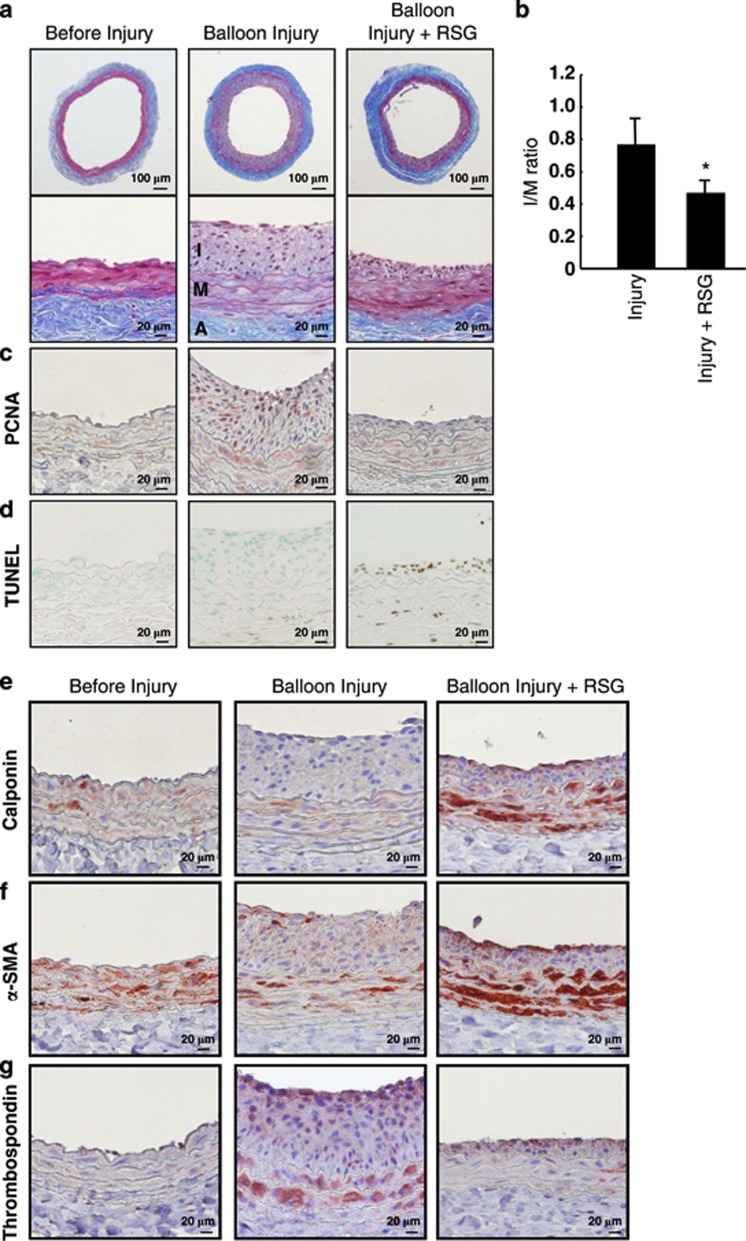
Vascular smooth muscle cells (VSMCs) undergo phenotypic changes in response to vascular injury such as angioplasty. Protein kinase G (PKG) has an important role in the process of VSMC phenotype switching. In this study, we examined whether rosiglitazone, a peroxisome proliferator-activated receptor (PPAR)-γ agonist, could modulate VSMC phenotype through the PKG pathway to reduce neointimal hyperplasia after angioplasty. In vitro experiments showed that rosiglitazone inhibited the phenotype change of VSMCs from a contractile to a synthetic form. The platelet-derived growth factor (PDGF)-induced reduction of PKG level was reversed by rosiglitazone treatment, resulting in increased PKG activity. This increased activity of PKG resulted in phosphorylation of vasodilator-stimulated phosphoprotein at serine 239, leading to inhibited proliferation of VSMCs. Interestingly, rosiglitazone did not change the level of nitric oxide (NO) or cyclic guanosine monophosphate (cGMP), which are upstream of PKG, suggesting that rosiglitazone influences PKG itself. Chromatin immunoprecipitation assays for the PKG promoter showed that the activation of PKG by rosiglitazone was mediated by the increased binding of Sp1 on the promoter region of PKG. In vivo experiments showed that rosiglitazone significantly inhibited neointimal formation after balloon injury. Immunohistochemistry staining for calponin and thrombospondin showed that this effect of rosiglitazone was mediated by modulating VSMC phenotype. Our findings demonstrate that rosiglitazone is a potent modulator of VSMC phenotype, which is regulated by PKG. This activation of PKG by rosiglitazone results in reduced neointimal hyperplasia after angioplasty. These results provide important mechanistic insight into the cardiovascular-protective effect of PPARγ.
血管平滑肌细胞(VSMCs)在血管损伤如血管成形术后会发生表型变化。蛋白激酶 G(PKG)在 VSMC 表型转换过程中起重要作用。在这项研究中,我们研究了罗格列酮(一种过氧化物酶体增殖物激活受体(PPAR)-γ激动剂)是否可以通过 PKG 途径调节 VSMC 表型,从而减少血管成形术后的新生内膜增生。体外实验表明,罗格列酮抑制了 VSMC 从收缩型向合成型的表型变化。血小板衍生生长因子(PDGF)诱导的 PKG 水平降低被罗格列酮治疗逆转,导致 PKG 活性增加。这种 PKG 活性的增加导致血管扩张刺激磷蛋白丝氨酸 239 磷酸化,从而抑制 VSMC 的增殖。有趣的是,罗格列酮并未改变 PKG 的上游物质一氧化氮(NO)或环鸟苷酸(cGMP)的水平,这表明罗格列酮影响 PKG 本身。PKG 启动子的染色质免疫沉淀分析表明,罗格列酮通过 Sp1 在 PKG 启动子区域的结合增加来激活 PKG。体内实验表明,罗格列酮显著抑制球囊损伤后的新生内膜形成。钙调蛋白和血栓调节蛋白的免疫组织化学染色表明,罗格列酮的这种作用是通过调节 VSMC 表型介导的。我们的研究结果表明,罗格列酮是 VSMC 表型的有效调节剂,由 PKG 调节。罗格列酮对 PKG 的激活导致血管成形术后新生内膜增生减少。这些结果为 PPARγ 的心血管保护作用提供了重要的机制见解。