Hong Eui-Ju, Jeung Eui-Bae
Laboratory of Veterinary Biochemistry and Molecular Biology, College of Veterinary Medicine, Chungbuk National University, Cheongju, Chungbuk 361-763, Korea.
Int J Mol Sci. 2013 Nov 26;14(12):23330-40. doi: 10.3390/ijms141223330.
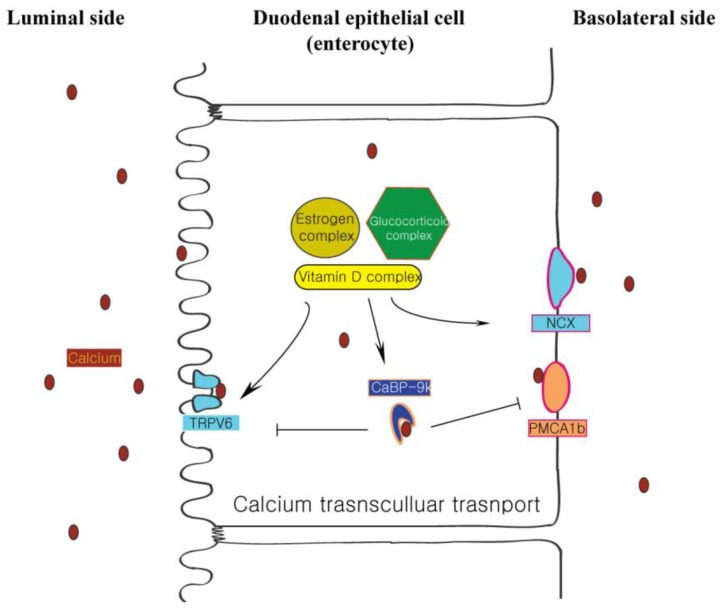
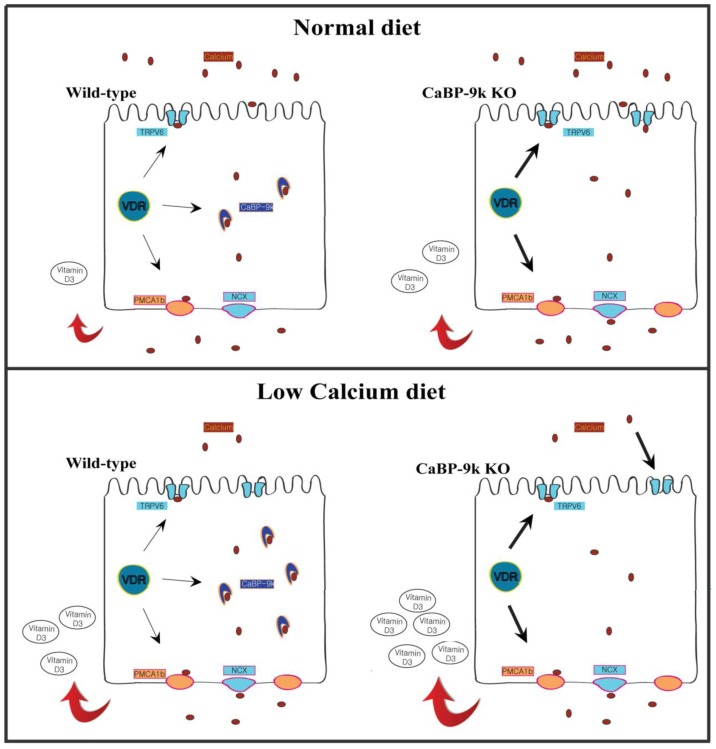
Calbindin-D9k (CaBP-9k) binds calcium with high affinity and regulates the distribution of free calcium in the cytoplasm. The expression of CaBP-9k is detected primarily in intestine that is vitamin D target tissue, and accumulates in the enterocytes of the duodenal villi. These enterocytes are the clearest example of vitamin D responsive cells, and the presence of CaBP-9k within them accentuates calcium absorption mediated by active transcellular calcium transport. It has been well established that the expression of CaBP-9k is mediated with vitamin D response element on its promoter and it regulates the amount of intracellular calcium in order to prevent cell death from reaching the toxicity of free calcium. There is now little doubt that glucocorticoid also decreases CaBP-9k expression in duodenal epithelial cells. In addition, it was reported that the level of CaBP-9k gene in enterocytes is increased in pregnancy when the plasma estradiol concentration is generally associated with a concomitant increase. Although calcium homeostasis was not disturbed in mice lacking the CaBP-9k gene, we found that CaBP-9k has a buffering role of free calcium in the cytosolic environment beyond that of calcium transfer. To expand our knowledge of the biological functions of CaBP-9k, our research has focused on defining the biological significance of intracellular CaBP-9k. Our findings suggest that the CaBP-9k gene is involved in compensatory induction of other calcium transporter genes in duodenal epithelial cells. This article summarizes the findings from recent studies on the expression and the functions of CaBP-9k in the small intestine.
钙结合蛋白-D9k(CaBP-9k)以高亲和力结合钙,并调节细胞质中游离钙的分布。CaBP-9k的表达主要在作为维生素D靶组织的肠道中检测到,并在十二指肠绒毛的肠细胞中积累。这些肠细胞是维生素D反应性细胞的最典型例子,其中CaBP-9k的存在增强了由主动跨细胞钙转运介导的钙吸收。已经充分证实,CaBP-9k的表达由其启动子上的维生素D反应元件介导,并且它调节细胞内钙的量以防止细胞因游离钙的毒性而死亡。现在几乎毫无疑问,糖皮质激素也会降低十二指肠上皮细胞中CaBP-9k的表达。此外,有报道称,在怀孕期间,当血浆雌二醇浓度通常随之升高时,肠细胞中CaBP-9k基因的水平会升高。尽管缺乏CaBP-9k基因的小鼠的钙稳态未受干扰,但我们发现CaBP-9k在细胞溶质环境中对游离钙具有缓冲作用,这超出了钙转运的作用。为了扩展我们对CaBP-9k生物学功能的认识,我们的研究集中在确定细胞内CaBP-9k的生物学意义。我们的研究结果表明,CaBP-9k基因参与十二指肠上皮细胞中其他钙转运蛋白基因的代偿性诱导。本文总结了最近关于CaBP-9k在小肠中的表达和功能的研究结果。