Department of Clinical and Biological Sciences, University of Torino, 10043 Orbassano (Torino), Italy.
Department of Neuroscience, University of Torino, Torino, Italy.
Free Radic Biol Med. 2014 Mar;68(100):134-47. doi: 10.1016/j.freeradbiomed.2013.11.020. Epub 2013 Nov 28.
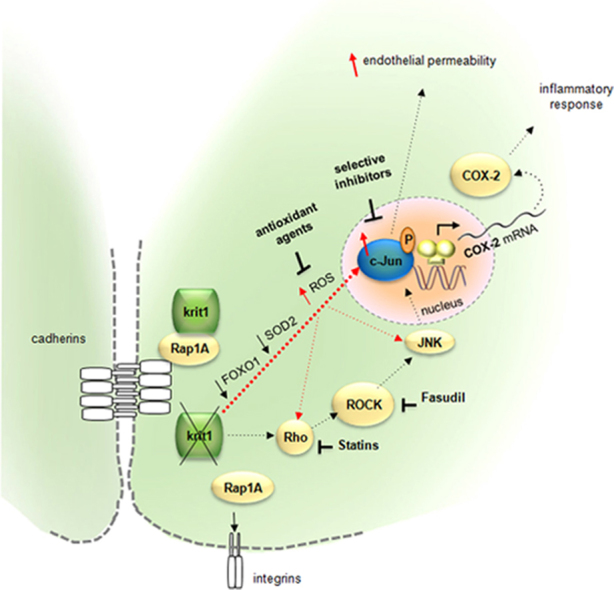
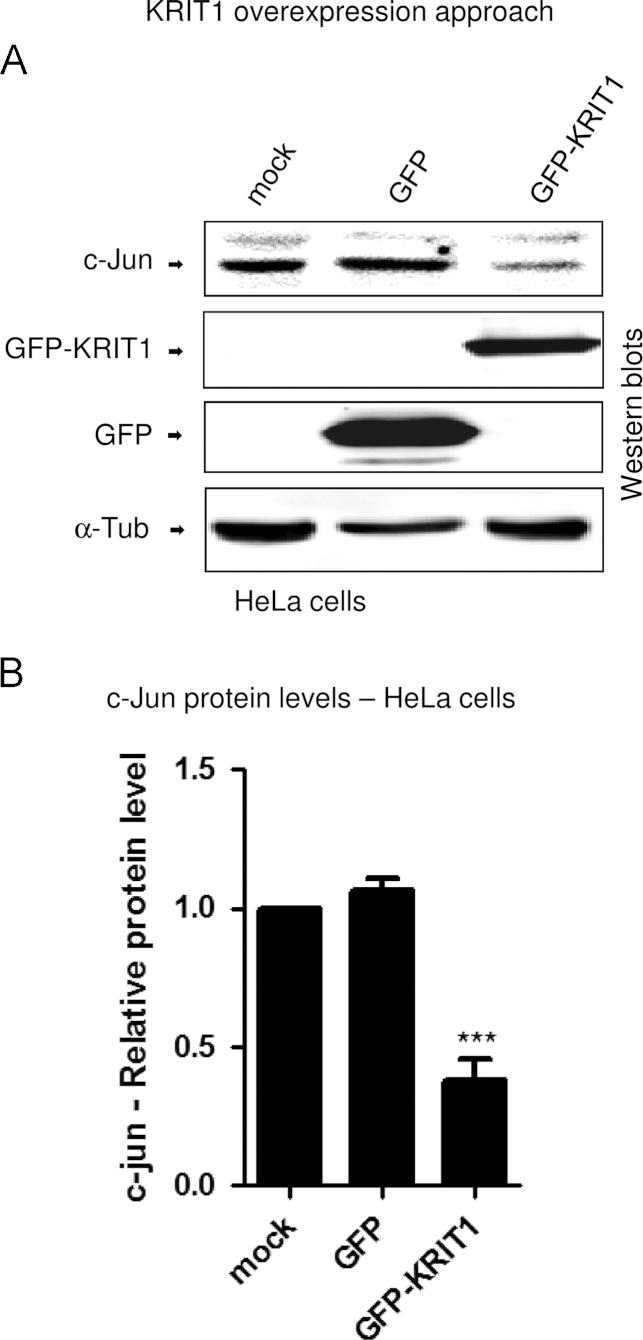
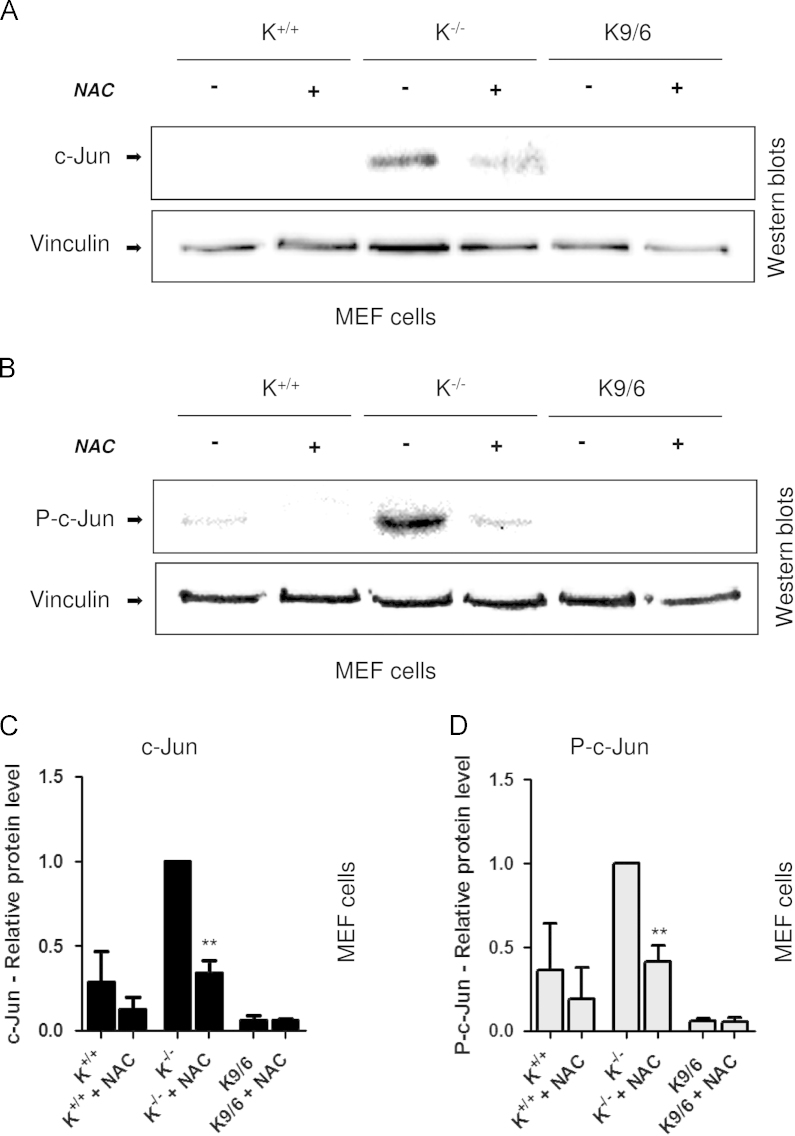
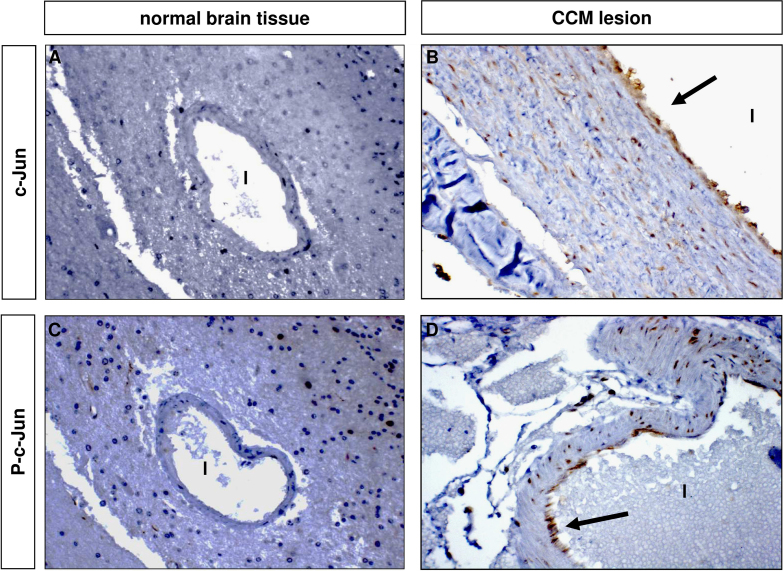
Loss-of-function mutations in the KRIT1 gene (CCM1) have been associated with the pathogenesis of cerebral cavernous malformations (CCM), a major cerebrovascular disease. However, KRIT1 functions and CCM pathogenetic mechanisms remain incompletely understood. Indeed, recent experiments in animal models have clearly demonstrated that the homozygous loss of KRIT1 is not sufficient to induce CCM lesions, suggesting that additional factors are necessary to cause CCM disease. Previously, we found that KRIT1 is involved in the maintenance of the intracellular reactive oxygen species (ROS) homeostasis to prevent ROS-induced cellular dysfunctions, including a reduced ability to maintain a quiescent state. Here, we show that KRIT1 loss of function leads to enhanced expression and phosphorylation of the redox-sensitive transcription factor c-Jun, as well as induction of its downstream target COX-2, in both cellular models and human CCM tissues. Furthermore, we demonstrate that c-Jun upregulation can be reversed by either KRIT1 re-expression or ROS scavenging, whereas KRIT1 overexpression prevents forced upregulation of c-Jun induced by oxidative stimuli. Taken together with the reported role of c-Jun in vascular dysfunctions triggered by oxidative stress, our findings shed new light on the molecular mechanisms underlying KRIT1 function and CCM pathogenesis.
KRIT1 基因(CCM1)的功能丧失突变与脑动静脉畸形(CCM)的发病机制有关,CCM 是一种主要的脑血管疾病。然而,KRIT1 的功能和 CCM 的发病机制仍不完全清楚。事实上,动物模型的最新实验清楚地表明,KRIT1 的纯合缺失不足以诱导 CCM 病变,这表明还需要其他因素才能导致 CCM 疾病。此前,我们发现 KRIT1 参与维持细胞内活性氧(ROS)的动态平衡,以防止 ROS 诱导的细胞功能障碍,包括维持静止状态的能力降低。在这里,我们表明,在细胞模型和人 CCM 组织中,KRIT1 功能丧失会导致氧化还原敏感转录因子 c-Jun 的表达和磷酸化增强,以及其下游靶标 COX-2 的诱导。此外,我们证明 c-Jun 的上调可以通过 KRIT1 的重新表达或 ROS 清除来逆转,而 KRIT1 的过表达可以防止氧化应激诱导的 c-Jun 的强制上调。结合 c-Jun 在氧化应激引发的血管功能障碍中的报告作用,我们的发现为 KRIT1 功能和 CCM 发病机制的分子机制提供了新的见解。