Office for Mental Health Support, Division for Counseling and Support, The University of Tokyo , Tokyo , Japan ; Department of Neuropsychiatry, Graduate School of Medicine, The University of Tokyo , Tokyo , Japan.
Front Psychiatry. 2013 Nov 14;4:145. doi: 10.3389/fpsyt.2013.00145. eCollection 2013.
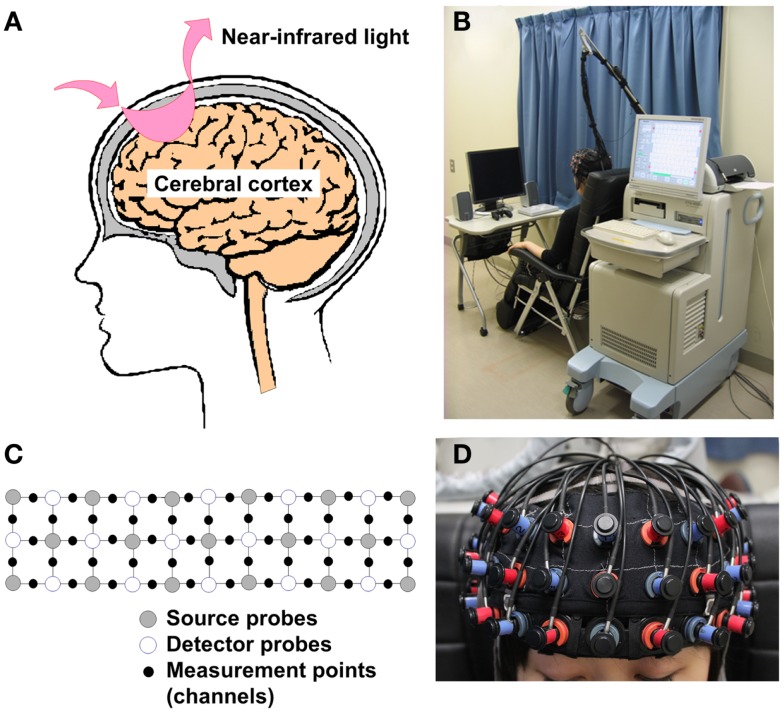
Functional near-infrared spectroscopy (fNIRS) is a relatively new technique that can measure hemoglobin changes in brain tissues, and its use in psychiatry has been progressing rapidly. Although it has several disadvantages (e.g., relatively low spatial resolution and the possibility of shallow coverage in the depth of brain regions) compared with other functional neuroimaging techniques (e.g., functional magnetic resonance imaging and positron emission tomography), fNIRS may be a candidate instrument for clinical use in psychiatry, as it can measure brain activity in naturalistic position easily and non-invasively. fNIRS instruments are also small and work silently, and can be moved almost everywhere including schools and care units. Previous fNIRS studies have shown that patients with schizophrenia have impaired activity and characteristic waveform patterns in the prefrontal cortex during the letter version of the verbal fluency task, and part of these results have been approved as one of the Advanced Medical Technologies as an aid for the differential diagnosis of depressive symptoms by the Ministry of Health, Labor and Welfare of Japan in 2009, which was the first such approval in the field of psychiatry. Moreover, previous studies suggest that the activity in the frontopolar prefrontal cortex is associated with their functions in chronic schizophrenia and is its next candidate biomarker. Future studies aimed at exploring fNIRS differences in various clinical stages, longitudinal changes, drug effects, and variations during different task paradigms will be needed to develop more accurate biomarkers that can be used to aid differential diagnosis, the comprehension of the present condition, the prediction of outcome, and the decision regarding treatment options in schizophrenia. Future fNIRS researches will require standardized measurement procedures, probe settings, analytical methods and tools, manuscript description, and database systems in an fNIRS community.
功能性近红外光谱(fNIRS)是一种相对较新的技术,可测量脑组织中血红蛋白的变化,其在精神病学中的应用正在迅速发展。尽管与其他功能神经影像学技术(例如功能磁共振成像和正电子发射断层扫描)相比,fNIRS 具有几个缺点(例如,空间分辨率相对较低,并且在脑区深度上可能存在浅层覆盖),但 fNIRS 可能是精神病学临床应用的候选仪器,因为它可以轻松地非侵入性地测量自然位置的大脑活动。fNIRS 仪器也很小,静音运行,几乎可以在任何地方移动,包括学校和护理单位。先前的 fNIRS 研究表明,精神分裂症患者在言语流畅性任务的字母版本中前额叶皮质的活动和特征波形模式受损,其中部分结果已被日本厚生劳动省批准为高级医疗技术之一,作为辅助抑郁症的鉴别诊断的工具 2009 年,这是精神病学领域的首次此类批准。此外,先前的研究表明,前额极前额叶皮质的活动与其在慢性精神分裂症中的功能有关,是其下一个候选生物标志物。未来需要进行旨在探索各种临床阶段、纵向变化、药物效应以及不同任务范式下变化的 fNIRS 差异的研究,以开发更准确的生物标志物,可用于辅助鉴别诊断、了解现状、预测结果和决策治疗方案在精神分裂症中。未来的 fNIRS 研究将需要在 fNIRS 社区中标准化测量程序、探头设置、分析方法和工具、手稿描述和数据库系统。