Athinoula A. Martinos Center for Biomedical Imaging, Department of Radiology, Massachusetts General Hospital, Harvard Medical School, Charlestown, MA, USA; Harvard-MIT Division of Health Sciences and Technology, Cambridge, MA, USA.
Neuroimage. 2014 Jan 15;85 Pt 1(0 1):127-35. doi: 10.1016/j.neuroimage.2013.01.073. Epub 2013 Feb 9.
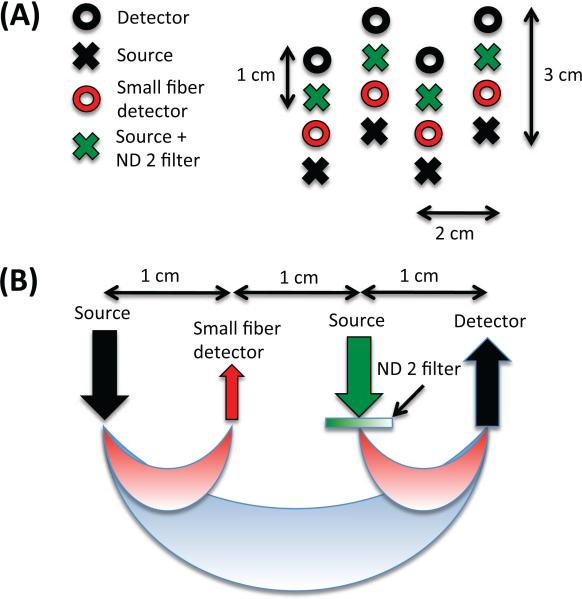
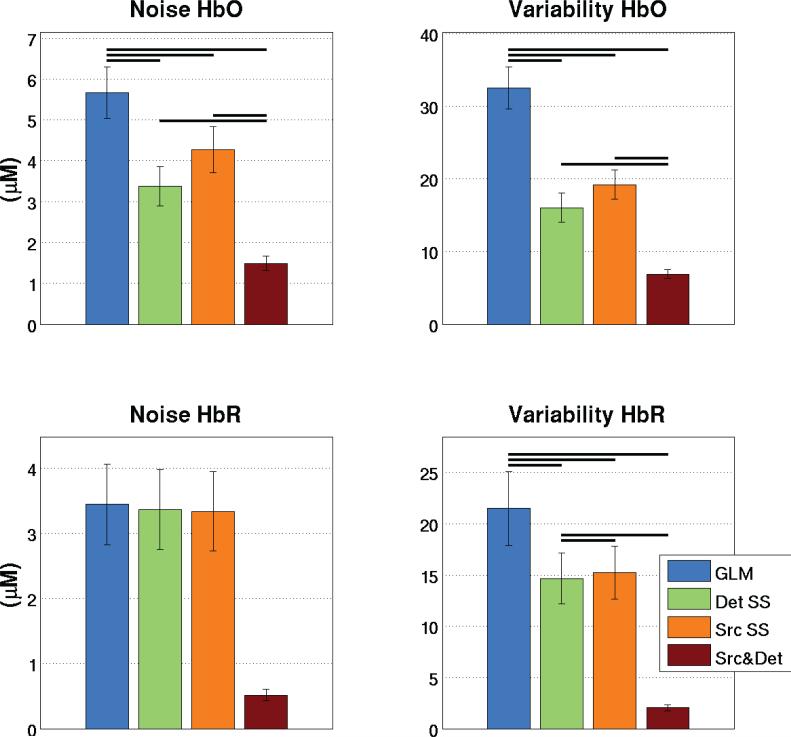
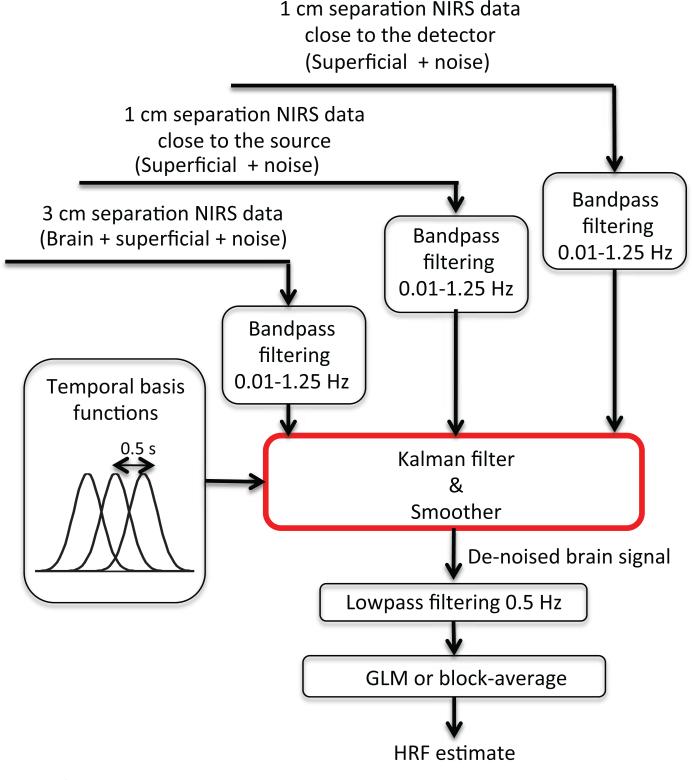
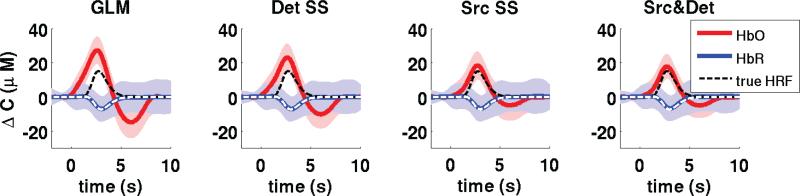
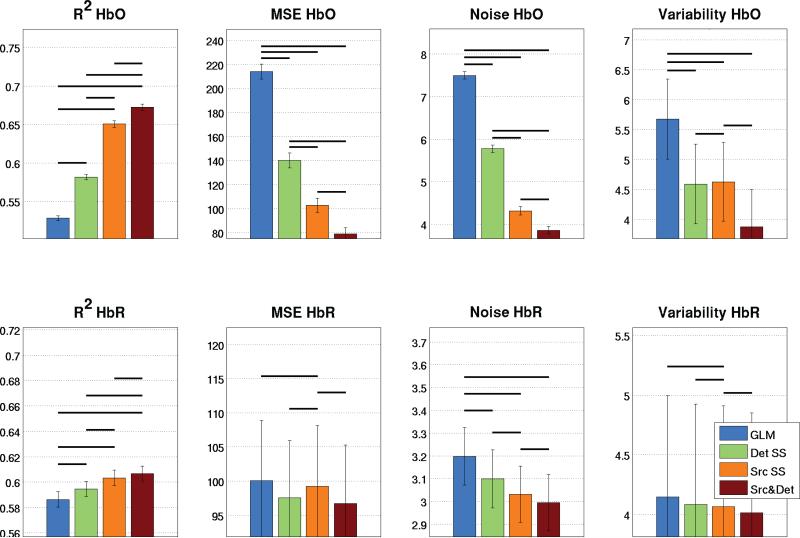
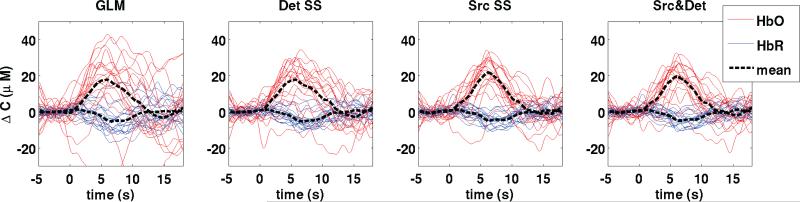
Near-Infrared Spectroscopy (NIRS) allows the recovery of the evoked hemodynamic response to brain activation. In adult human populations, the NIRS signal is strongly contaminated by systemic interference occurring in the superficial layers of the head. An approach to overcome this difficulty is to use additional NIRS measurements with short optode separations to measure the systemic hemodynamic fluctuations occurring in the superficial layers. These measurements can then be used as regressors in the post-experiment analysis to remove the systemic contamination and isolate the brain signal. In our previous work, we showed that the systemic interference measured in NIRS is heterogeneous across the surface of the scalp. As a consequence, the short separation measurement used in the regression procedure must be located close to the standard NIRS channel from which the evoked hemodynamic response of the brain is to be recovered. Here, we demonstrate that using two short separation measurements, one at the source optode and one at the detector optode, further increases the performance of the short separation regression method compared to using a single short separation measurement. While a single short separation channel produces an average reduction in noise of 33% for HbO, using a short separation channel at both source and detector reduces noise by 59% compared to the standard method using a general linear model (GLM) without short separation. For HbR, noise reduction of 3% is achieved using a single short separation and this number goes to 47% when two short separations are used. Our work emphasizes the importance of integrating short separation measurements both at the source and at the detector optode of the standard channels from which the hemodynamic response is to be recovered. While the implementation of short separation sources presents some difficulties experimentally, the improvement in noise reduction is significant enough to justify the practical challenges.
近红外光谱(NIRS)允许恢复大脑激活的诱发血液动力学反应。在成年人群中,NIRS 信号强烈受到头部浅层发生的系统干扰的污染。克服这一困难的一种方法是使用具有短光程分离的附加 NIRS 测量来测量浅层发生的系统血液动力学波动。然后,这些测量可以用作实验后分析中的回归量,以去除系统污染并隔离大脑信号。在我们之前的工作中,我们表明在 NIRS 中测量的系统干扰在头皮表面是不均匀的。因此,回归过程中使用的短分离测量必须靠近要恢复大脑诱发血液动力学反应的标准 NIRS 通道。在这里,我们证明使用两个短分离测量值,一个在源光程,一个在探测器光程,与使用单个短分离测量值相比,进一步提高了短分离回归方法的性能。虽然单个短分离通道可使 HbO 的噪声平均降低 33%,但与不使用短分离的普通线性模型 (GLM) 相比,在源和探测器处使用短分离通道可将噪声降低 59%。对于 HbR,使用单个短分离可实现 3%的噪声降低,当使用两个短分离时,该数字增加到 47%。我们的工作强调了在要恢复血液动力学反应的标准通道的源和探测器光程处集成短分离测量的重要性。虽然短分离源的实现在实验上存在一些困难,但噪声降低的改善足以证明实际挑战是合理的。