Chen Jing, Qi Lihong, Xia Zhen, Shen Mei, Shen Xin, Mei Jian, DeRiemer Kathryn
Department of Tuberculosis Control, Shanghai Municipal Center for Disease Control and Prevention, Shanghai, China.
PLoS One. 2013 Nov 28;8(11):e81351. doi: 10.1371/journal.pone.0081351. eCollection 2013.
Migration is a major challenge to tuberculosis (TB) control worldwide. TB treatment requires multiple drugs for at least six months. Some TB patients default before completing their treatment regimen, which can lead to ongoing infectiousness and drug resistance.
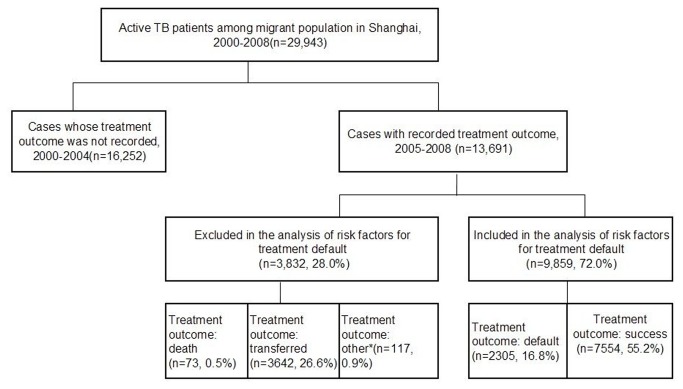
We conducted a retrospective analysis of 29,943 active TB cases among urban migrants that were reported between 2000 to 2008 in Shanghai, China. We used logistic regression models to identify factors independently associated with treatment defaults in TB patients among urban migrants during 2005-2008.
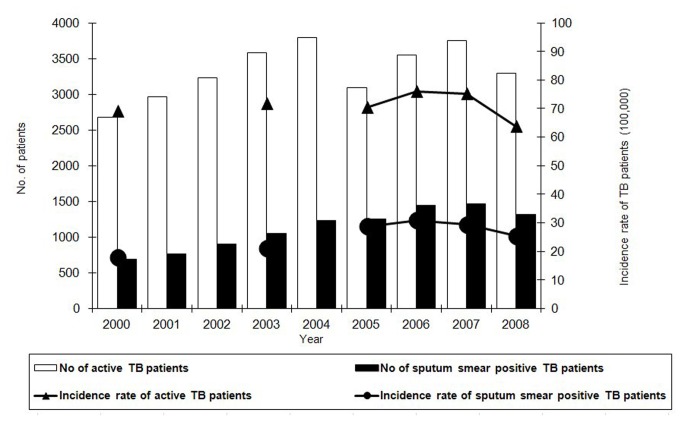
Fifty-two percent of the total TB patients reported in Shanghai during the study period were among urban migrants. Three factors increased the odds of a treatment default: case management using self-administered therapy (OR, 5.84, 95% CI, 3.14-10.86, p<0.0005), being a retreatment case (OR, 1.47, 95% CI, 1.25-1.71, p<0.0005), and age >60 years old (OR, 1.33, 95% CI, 1.05-1.67, p=0.017). The presence of a cavity in the initial chest radiograph decreased the odds for a treatment default (OR, 0.87, 95% CI, 0.77-0.97, p=0.015), as did migration from central China (OR, 0.85, 95% CI, 0.73-0.99, p=0.042), case management by family members (OR, 0.73, 95% CI 0.66-0.81, p<0.0005), and the combination of case detection by a required physical exam and case management by health care staff (OR, 0.64, 95% CI, 0.45-0.93, p=0.019).
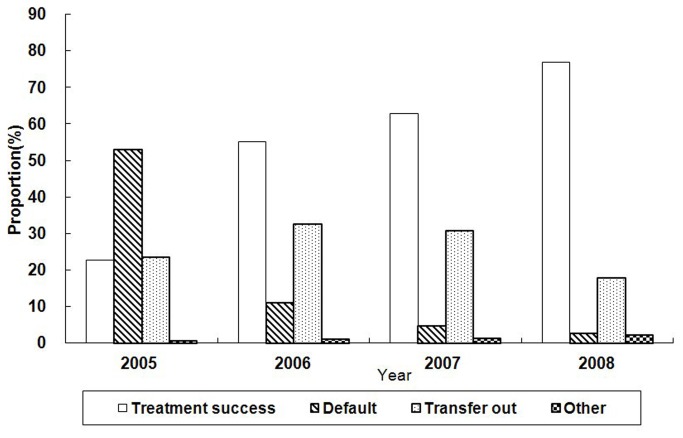
Among TB patients who were urban migrants in Shanghai, case management using self-administered therapy was the strongest modifiable risk factor that was independently associated with treatment defaults. Interventions that target retreated TB cases could also reduce treatment defaults among urban migrants. Health departments should develop effective measures to prevent treatment defaults among urban migrants, to ensure completion of therapy among urban migrants who move between cities and provinces, and to improve reporting of treatment outcomes.
人口流动是全球结核病控制面临的一项重大挑战。结核病治疗需要使用多种药物,疗程至少六个月。一些结核病患者在完成治疗方案前就中断治疗,这可能导致持续传染和耐药性。
我们对2000年至2008年期间在中国上海报告的29943例城市流动结核病患者进行了回顾性分析。我们使用逻辑回归模型来确定2005年至2008年期间城市流动结核病患者中与治疗中断独立相关的因素。
研究期间在上海报告的结核病患者中,52%为城市流动人员。有三个因素增加了治疗中断的几率:采用自我管理疗法的病例管理(比值比[OR]为5.84,95%置信区间[CI]为3.14 - 10.86,p<0.0005)、复治病例(OR为1.47,95%CI为1.25 - 1.71,p<0.0005)以及年龄>60岁(OR为1.33,95%CI为1.05 - 1.67,p = 0.017)。初始胸部X线片显示有空洞可降低治疗中断的几率(OR为0.87,95%CI为0.77 - 0.97,p = 0.015),来自中国中部地区的流动患者也是如此(OR为0.85,95%CI为0.73 - 0.99,p = 0.042),由家庭成员进行病例管理(OR为0.73,95%CI为0.66 - 0.81,p<0.0005),以及通过必要的体格检查进行病例发现和由医护人员进行病例管理相结合(OR为0.64,95%CI为0.45 - 0.93,p = 0.019)。
在上海的城市流动结核病患者中,采用自我管理疗法的病例管理是与治疗中断独立相关的最强可改变风险因素。针对复治结核病病例的干预措施也可减少城市流动人员中的治疗中断情况。卫生部门应制定有效措施来预防城市流动人员中的治疗中断,确保在城市间和省份间流动的城市流动人员完成治疗,并改善治疗结果报告。