Issa-Nummer Yasmin, Darb-Esfahani Silvia, Loibl Sibylle, Kunz Georg, Nekljudova Valentina, Schrader Iris, Sinn Bruno Valentin, Ulmer Hans-Ullrich, Kronenwett Ralf, Just Marianne, Kühn Thorsten, Diebold Kurt, Untch Michael, Holms Frank, Blohmer Jens-Uwe, Habeck Jörg-Olaf, Dietel Manfred, Overkamp Friedrich, Krabisch Petra, von Minckwitz Gunter, Denkert Carsten
German Breast Group, Neu-Isenburg, Germany.
PLoS One. 2013 Dec 2;8(12):e79775. doi: 10.1371/journal.pone.0079775. eCollection 2013.
We have recently described an increased lymphocytic infiltration rate in breast carcinoma tissue is a significant response predictor for anthracycline/taxane-based neoadjuvant chemotherapy (NACT). The aim of this study was to prospectively validate the tumor-associated lymphocyte infiltrate as predictive marker for response to anthracycline/taxane-based NACT.
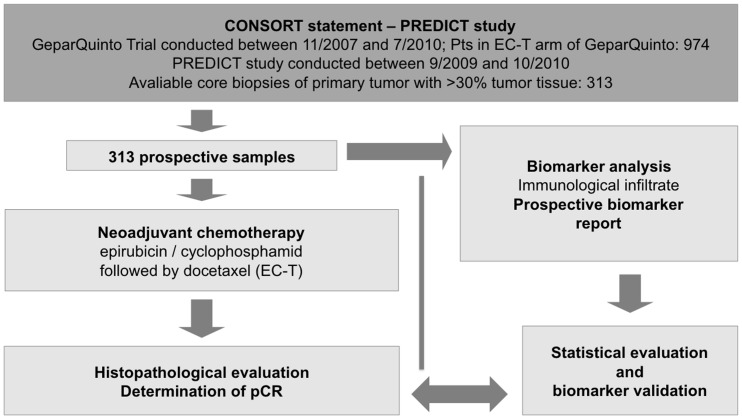
The immunological infiltrate was prospectively evaluated in a total of 313 core biopsies from HER2 negative patients of the multicenter PREDICT study, a substudy of the neoadjuvant GeparQuinto study. Intratumoral lymphocytes (iTuLy), stromal lymphocytes (strLy) as well as lymphocyte-predominant breast cancer (LPBC) were evaluated by histopathological assessment. Pathological complete response (pCR) rates were analyzed and compared between the defined subgroups using the exact test of Fisher.
Patients with lymphocyte-predominant breast cancer (LPBC) had a significantly increased pCR rate of 36.6%, compared to non-LPBC patients (14.3%, p<0.001). LPBC and stromal lymphocytes were significantly independent predictors for pCR in multivariate analysis (LPBC: OR 2.7, p = 0.003, strLy: OR 1.2, p = 0.01). The amount of intratumoral lymphocytes was significantly predictive for pCR in univariate (OR 1.2, p = 0.01) but not in multivariate logistic regression analysis (OR 1.2, p = 0.11).
Confirming previous investigations of our group, we have prospectively validated in an independent cohort that an increased immunological infiltrate in breast tumor tissue is predictive for response to anthracycline/taxane-based NACT. Patients with LPBC and increased stromal lymphocyte infiltration have significantly increased pCR rates. The lymphocytic infiltrate is a promising additional parameter for histopathological evaluation of breast cancer core biopsies.
我们最近描述了乳腺癌组织中淋巴细胞浸润率的增加是基于蒽环类/紫杉类的新辅助化疗(NACT)的重要反应预测指标。本研究的目的是前瞻性验证肿瘤相关淋巴细胞浸润作为基于蒽环类/紫杉类NACT反应的预测标志物。
在多中心PREDICT研究(新辅助GeparQuinto研究的一个子研究)中,对313例HER2阴性患者的核心活检组织进行前瞻性免疫浸润评估。通过组织病理学评估来评价瘤内淋巴细胞(iTuLy)、基质淋巴细胞(strLy)以及淋巴细胞为主型乳腺癌(LPBC)。使用Fisher精确检验分析并比较定义亚组之间的病理完全缓解(pCR)率。
淋巴细胞为主型乳腺癌(LPBC)患者的pCR率显著提高,为36.6%,而非LPBC患者为14.3%(p<0.001)。在多变量分析中,LPBC和基质淋巴细胞是pCR的显著独立预测因素(LPBC:OR 2.7,p = 0.003;strLy:OR 1.2,p = 0.01)。瘤内淋巴细胞数量在单变量分析中对pCR有显著预测性(OR 1.2,p = 0.01),但在多变量逻辑回归分析中无显著预测性(OR 1.2,p = 0.11)。
证实了我们团队之前的研究,我们在一个独立队列中前瞻性验证了乳腺肿瘤组织中免疫浸润增加可预测基于蒽环类/紫杉类的NACT反应。LPBC患者和基质淋巴细胞浸润增加的患者pCR率显著提高。淋巴细胞浸润是乳腺癌核心活检组织病理学评估中一个有前景的附加参数。