Novaes Renan Milagres Lage, Ribeiro Renata Acácio, Lemos-Filho José Pires, Lovato Maria Bernadete
Empresa Brasileira de Pesquisa Agropecuária, Londrina, Brasil.
PLoS One. 2013 Dec 2;8(12):e82198. doi: 10.1371/journal.pone.0082198. eCollection 2013.
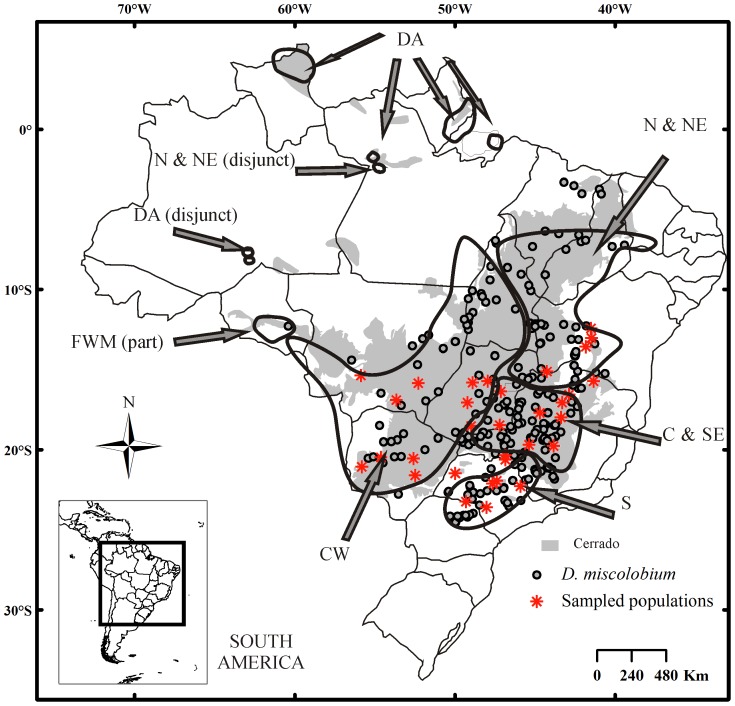
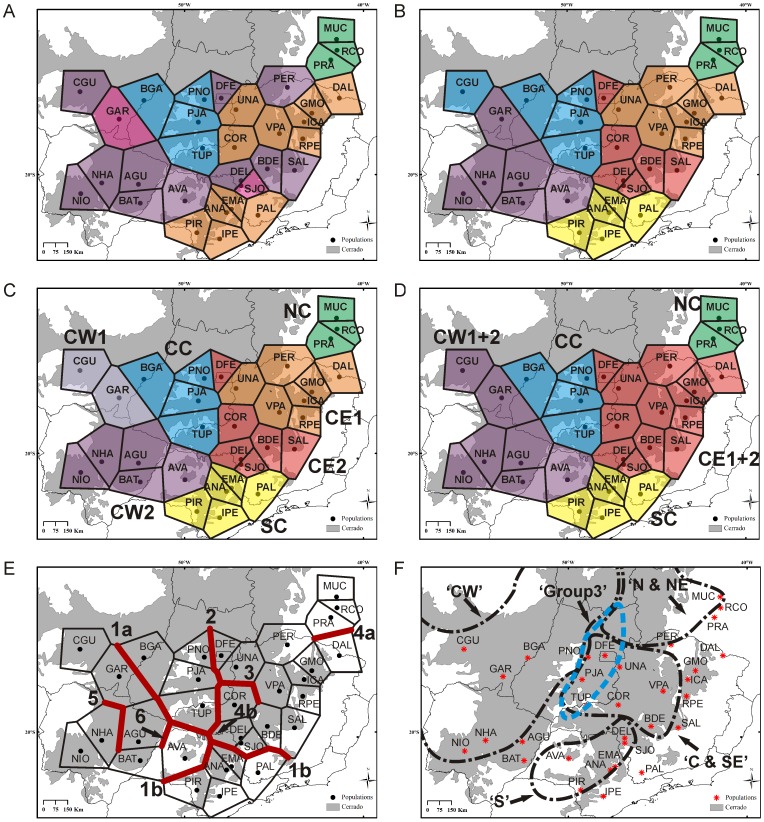
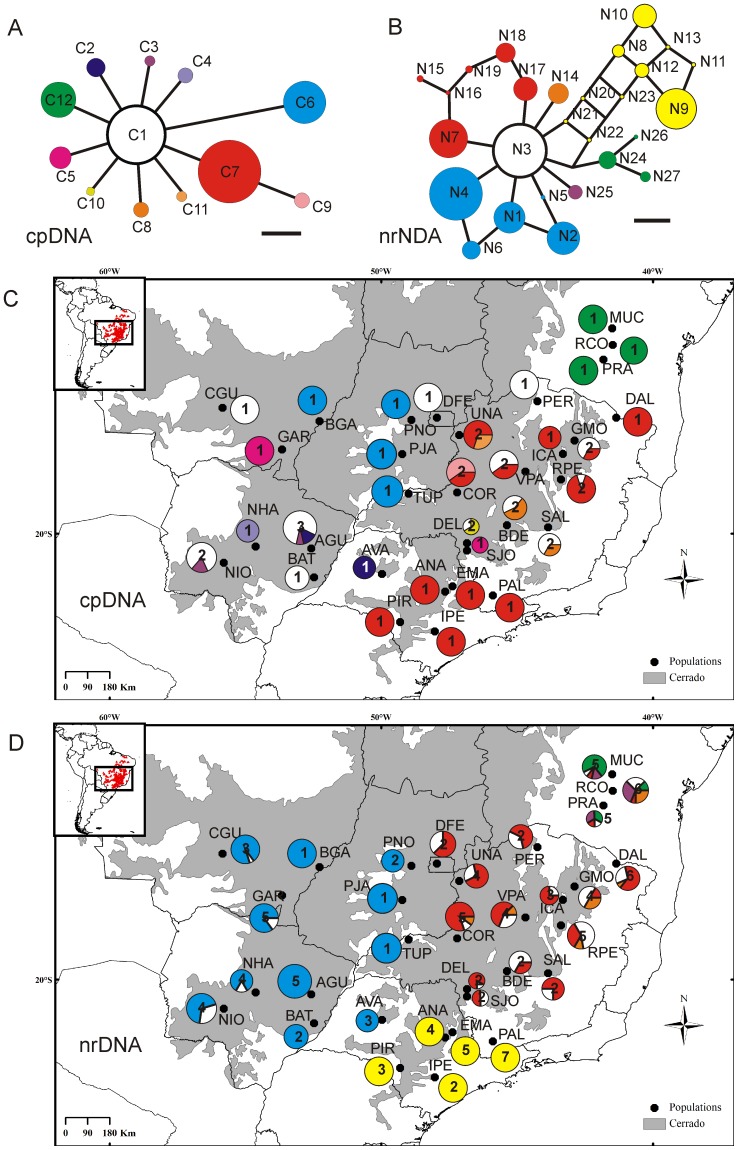
Few studies have addressed the phylogeography of species of the Cerrado, the largest savanna biome of South America. Here we aimed to investigate the phylogeographical structure of Dalbergia miscolobium, a widespread tree from the Cerrado, and to verify its concordance with plant phylogeographical and biogeographical patterns so far described. A total of 287 individuals from 32 populations were analyzed by sequencing the trnL intron of the chloroplast DNA and the internal transcribed spacer of the nuclear ribosomal DNA. Analysis of population structure and tests of population expansion were performed and the time of divergence of haplotypes was estimated. Twelve and 27 haplotypes were identified in the cpDNA and nrDNA data, respectively. The star-like network configuration and the mismatch distributions indicated a recent spatial and demographic expansion of the species. Consistent with previous tree phylogeographical studies of Cerrado trees, the cpDNA also suggested a recent expansion towards the southern Cerrado. The diversity of D. miscolobium was widespread but high levels of genetic diversity were found in the Central Eastern and in the southern portion of Central Western Cerrado. The combined analysis of cpDNA and nrDNA supported a phylogeographic structure into seven groups. The phylogeographical pattern showed many concordances with biogeographical and phylogeographical studies in the Cerrado, mainly with the Cerrado phytogeographic provinces superimposed to our sampling area. The data reinforced the uniqueness of Northeastern and Southeastern Cerrados and the differentiation between Eastern and Western Central Cerrados. The recent diversification of the species (estimated between the Pliocene and the Pleistocene) and the 'genealogical concordances' suggest that a shared and persistent pattern of species diversification might have been present in the Cerrado over time. This is the first time that an extensive 'genealogical concordance' between phylogeographic and phytogeographic patterns is shown for the Cerrado biome.
很少有研究涉及南美洲最大的稀树草原生物群落——塞拉多地区物种的系统地理学。在这里,我们旨在研究塞拉多地区一种广泛分布的树木——杂色黄檀的系统地理结构,并验证其与迄今所描述的植物系统地理和生物地理模式的一致性。通过对叶绿体DNA的trnL内含子和核糖体DNA的内部转录间隔区进行测序,分析了来自32个种群的287个个体。进行了种群结构分析和种群扩张测试,并估计了单倍型的分歧时间。在叶绿体DNA和核糖体DNA数据中分别鉴定出12个和27个单倍型。星状网络结构和失配分布表明该物种最近在空间和种群数量上有所扩张。与之前对塞拉多树木的系统地理学研究一致,叶绿体DNA也表明该物种最近向塞拉多南部扩张。杂色黄檀的多样性分布广泛,但在塞拉多中西部的中东部和南部发现了高水平的遗传多样性。叶绿体DNA和核糖体DNA的联合分析支持将系统地理结构分为七组。系统地理模式与塞拉多地区的生物地理和系统地理学研究有许多一致性,主要与叠加在我们采样区域的塞拉多植物地理省份一致。数据强化了东北和东南塞拉多的独特性以及中西部东西部之间的差异。该物种最近的多样化(估计在上新世和更新世之间)以及“谱系一致性”表明,随着时间的推移,塞拉多地区可能存在一种共同且持久的物种多样化模式。这是首次在塞拉多生物群落中展示系统地理模式和植物地理模式之间广泛的“谱系一致性”。