Buzatti Renata Santiago de Oliveira, Pfeilsticker Thais R, de Magalhães Rafael Félix, Bueno Marcelo L, Lemos-Filho José P, Lovato Maria B
Departamento de Biologia Geral, Instituto de Ciências Biológicas, Universidade Federal de Minas Gerais, Belo Horizonte, Brazil.
Programa de Pós-Graduação em Zoologia, Instituto de Ciências Biológicas, Universidade Federal de Minas Gerais, Belo Horizonte, Brazil.
Front Plant Sci. 2018 Jul 17;9:981. doi: 10.3389/fpls.2018.00981. eCollection 2018.
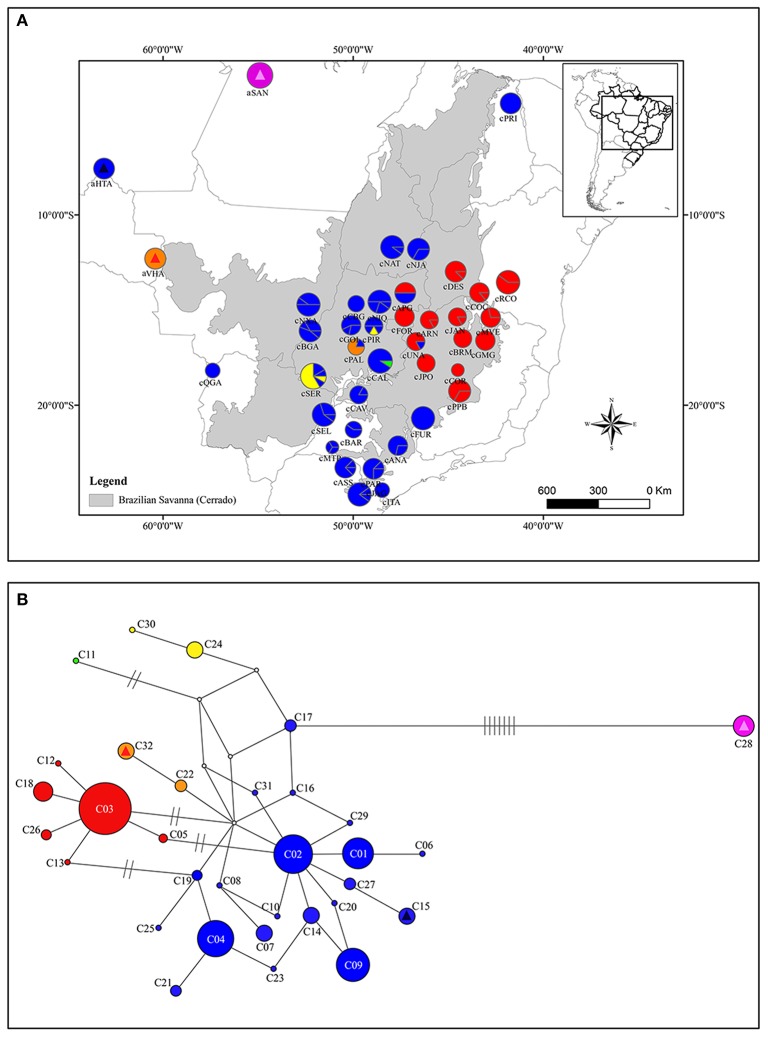
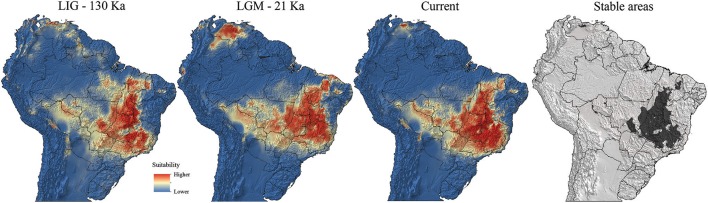
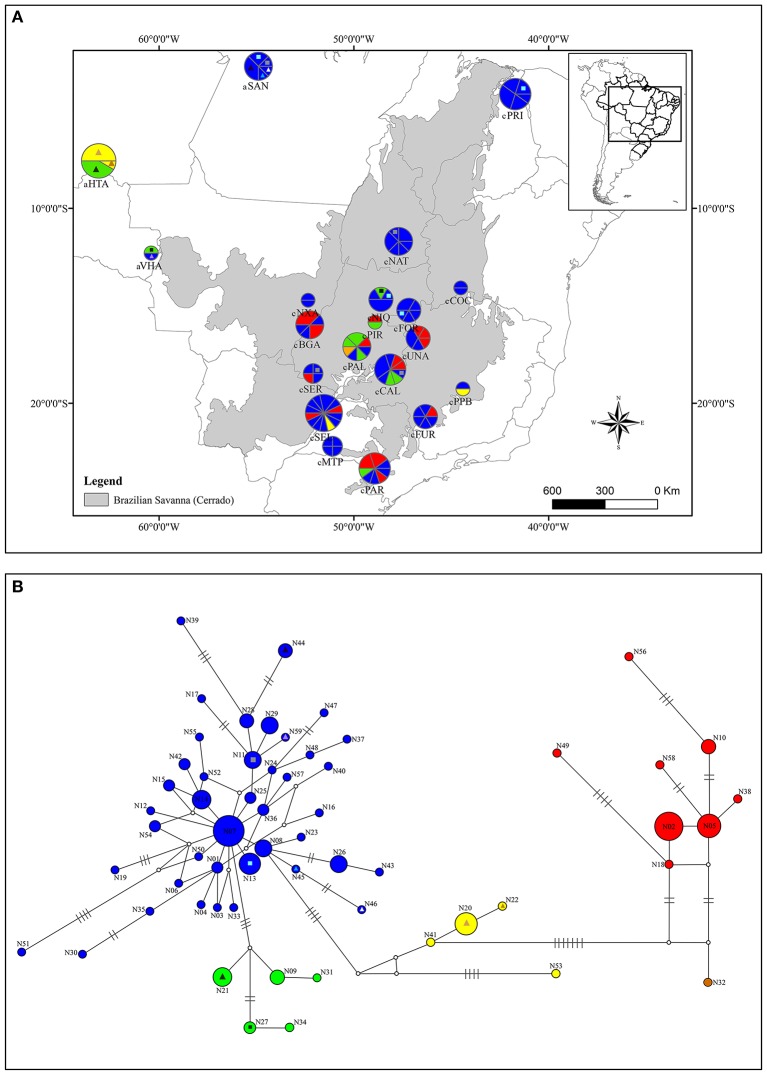
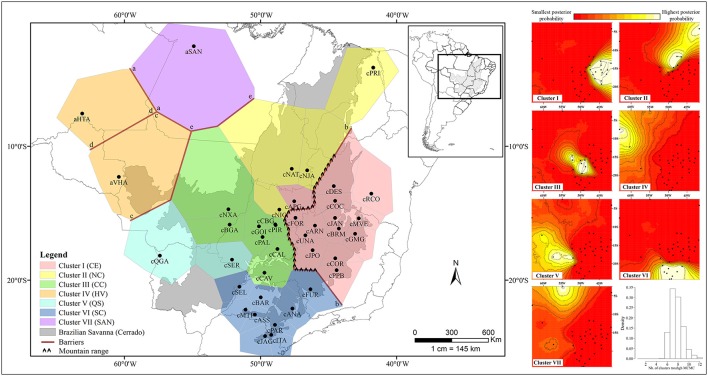
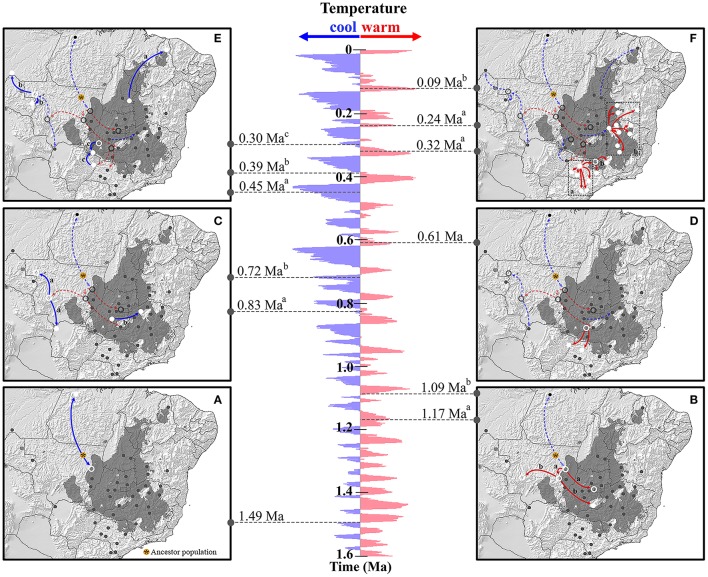
The evolutionary processes underlying the high diversity and endemism in the Cerrado, the most extensive Neotropical savanna, remain unclear, including the factors promoting the presence and evolution of savanna enclaves in the Amazon forest. In this study, we investigated the effects of past climate changes on genetic diversity, dynamics of species range and the historical connections between the savanna enclaves and Cerrado core for , a tree species widely distributed in the biome. Totally, 40 populations distributed in the Cerrado core and Amazon savannas were analyzed using chloroplast and nuclear DNA sequences. We used phylogeographic, coalescent and ecological niche modeling approaches. Genetic data revealed a phylogeographic structure shaped by Pleistocene climatic oscillations. An eastern-western split in the Cerrado core was observed. The central portion of the Cerrado core harbored most of the sampled diversity for cpDNA. Ecological niche models predicted the presence of a large historical refuge in this region and multiple small refuges in peripheral areas. Relaxed Random Walk (RRW) models indicated the ancestral population in the north-western border of the central portion of the Cerrado core and cyclical dynamics of colonization related to Pleistocene climatic oscillations. Central and western ancient connections between Cerrado core and Amazonian savannas were observed. No evidence of connections among the Amazonian savannas was detected. Our study highlights the importance of Pleistocene climatic oscillations for structuring the genetic diversity of and complex evolutionary history of ecotonal areas in the Cerrado. Our results do not support the recent replacement of a large area in the Amazon forest by savanna vegetation. The Amazonian savannas appear to be fragmented and isolated from each other, evolving independently a long ago.
新热带地区最广袤的稀树草原——塞拉多地区,其高度的生物多样性和特有性背后的进化过程仍不明晰,其中包括促使亚马逊森林中稀树草原飞地得以存在和进化的因素。在本研究中,我们调查了过去气候变化对一种广泛分布于该生物群落的树种——[树种名称未给出]的遗传多样性、物种分布范围动态以及稀树草原飞地与塞拉多核心区域之间历史联系的影响。总共对分布在塞拉多核心区域和亚马逊稀树草原的40个种群进行了叶绿体和核DNA序列分析。我们采用了系统发育地理学、溯祖理论和生态位建模方法。遗传数据揭示了由更新世气候振荡塑造的系统发育地理结构。在塞拉多核心区域观察到了东西部的分化。塞拉多核心区域的中部拥有叶绿体DNA样本中的大部分多样性。生态位模型预测该区域存在一个大型历史避难所,周边地区存在多个小型避难所。宽松随机游走(RRW)模型表明,塞拉多核心区域中部西北边界为祖先种群所在地,且与更新世气候振荡相关的殖民化呈现周期性动态。观察到塞拉多核心区域与亚马逊稀树草原之间存在中部和西部的古代联系。未检测到亚马逊稀树草原之间存在联系的证据。我们的研究强调了更新世气候振荡对于构建[树种名称未给出]的遗传多样性以及塞拉多生态交错区复杂进化历史的重要性。我们的结果不支持近期亚马逊森林的大片区域被稀树草原植被取代的观点。亚马逊稀树草原似乎彼此分散且相互隔离,很久以前就独立进化了。