Department of Vector Biology, Liverpool School of Tropical Medicine, Pembroke Place, Liverpool L3 5QA, UK.
Parasit Vectors. 2013 Dec 6;6:343. doi: 10.1186/1756-3305-6-343.
The emergence of pyrethroid resistance in the malaria vector, Anopheles arabiensis, threatens to undermine the considerable gains made towards eliminating malaria on Zanzibar. Previously, resistance was restricted to the island of Pemba while mosquitoes from Unguja, the larger of the two islands of Zanzibar, were susceptible. Here, we characterised the mechanism(s) responsible for resistance on Zanzibar using a combination of gene expression and target-site mutation assays.
WHO resistance bioassays were conducted using 1-5d old adult Anopheles gambiae s.l. collected between 2011 and 2013 across the archipelago. Synergist assays with the P450 inhibitor piperonyl-butoxide were performed in 2013. Members of the An. gambiae complex were PCR-identified and screened for target-site mutations (kdr and Ace-1). Gene expression in pyrethroid resistant An. arabiensis from Pemba was analysed using whole-genome microarrays.
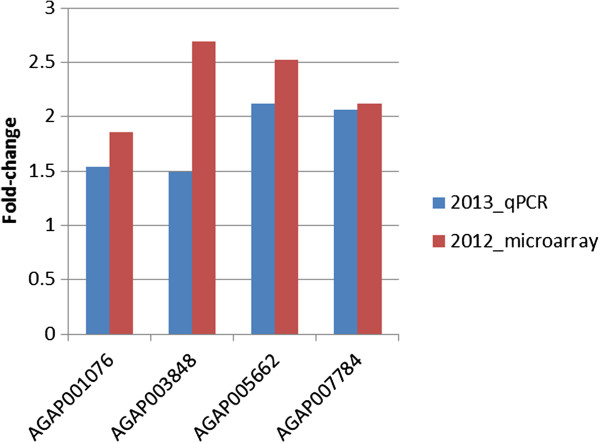
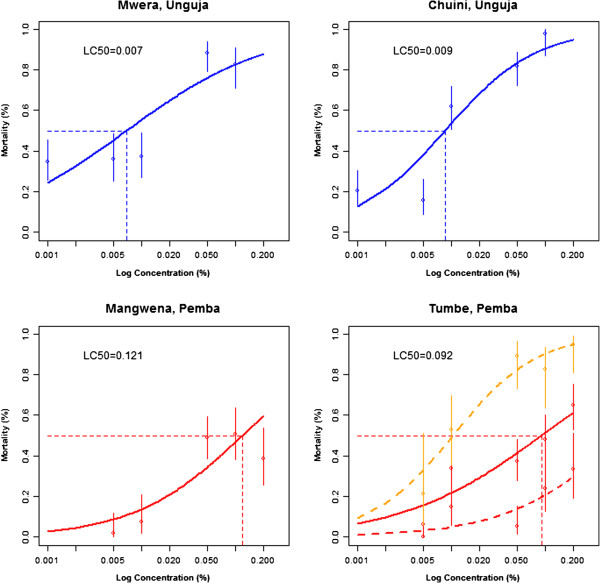
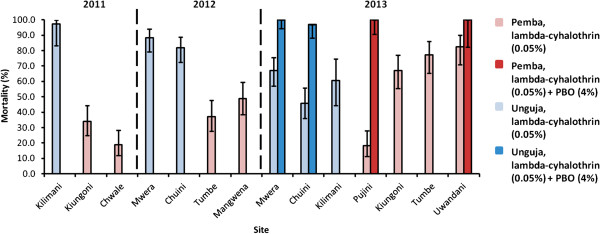
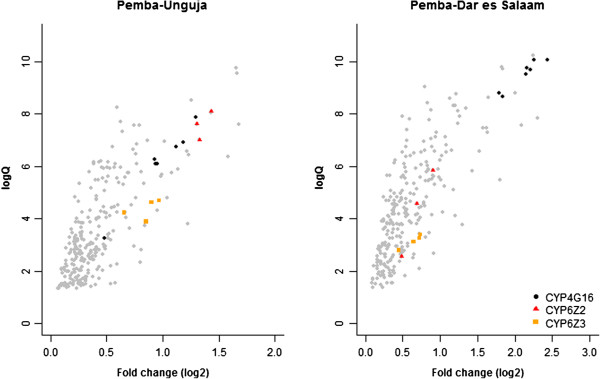
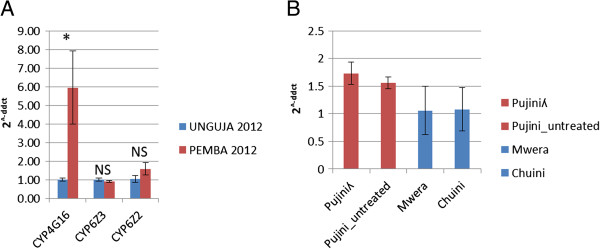
Pyrethroid resistance is now present across the entire Zanzibar archipelago. Survival to the pyrethroid lambda-cyhalothrin in bioassays conducted in 2013 was 23.5-54.3% on Unguja and 32.9-81.7% on Pemba. We present evidence that resistance is mediated, in part at least, by elevated P450 monoxygenases. Whole-genome microarray scans showed that the most enriched gene terms in resistant An. arabiensis from Pemba were associated with P450 activity and synergist assays with PBO completely restored susceptibility to pyrethroids in both islands. CYP4G16 was the most consistently over-expressed gene in resistant mosquitoes compared with two susceptible strains from Unguja and Dar es Salaam. Expression of this P450 is enriched in the abdomen and it is thought to play a role in hydrocarbon synthesis. Microarray and qPCR detected several additional genes putatively involved in this pathway enriched in the Pemba pyrethroid resistant population and we hypothesise that resistance may be, in part, related to alterations in the structure of the mosquito cuticle. None of the kdr target-site mutations, associated with pyrethroid/DDT resistance in An. gambiae elsewhere in Africa, were found on the islands.
The consequences of this resistance phenotype are discussed in relation to future vector control strategies on Zanzibar to support the ongoing malaria elimination efforts on the islands.
拟除虫菊酯在疟疾传播媒介按蚊中的抗药性的出现,威胁到了桑给巴尔岛在消除疟疾方面取得的巨大成果。此前,抗药性仅限于奔巴岛,而桑给巴尔岛较大的主岛——温古贾岛的蚊子则对此敏感。在这里,我们使用基因表达和靶标突变检测组合,对桑给巴尔岛的抗药性机制进行了描述。
使用 2011 年至 2013 年间采集的 1-5 龄期成年冈比亚按蚊按蚊 gambiae s.l.,进行了世界卫生组织抗药性生物测定。2013 年进行了与 P450 抑制剂增效醚的增效剂测定。采用 PCR 对冈比亚按蚊复合体进行鉴定,并对靶标突变(kdr 和 Ace-1)进行筛选。使用全基因组微阵列分析,对来自奔巴岛的抗拟除虫菊酯的按蚊 arabiensis 进行了基因表达分析。
目前,整个桑给巴尔群岛都存在拟除虫菊酯抗药性。2013 年进行的生物测定中,在温古贾岛和奔巴岛,用拟除虫菊酯 lambda-氯氰菊酯处理的存活率分别为 23.5-54.3%和 32.9-81.7%。我们提供的证据表明,抗性至少部分是由 P450 单加氧酶升高介导的。全基因组微阵列扫描显示,来自奔巴岛的抗药性按蚊 arabiensis 中最丰富的基因术语与 P450 活性相关,增效醚与 PBO 的协同作用完全恢复了两个岛屿对拟除虫菊酯的敏感性。与来自温古贾岛和达累斯萨拉姆的两种敏感性品系相比,CYP4G16 是在抗药性蚊子中表达最一致上调的基因。这种 P450 存在于腹部,被认为在碳氢化合物合成中发挥作用。微阵列和 qPCR 检测到在奔巴岛抗药性种群中富集的其他几个可能参与该途径的基因,并假设抗性可能部分与蚊子表皮结构的改变有关。在非洲其他地方与拟除虫菊酯/滴滴涕抗药性相关的 kdr 靶标突变均未在这些岛屿上发现。
讨论了这种抗药性表型对未来桑给巴尔岛病媒控制策略的影响,以支持这些岛屿正在进行的消除疟疾工作。