Center for Human Nutrition, University of Texas Southwestern Medical Center, Dallas, Texas.
Division of Endocrinology, University of Texas Southwestern Medical Center, Dallas, Texas.
Gastroenterology. 2014 Mar;146(3):726-35. doi: 10.1053/j.gastro.2013.11.049. Epub 2013 Dec 4.
BACKGROUND & AIMS: There have been few studies of the role of de novo lipogenesis in the development of nonalcoholic fatty liver disease (NAFLD). We used isotope analyses to compare de novo lipogenesis and fatty acid flux between subjects with NAFLD and those without, matched for metabolic factors (controls).
We studied subjects with metabolic syndrome and/or levels of alanine aminotransferase and aspartate aminotransferase >30 mU/L, using magnetic resonance spectroscopy to identify those with high levels (HighLF, n = 13) or low levels (LowLF, n = 11) of liver fat. Clinical and demographic information was collected from all participants, and insulin sensitivity was measured using the insulin-modified intravenous glucose tolerance test. Stable isotopes were administered and gas chromatography with mass spectrometry was used to analyze free (nonesterified) fatty acid (FFA) and triacylglycerol flux and lipogenesis.
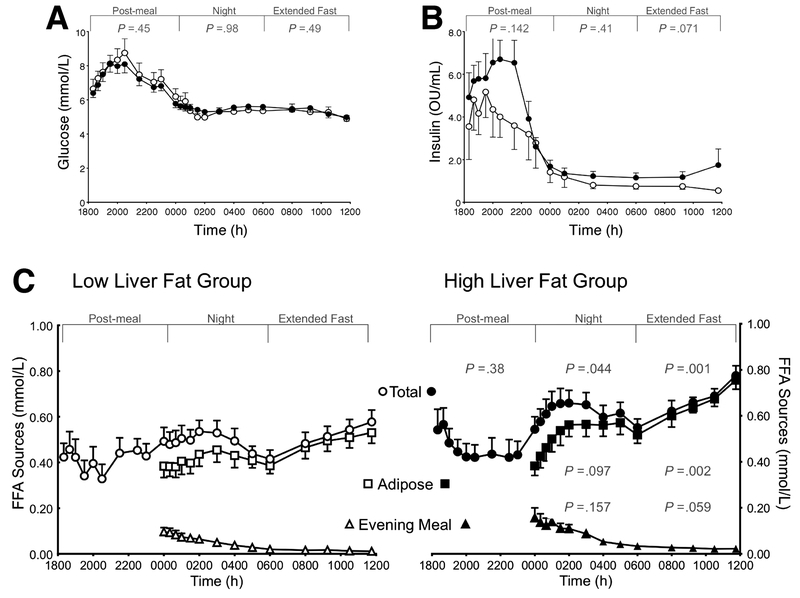
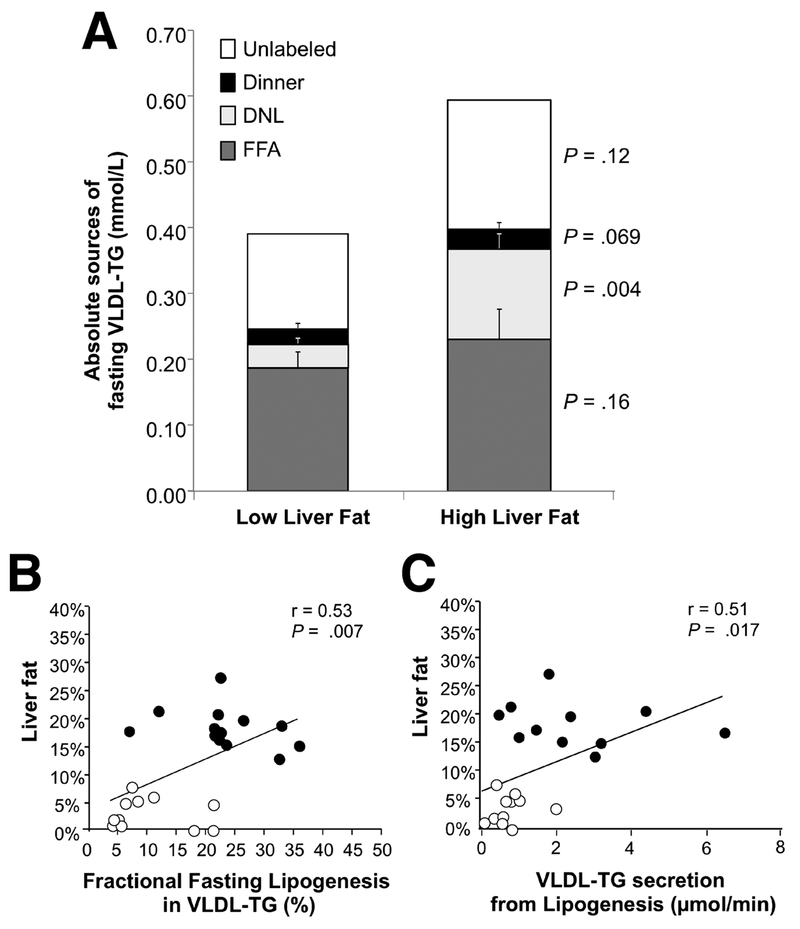
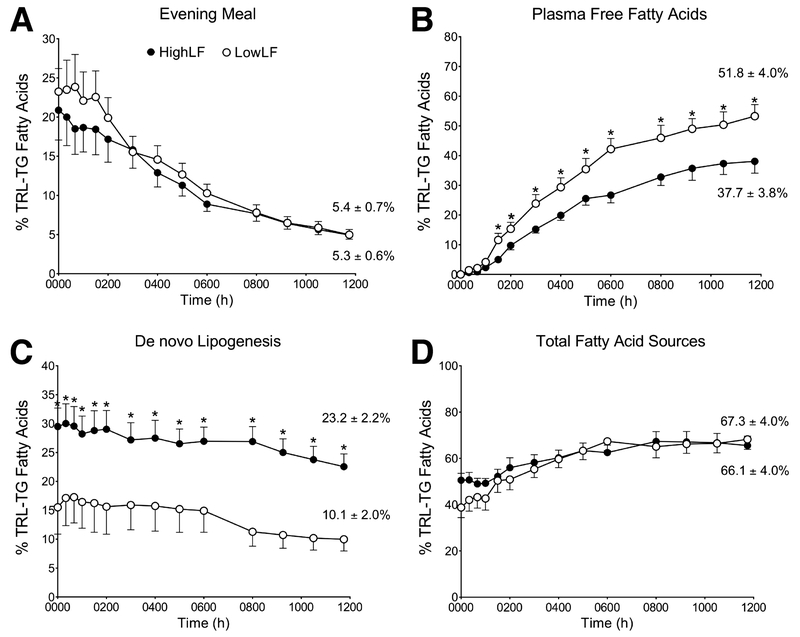
Subjects with HighLF (18.4% ± 3.6%) had higher plasma levels of FFAs during the nighttime and higher concentrations of insulin than subjects with LowLF (3.1% ± 2.7%; P = .04 and P < .001, respectively). No differences were observed between groups in adipose flux of FFAs (414 ± 195 μmol/min for HighLF vs 358 ± 105 μmol/min for LowLF; P = .41) or production of very-low-density lipoprotein triacylglycerol from FFAs (4.06 ± 2.57 μmol/min vs 4.34 ± 1.82 μmol/min; P = .77). In contrast, subjects with HighLF had more than 3-fold higher rates of de novo fatty acid synthesis than subjects with LowLF (2.57 ± 1.53 μmol/min vs 0.78 ± 0.42 μmol/min; P = .001). As a percentage of triacylglycerol palmitate, de novo lipogenesis was 2-fold higher in subjects with HighLF (23.2% ± 7.9% vs 10.1% ± 6.7%; P < .001); this level was independently associated with the level of intrahepatic triacylglycerol (r = 0.53; P = .007).
By administering isotopes to subjects with NAFLD and control subjects, we confirmed that those with NAFLD have increased synthesis of fatty acids. Subjects with NAFLD also had higher nocturnal plasma levels of FFAs and did not suppress the contribution from de novo lipogenesis on fasting. These findings indicate that lipogenesis might be a therapeutic target for NAFLD.
鲜有研究探讨从头合成脂肪在非酒精性脂肪性肝病(NAFLD)发展中的作用。我们使用同位素分析比较了 NAFLD 患者与匹配代谢因素(对照组)的患者之间的从头合成脂肪和脂肪酸流量。
我们使用磁共振波谱法鉴定出患有高(HighLF,n=13)或低(LowLF,n=11)肝脂肪水平的代谢综合征和/或丙氨酸氨基转移酶和天冬氨酸氨基转移酶水平>30 mU/L 的患者。从所有参与者收集临床和人口统计学信息,并使用胰岛素改良静脉葡萄糖耐量试验测量胰岛素敏感性。给予稳定同位素,使用气相色谱-质谱联用分析游离(非酯化)脂肪酸(FFA)和三酰甘油流量和从头合成脂肪。
HighLF(18.4%±3.6%)组夜间血浆 FFA 水平和胰岛素浓度均高于 LowLF(3.1%±2.7%;P=0.04 和 P<0.001)。两组之间 FFA 的脂肪通量(HighLF 为 414±195 μmol/min,LowLF 为 358±105 μmol/min;P=0.41)或 FFA 生成极低密度脂蛋白三酰甘油(HighLF 为 4.06±2.57 μmol/min,LowLF 为 4.34±1.82 μmol/min;P=0.77)无差异。相比之下,HighLF 组的脂肪酸从头合成率高于 LowLF 组(2.57±1.53 μmol/min vs 0.78±0.42 μmol/min;P=0.001),超过 3 倍。HighLF 组的三酰甘油棕榈酸的从头合成脂肪率为 2 倍(23.2%±7.9% vs 10.1%±6.7%;P<0.001);该水平与肝内三酰甘油水平独立相关(r=0.53;P=0.007)。
通过给 NAFLD 患者和对照受试者施用同位素,我们证实了 NAFLD 患者脂肪酸的合成增加。NAFLD 患者夜间血浆 FFA 水平也较高,并且不能抑制空腹时从头合成脂肪的贡献。这些发现表明,脂肪生成可能是治疗 NAFLD 的一个靶点。