Department of Pediatrics, Blood and Marrow Transplant, Medical School, University of Minnesota, Minneapolis, Minnesota, USA; Stem Cell Institute, University of Minnesota, Minneapolis, Minnesota, USA.
St John's Institute of Dermatology, King's College London (Guy's Campus), London, UK.
J Invest Dermatol. 2014 May;134(5):1246-1254. doi: 10.1038/jid.2013.523. Epub 2013 Dec 6.
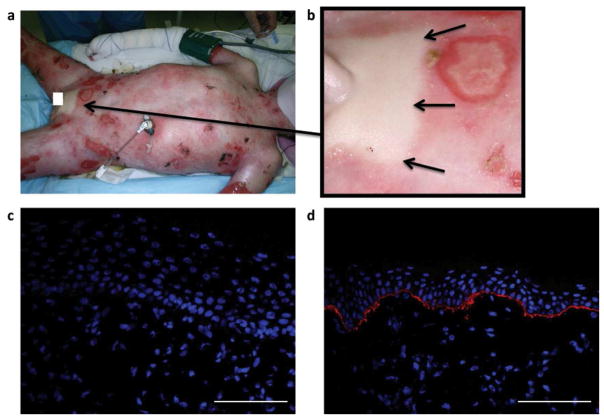
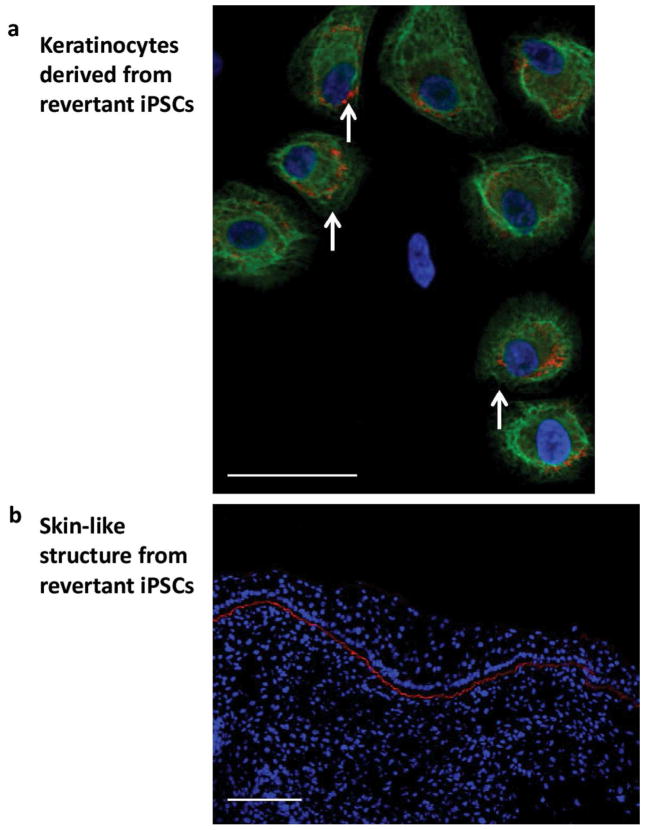
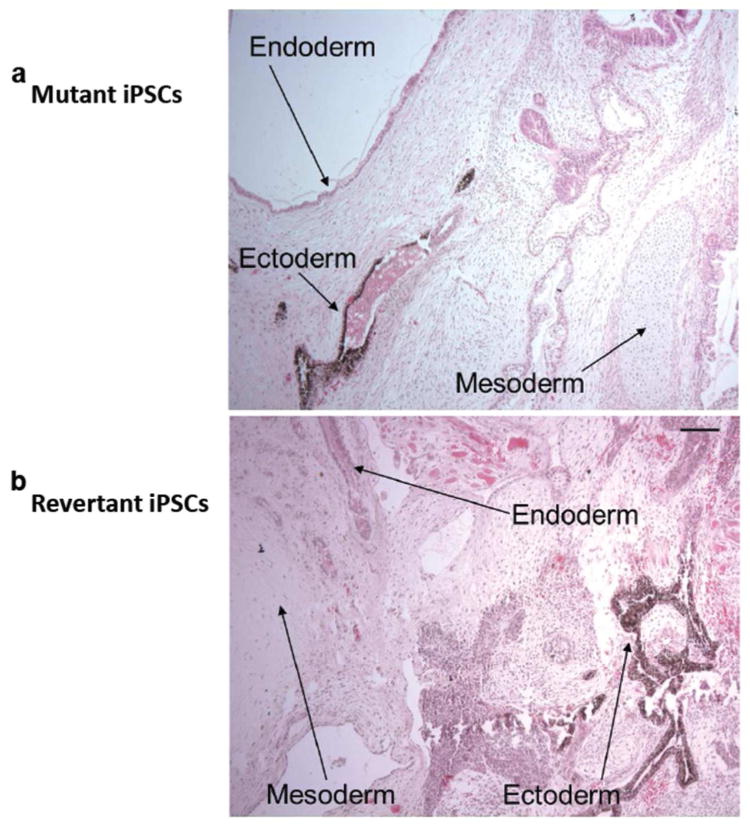
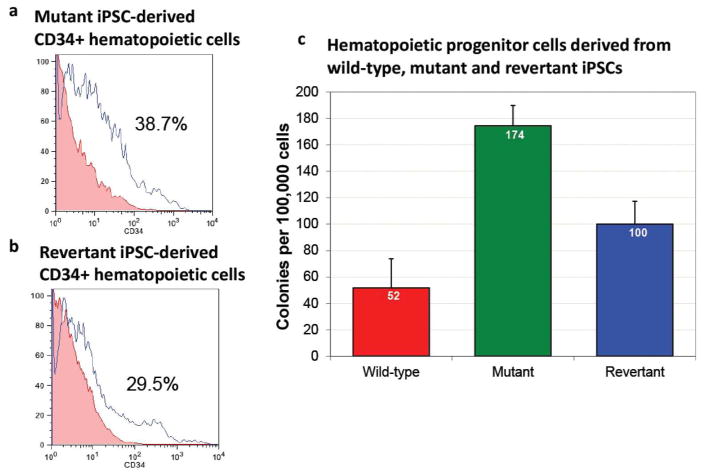
Spontaneous reversion of disease-causing mutations has been observed in some genetic disorders. In our clinical observations of severe generalized recessive dystrophic epidermolysis bullosa (RDEB), a currently incurable blistering genodermatosis caused by loss-of-function mutations in COL7A1 that results in a deficit of type VII collagen (C7), we have observed patches of healthy-appearing skin on some individuals. When biopsied, this skin revealed somatic mosaicism resulting in the self-correction of C7 deficiency. We believe this source of cells could represent an opportunity for translational 'natural' gene therapy. We show that revertant RDEB keratinocytes expressing functional C7 can be reprogrammed into induced pluripotent stem cells (iPSCs) and that self-corrected RDEB iPSCs can be induced to differentiate into either epidermal or hematopoietic cell populations. Our results give proof-of-principle that an inexhaustible supply of functional patient-specific revertant cells can be obtained--potentially relevant to local wound therapy and systemic hematopoietic cell transplantation. This technology may also avoid some of the major limitations of other cell therapy strategies, e.g., immune rejection and insertional mutagenesis, which are associated with viral- and nonviral-mediated gene therapy. We believe this approach should be the starting point for autologous cellular therapies using 'natural' gene therapy in RDEB and other diseases.
在一些遗传疾病中,已经观察到致病突变的自发逆转。在我们对严重的全身性隐性营养不良性大疱性表皮松解症(RDEB)的临床观察中,这是一种目前无法治愈的水疱性遗传性皮肤病,由 COL7A1 中的功能丧失突变引起,导致 VII 型胶原蛋白(C7)缺乏,我们观察到一些个体的皮肤出现健康斑块。活检时,这种皮肤显示出体细胞镶嵌现象,导致 C7 缺乏的自我纠正。我们认为这些细胞来源可能为转化“自然”基因治疗提供机会。我们表明,表达功能性 C7 的逆转 RDEB 角质形成细胞可以被重编程为诱导多能干细胞(iPSC),并且自我纠正的 RDEB iPSC 可以被诱导分化为表皮或造血细胞群体。我们的结果提供了原理验证,即可以获得功能齐全的患者特异性逆转细胞的无尽供应——这可能与局部伤口治疗和全身造血细胞移植有关。该技术还可能避免其他细胞治疗策略的一些主要限制,例如与病毒和非病毒介导的基因治疗相关的免疫排斥和插入突变。我们认为,在 RDEB 和其他疾病中,这种方法应该是使用“自然”基因治疗进行自体细胞治疗的起点。