Center for iPS Cell Research and Application (CiRA), Kyoto University, Kyoto 606-8507, Japan.
Stem Cell Reports. 2013 Sep 26;1(4):283-92. doi: 10.1016/j.stemcr.2013.08.007. eCollection 2013.
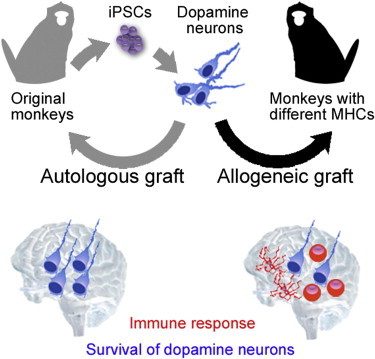
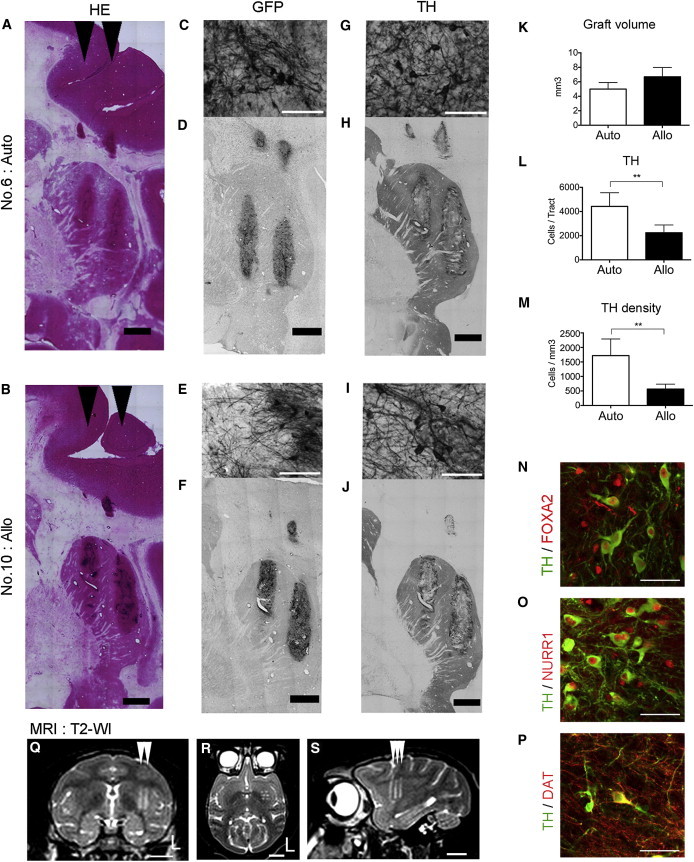
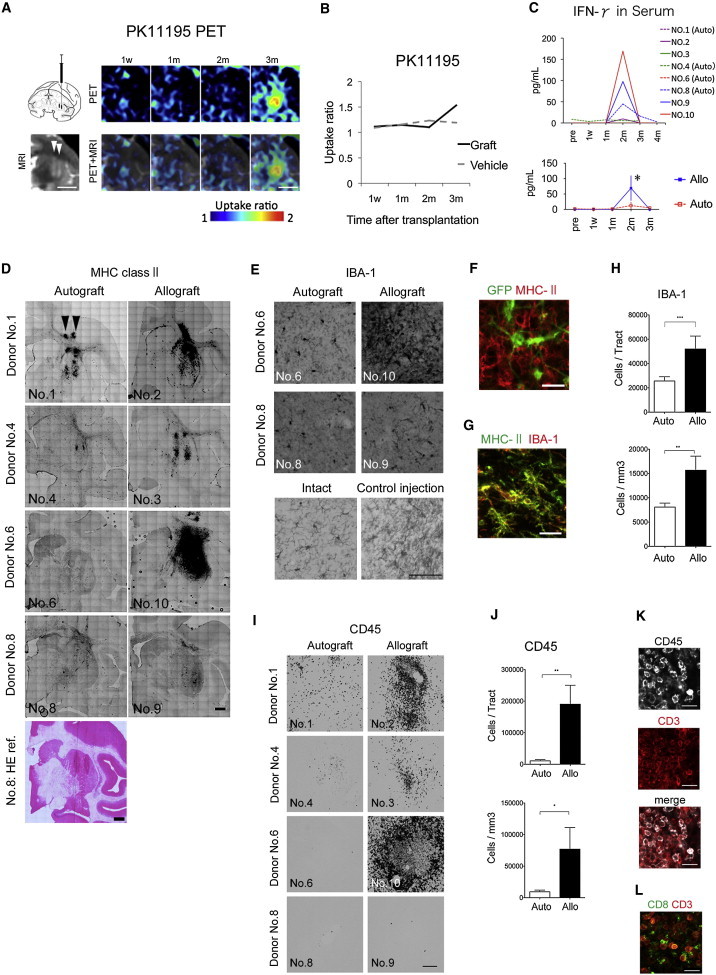
Induced pluripotent stem cells (iPSCs) provide the potential for autologous transplantation using cells derived from a patient's own cells. However, the immunogenicity of iPSCs or their derivatives has been a matter of controversy, and up to now there has been no direct comparison of autologous and allogeneic transplantation in the brains of humans or nonhuman primates. Here, using nonhuman primates, we found that the autologous transplantation of iPSC-derived neurons elicited only a minimal immune response in the brain. In contrast, the allografts caused an acquired immune response with the activation of microglia (IBA-1(+)/MHC class II(+)) and the infiltration of leukocytes (CD45(+)/CD3(+)). Consequently, a higher number of dopaminergic neurons survived in the autografts. Our results suggest that the autologous transplantation of iPSC-derived neural cells is advantageous for minimizing the immune response in the brain compared with allogeneic grafts.
诱导多能干细胞(iPSCs)为使用患者自身细胞衍生的细胞进行自体移植提供了可能。然而,iPSCs 或其衍生物的免疫原性一直存在争议,到目前为止,还没有在人类或非人类灵长类动物的大脑中对自体和同种异体移植进行直接比较。在这里,我们使用非人类灵长类动物发现,iPSC 衍生神经元的自体移植仅在大脑中引起最小的免疫反应。相比之下,同种异体移植物引起获得性免疫反应,小胶质细胞(IBA-1(+)/MHC Ⅱ类(+))激活和白细胞浸润(CD45(+)/CD3(+))。因此,自体移植物中存活的多巴胺能神经元数量更多。我们的结果表明,与同种异体移植物相比,iPSC 衍生神经细胞的自体移植有利于最大限度地减少大脑中的免疫反应。