Saul R. Korey Department of Neurology, Albert Einstein College of Medicine, Bronx, New York, U.S.A; Laboratory of Developmental Epilepsy and Dominick P. Purpura Department of Neuroscience, Albert Einstein College of Medicine, Bronx, New York, U.S.A.
Epilepsia. 2014 Jan;55(1):94-102. doi: 10.1111/epi.12424. Epub 2013 Oct 28.
Infantile spasms (IS) have poor outcomes and limited treatment options, including vigabatrin, a γ-aminobutyric acid (GABA) aminotransferase inactivator. Vigabatrin has been associated with retinal toxicity. A high affinity vigabatrin analogue (CPP-115; Catalyst Pharmaceutical Partners, Inc., Coral Gables, FL, U.S.A.) has shown lower risk of retinal toxicity. Here, we test the efficacy of CPP-115 in reducing spasms and its tolerability in the multiple-hit rat model of IS, in which daily vigabatrin reduced spasms for only one day, but was not well tolerated.
Male rats were treated with the protocol of the multiple-hit model of IS on postnatal day 3 (PN3). Using a randomized, blinded, vehicle-controlled, dose-response study design, CPP-115 (0.1, 1, or 5 mg/kg intraperitoneally [i.p.]) or vehicle was given daily (PN4-12) or as a single injection (PN7) after spasm onset. Intermittent video- or video-electroencephalography (EEG) monitoring was done. Secondary end points included the following: daily weights, survival, performance on open field activity, surface righting time, and negative geotaxis (PN3-20), horizontal bar (PN13-20), and Barnes maze (PN16-19). Statistics used a linear mixed model of raw or normalized log-transformed data, taking into account the repeated observations on each animal.
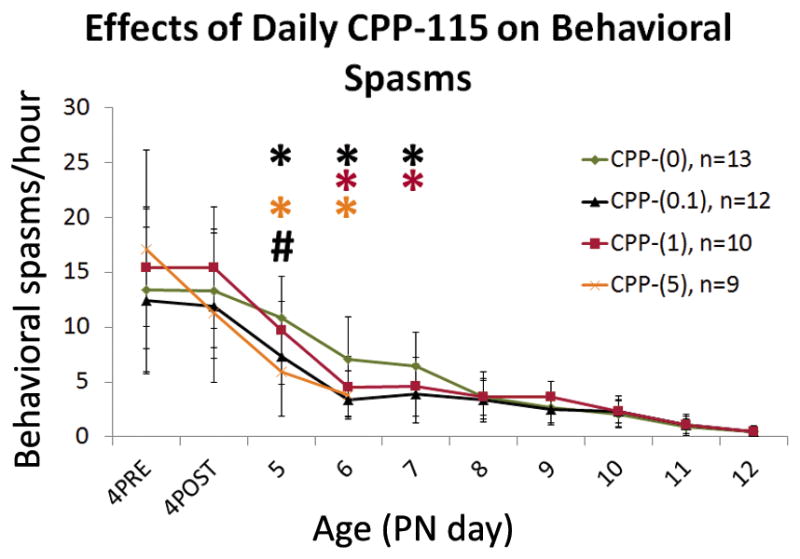
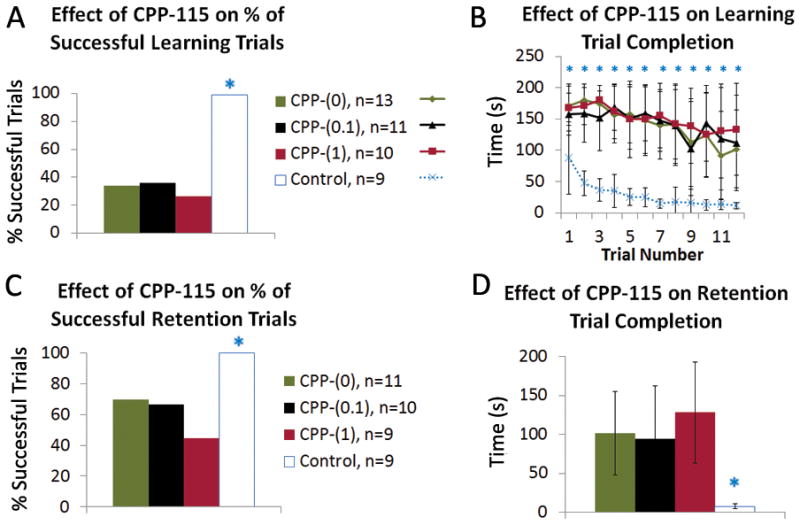
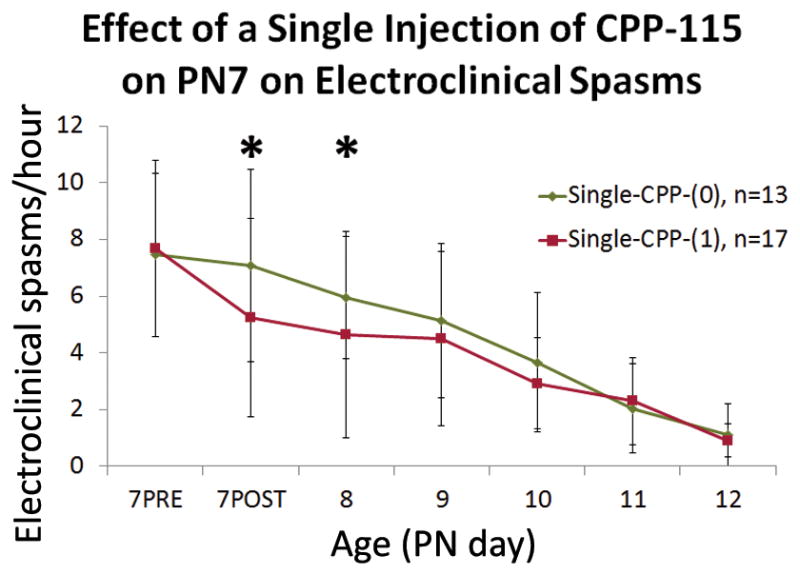
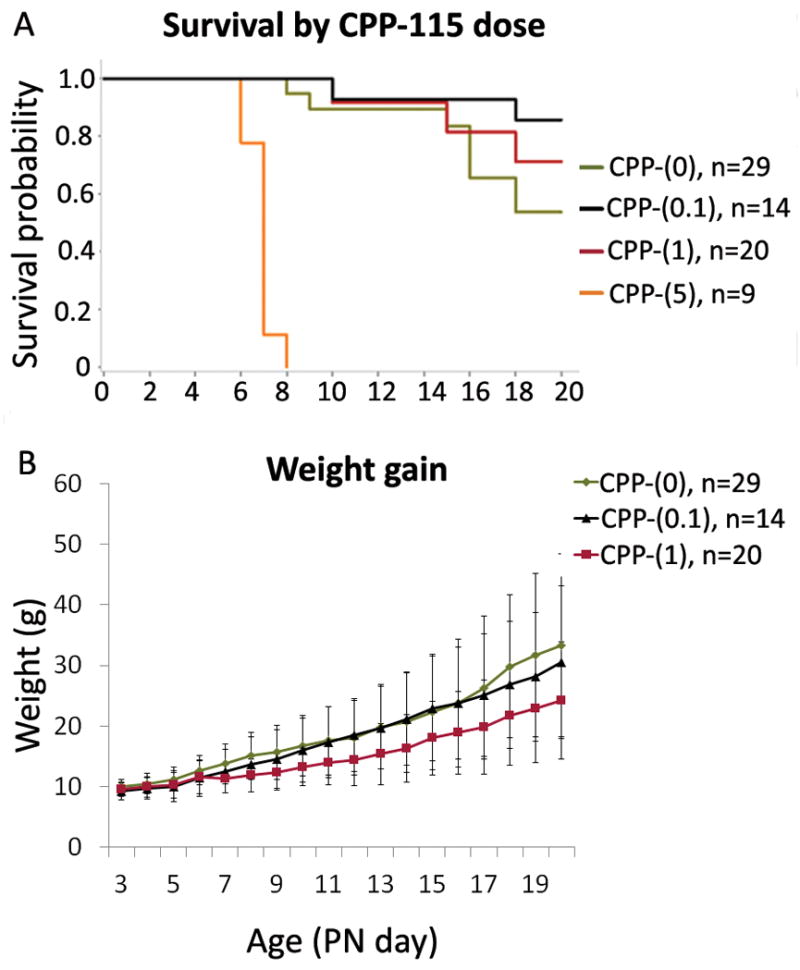
The lower CPP-115 doses (0.1-1 mg/kg/day, PN4-12) reduced spasms between PN6 and 7 without increasing mortality. CPP-115 at 5 mg/kg/day (PN4-12) reduced spasms earlier (PN5), but was eventually lethal. A single CPP-115 injection (1 mg/kg, i.p.) decreased electroclinical spasms acutely but transiently. CPP-115 transiently improved the probability to >50% reduction of spasms, but did not accelerate spasm cessation. CPP-115 did not alter neurodevelopmental outcomes or visuospatial learning.
We provide proof-of-concept evidence that CPP-115, a vigabatrin analogue, decreases spasms in the multiple-hit rat model of IS at considerably lower and better tolerated doses than vigabatrin did in our previous studies. Further optimization of the treatment protocol is needed. CPP-115 may be a promising new candidate treatment for IS with better tolerability than vigabatrin.
婴儿痉挛症(IS)的预后较差,治疗选择有限,包括 GABA 转氨酶抑制剂氨己烯酸。氨己烯酸与视网膜毒性有关。一种高亲和力的氨己烯酸类似物(CPP-115;Catalyst Pharmaceutical Partners,Inc.,美国佛罗里达州珊瑚阁)显示出较低的视网膜毒性风险。在这里,我们测试 CPP-115 降低痉挛的疗效及其在 IS 多打击大鼠模型中的耐受性,其中每日氨己烯酸仅能减少一天的痉挛,但耐受性不佳。
雄性大鼠于生后第 3 天(PN3)接受 IS 多打击模型的方案治疗。采用随机、盲法、对照、剂量反应研究设计,CPP-115(0.1、1 或 5mg/kg 腹腔内 [i.p.])或载体在痉挛发作后每日(PN4-12)或单次注射(PN7)给予。间歇性视频或视频脑电图(EEG)监测。次要终点包括以下内容:每日体重、存活、旷场活动、表面翻正时间和负趋地性(PN3-20)、横杆(PN13-20)和 Barnes 迷宫(PN16-19)的表现。统计分析采用原始或对数转换后数据的线性混合模型,考虑到每个动物的重复观察。
较低剂量的 CPP-115(0.1-1mg/kg/天,PN4-12)减少了 PN6 至 7 之间的痉挛,而不增加死亡率。CPP-115 (5mg/kg/天,PN4-12)更早地减少痉挛(PN5),但最终是致命的。单次 CPP-115 注射(1mg/kg,i.p.)可迅速但短暂地降低临床电痉挛。CPP-115 短暂地增加痉挛减少 50%以上的可能性,但不会加速痉挛停止。CPP-115 并未改变神经发育结局或视觉空间学习。
我们提供了概念验证证据,表明 CPP-115(一种氨己烯酸类似物)在 IS 的多打击大鼠模型中以比我们之前研究中的氨己烯酸低得多且更好耐受的剂量降低痉挛。需要进一步优化治疗方案。CPP-115 可能是一种有前途的新候选治疗方法,其耐受性优于氨己烯酸。