Neuroscience Department, Meyer Children's Hospital, Florence, Italy.
University of Florence, Florence, Italy.
Physiol Rev. 2023 Jan 1;103(1):433-513. doi: 10.1152/physrev.00063.2021. Epub 2022 Aug 11.
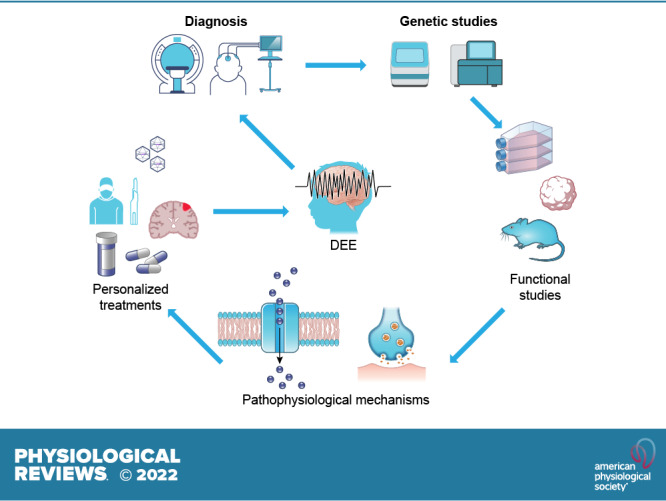
Developmental and epileptic encephalopathies (DEEs) are a heterogeneous group of disorders characterized by early-onset, often severe epileptic seizures and EEG abnormalities on a background of developmental impairment that tends to worsen as a consequence of epilepsy. DEEs may result from both nongenetic and genetic etiologies. Genetic DEEs have been associated with mutations in many genes involved in different functions including cell migration, proliferation, and organization, neuronal excitability, and synapse transmission and plasticity. Functional studies performed in different animal models and clinical trials on patients have contributed to elucidate pathophysiological mechanisms underlying many DEEs and have explored the efficacy of different treatments. Here, we provide an extensive review of the phenotypic spectrum included in the DEEs and of the genetic determinants and pathophysiological mechanisms underlying these conditions. We also provide a brief overview of the most effective treatment now available and of the emerging therapeutic approaches.
发育性和癫痫性脑病(DEEs)是一组异质性疾病,其特征为早期发病、常伴有严重的癫痫发作和脑电图异常,且伴有发育障碍,这种障碍会因癫痫而恶化。DEEs 可能由遗传和非遗传病因引起。许多参与不同功能的基因的突变与遗传性 DEEs 有关,包括细胞迁移、增殖和组织、神经元兴奋性以及突触传递和可塑性。在不同的动物模型和临床试验中进行的功能研究有助于阐明许多 DEEs 的病理生理机制,并探索了不同治疗方法的疗效。在这里,我们广泛回顾了 DEEs 的表型谱以及这些疾病的遗传决定因素和病理生理机制。我们还简要概述了目前最有效的治疗方法和新兴的治疗方法。