Department of Physiology and Medical Physics, Royal College of Surgeons in Ireland Dublin, Ireland ; Centre for the Study of Neurological Disorders, Royal College of Surgeons in Ireland Dublin, Ireland.
Front Cell Neurosci. 2013 Nov 26;7:237. doi: 10.3389/fncel.2013.00237.
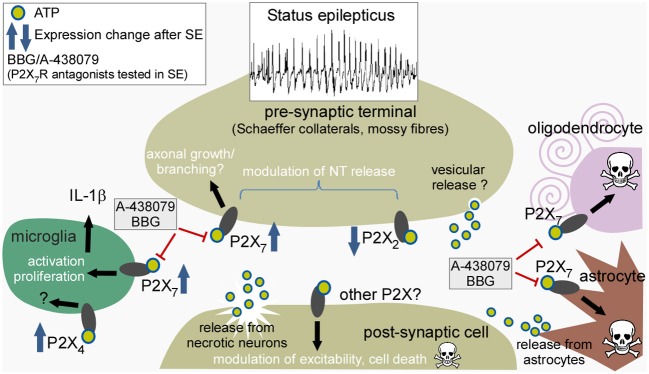
Prolonged seizures are amongst the most common neurological emergencies. Status epilepticus is a state of continuous seizures that is life-threatening and prompt termination of status epilepticus is critical to protect the brain from permanent damage. Frontline treatment comprises parenteral administration of anticonvulsants such as lorazepam that facilitate γ-amino butyric acid (GABA) transmission. Because status epilepticus can become refractory to anticonvulsants in a significant proportion of patients, drugs which act on different neurotransmitter systems may represent potential adjunctive treatments. P2X receptors are a class of ligand-gated ion channel activated by ATP that contributes to neuro- and glio-transmission. P2X receptors are expressed by both neurons and glia in various brain regions, including the hippocampus. Electrophysiology, pharmacology and genetic studies suggest certain P2X receptors are activated during pathologic brain activity. Expression of several members of the family including P2X2, P2X4, and P2X7 receptors has been reported to be altered in the hippocampus following status epilepticus. Recent studies have shown that ligands of the P2X7 receptor can have potent effects on seizure severity during status epilepticus and mice lacking this receptor display altered seizures in response to chemoconvulsants. Antagonists of the P2X7 receptor also modulate neuronal death, microglial responses and neuroinflammatory signaling. Recent work also found altered neuronal injury and inflammation after status epilepticus in mice lacking the P2X4 receptor. In summary, members of the P2X receptor family may serve important roles in the pathophysiology of status epilepticus and represent novel targets for seizure control and neuroprotection.
持续性癫痫发作是最常见的神经急症之一。癫痫持续状态是一种持续癫痫发作的状态,具有生命威胁性,迅速终止癫痫持续状态对于保护大脑免受永久性损伤至关重要。一线治疗包括静脉给予抗惊厥药物,如劳拉西泮,以促进γ-氨基丁酸(GABA)传递。由于在相当一部分患者中,癫痫持续状态可能对抗惊厥药物产生抗药性,因此作用于不同神经递质系统的药物可能代表潜在的辅助治疗方法。P2X 受体是一类由 ATP 激活的配体门控离子通道,有助于神经和神经胶质传递。P2X 受体在包括海马体在内的各种脑区的神经元和神经胶质中表达。电生理学、药理学和遗传学研究表明,在病理性脑活动期间,某些 P2X 受体被激活。在癫痫持续状态后,海马体中已经报道了包括 P2X2、P2X4 和 P2X7 受体在内的几个家族成员的表达发生改变。最近的研究表明,P2X7 受体的配体在癫痫持续状态期间对癫痫发作的严重程度具有强大的影响,并且缺乏该受体的小鼠在对化学惊厥剂的反应中表现出改变的癫痫发作。P2X7 受体拮抗剂还调节神经元死亡、小胶质细胞反应和神经炎症信号。最近的工作还发现,在缺乏 P2X4 受体的小鼠中,癫痫持续状态后神经元损伤和炎症发生改变。总之,P2X 受体家族的成员可能在癫痫持续状态的病理生理学中发挥重要作用,是控制癫痫发作和神经保护的新靶点。