Nee Derek Evan, Jonides John
Helen Wills Neuroscience Institute, University of California Berkeley, CA, USA.
Front Hum Neurosci. 2013 Nov 26;7:796. doi: 10.3389/fnhum.2013.00796.
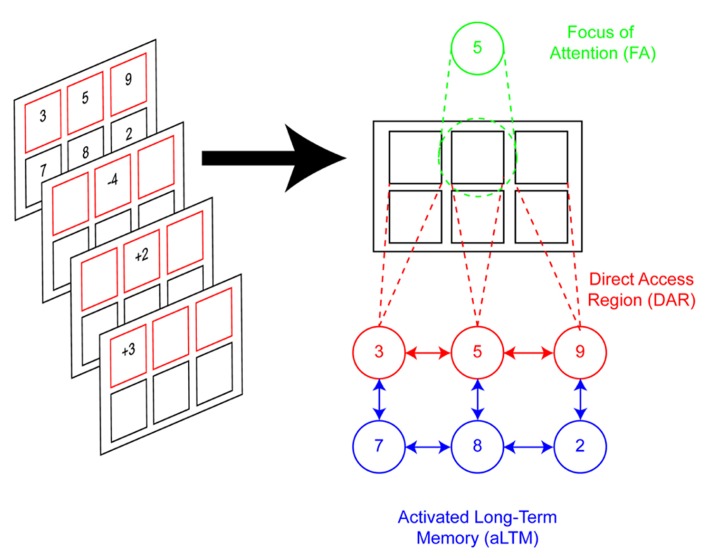
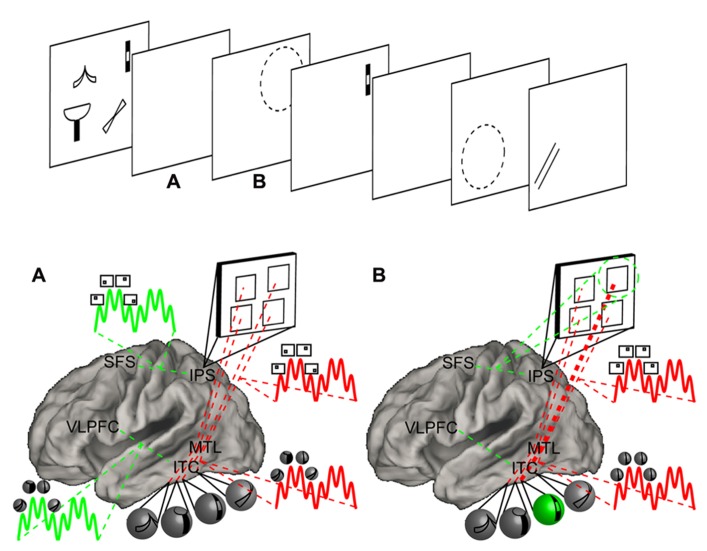
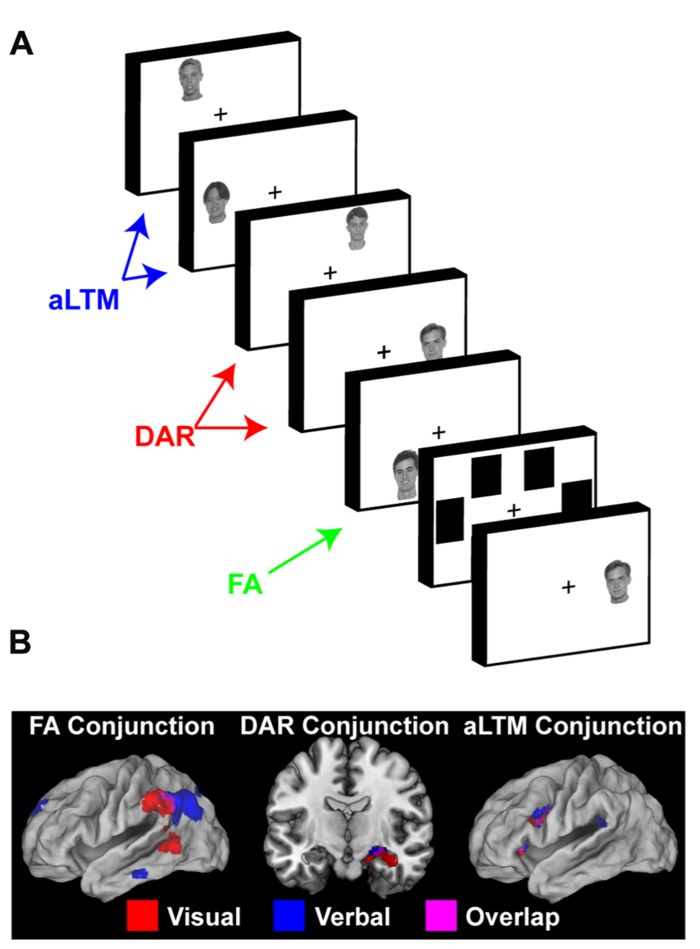
The ability to hold information briefly in mind in the absence of external stimulation forms the core of much of higher-order cognition. This ability is referred to as short-term memory (STM). However, single-term labels such as this belie the complexity of the underlying construct. Here, we review evidence that STM is an amalgamation of three qualitatively distinct states. We argue that these distinct states emerge from the combination of frontal selection mechanisms (often considered the domain of attention and cognitive control), medial temporal binding mechanisms (often considered the domain of long-term memory, LTM), and synaptic plasticity. These various contributions lead to a single representation amenable to elaborated processing (focus of attention), a limited set of active representations among which attention can be flexibly switched (direct-access region), and passive representations whose residual traces facilitate re-activation (activated LTM). We suggest that selection and binding mechanisms are typically engaged simultaneously, providing multiple forms and routes of short-term maintenance. We propose that such a framework can resolve discrepancies among recent studies that have attempted to understand the relationship between attention and STM on the one hand, and between LTM and STM on the other. We anticipate that recent advances in neuroimaging and neurophysiology will elucidate the mechanisms underlying shifts and transformations among these representational states, providing a window into the dynamic processes of higher-order cognition.
在没有外部刺激的情况下将信息短暂地记在脑海中的能力构成了许多高阶认知的核心。这种能力被称为短期记忆(STM)。然而,这样的单一术语标签掩盖了潜在结构的复杂性。在这里,我们回顾了证据表明STM是三种性质不同的状态的融合。我们认为,这些不同的状态源于额叶选择机制(通常被认为是注意力和认知控制的领域)、内侧颞叶绑定机制(通常被认为是长期记忆,LTM的领域)和突触可塑性的结合。这些不同的贡献导致了一个适合精细加工的单一表征(注意力焦点)、一组有限的活跃表征,注意力可以在其中灵活切换(直接访问区域),以及被动表征,其残留痕迹有助于重新激活(激活的LTM)。我们认为选择和绑定机制通常同时参与,提供了多种形式和短期维持的途径。我们提出这样一个框架可以解决最近试图理解一方面注意力与STM之间,另一方面LTM与STM之间关系的研究中的差异。我们预计神经成像和神经生理学的最新进展将阐明这些表征状态之间转换和转变的潜在机制,为高阶认知的动态过程提供一个窗口。