Lou Jiatao, Ben Suqin, Yang Guohua, Liang Xiaohui, Wang Xiaoqian, Ni Songshi, Han Baohui
Department of Clinical Laboratory, Shanghai Chest Hospital Affiliated to Shanghai Jiao Tong University, Shanghai, China.
PLoS One. 2013 Dec 6;8(12):e80458. doi: 10.1371/journal.pone.0080458. eCollection 2013.
Quantification of circulating tumor cells (CTC) is valuable for evaluation of non-small cell lung cancer (NSCLC). The sensitivity of current methods constrains their use to detect rare CTCs in early stage. Here we evaluate a novel method, ligand-targeted polymerase chain reaction (LT-PCR), that can detect rare CTCs in NSCLC patients.
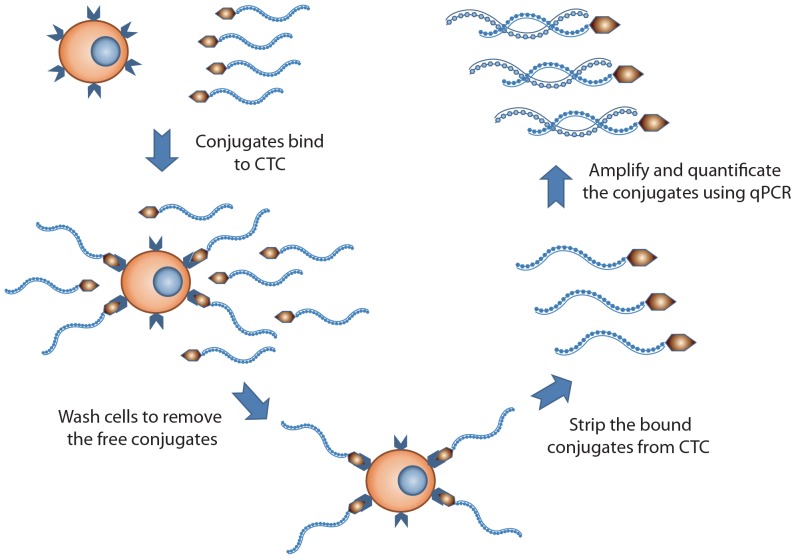
CTCs were enriched by immunomagnetic depletion of leukocytes and then labeled by a conjugate of a tumor-specific ligand and an oligonucleotide. After washing off free conjugates, the bound conjugates were stripped from CTCs and then analyzed by qPCR. To evaluate the clinical utility, blood samples were obtained from 72 NSCLC patients (33 initially diagnosed and 39 on chemotherapy), 20 benign patients, and 24 healthy donors.
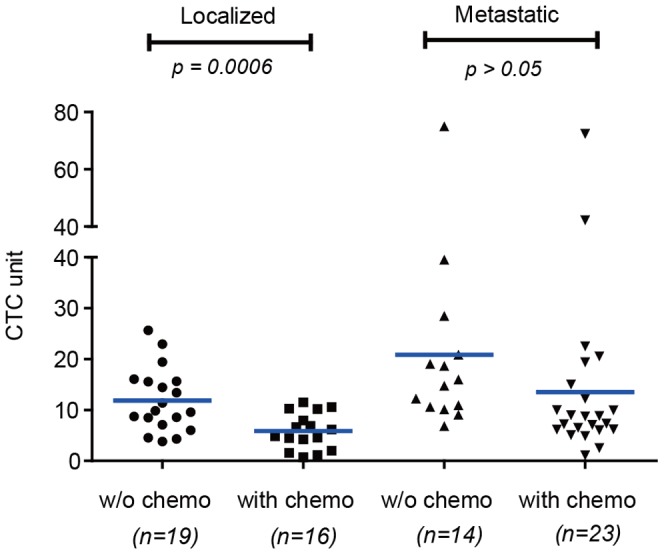
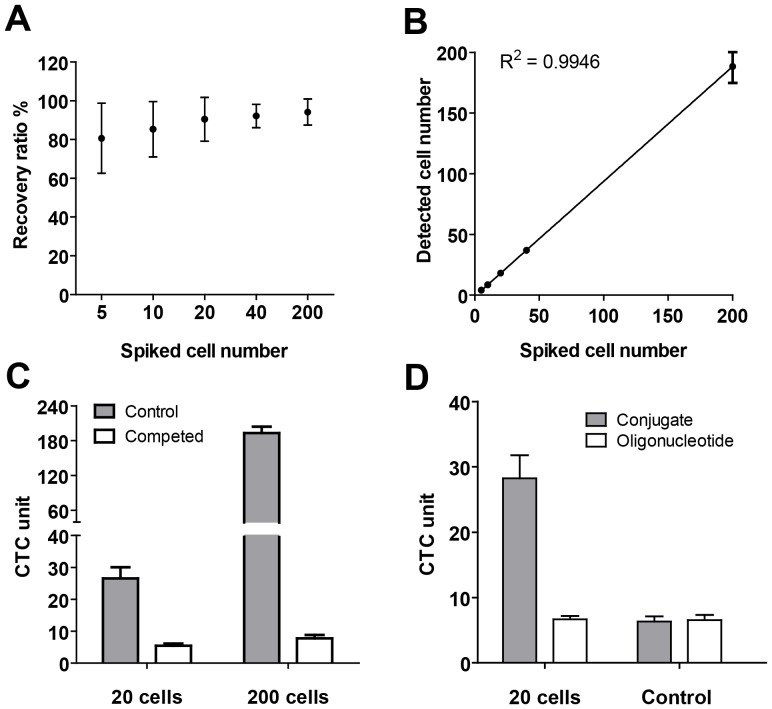
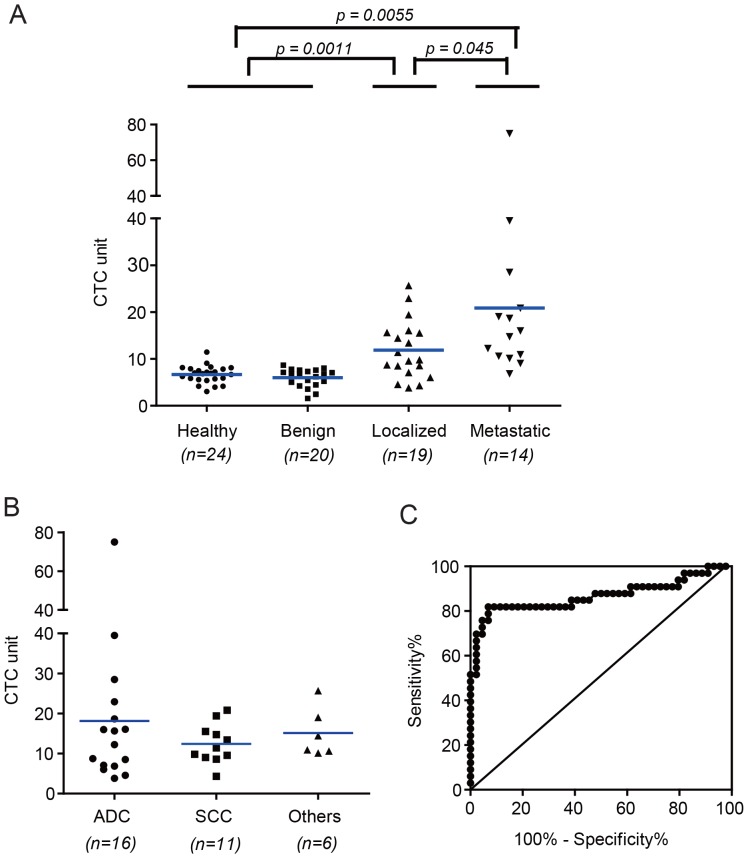
Experiments with healthy blood spiked with tumor cells indicated the LT-PCR allows specific detection of CTC. The clinical study showed that the initially diagnosed patients have an average of 20.8 CTC units with metastatic diseases, 11.8 CTC units with localized diseases, and 6.0 CTC units with benign diseases. With the threshold of 8.5 CTC units, the assay can detect 80% of stage I/II, 67% of stage III, and 93% of stage IV cancer. With the benign patients and healthy donors as control group, the method can detect cancer with a sensitivity of 81.8% and a specificity of 93.2%.
The LT-PCR would allow quantification of CTC in NSCLC patients at a more sensitive level, providing a potential tool for stratifying malignant lung diseases, especially at early stage.
循环肿瘤细胞(CTC)的定量分析对于非小细胞肺癌(NSCLC)的评估具有重要价值。当前方法的敏感性限制了其在早期检测罕见CTC中的应用。在此,我们评估一种新型方法——配体靶向聚合酶链反应(LT-PCR),该方法可检测NSCLC患者中的罕见CTC。
通过白细胞免疫磁珠去除法富集CTC,然后用肿瘤特异性配体与寡核苷酸的偶联物进行标记。洗去游离的偶联物后,从CTC上剥离结合的偶联物,然后通过qPCR进行分析。为评估其临床实用性,采集了72例NSCLC患者(33例初诊患者和39例接受化疗患者)、20例良性疾病患者及24例健康供者的血样。
用添加肿瘤细胞的健康血液进行的实验表明,LT-PCR能够特异性检测CTC。临床研究显示,初诊患者中,转移性疾病患者平均有20.8个CTC单位,局限性疾病患者有11.8个CTC单位,良性疾病患者有6.0个CTC单位。以8.5个CTC单位为阈值,该检测方法可检测出80%的Ⅰ/Ⅱ期、67%的Ⅲ期和93%的Ⅳ期癌症。以良性疾病患者和健康供者作为对照组,该方法检测癌症的灵敏度为81.8%,特异性为93.2%。
LT-PCR能够在更敏感的水平上对NSCLC患者的CTC进行定量分析,为恶性肺部疾病尤其是早期疾病的分层提供了一种潜在工具。