Vršanský Peter, van de Kamp Thomas, Azar Dany, Prokin Alexander, Vidlička L'ubomír, Vagovič Patrik
Geological Institute, Slovak Academy of Sciences, Bratislava, Slovakia ; Arthropoda Laboratory, Paleontological Institute, Russian Academy of Sciences, Moscow, Russia.
PLoS One. 2013 Dec 4;8(12):e80560. doi: 10.1371/journal.pone.0080560. eCollection 2013.
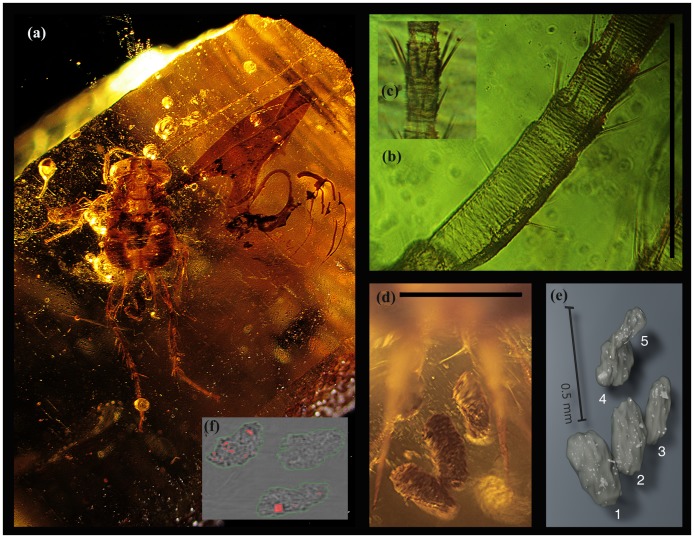
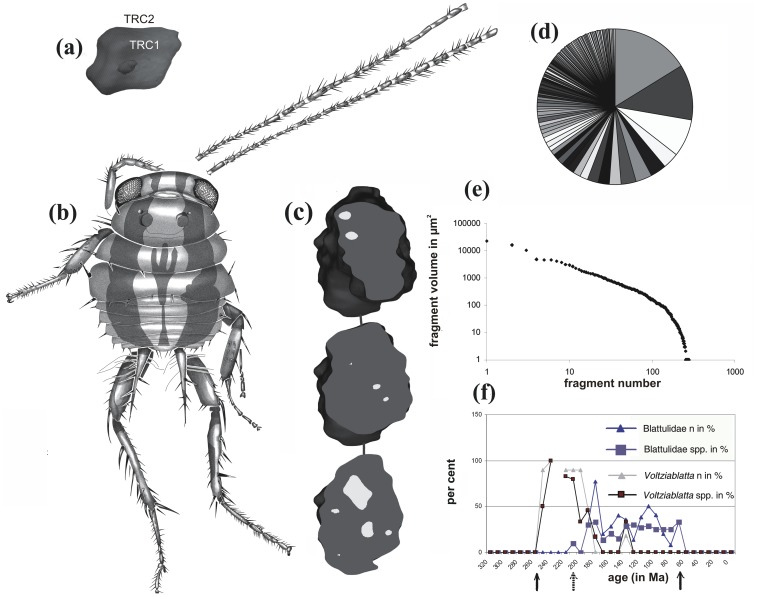
Dinosaurs undoubtedly produced huge quantities of excrements. But who cleaned up after them? Dung beetles and flies with rapid development were rare during most of the Mesozoic. Candidates for these duties are extinct cockroaches (Blattulidae), whose temporal range is associated with herbivorous dinosaurs. An opportunity to test this hypothesis arises from coprolites to some extent extruded from an immature cockroach preserved in the amber of Lebanon, studied using synchrotron X-ray microtomography. 1.06% of their volume is filled by particles of wood with smooth edges, in which size distribution directly supports their external pre-digestion. Because fungal pre-processing can be excluded based on the presence of large particles (combined with small total amount of wood) and absence of damages on wood, the likely source of wood are herbivore feces. Smaller particles were broken down biochemically in the cockroach hind gut, which indicates that the recent lignin-decomposing termite and cockroach endosymbionts might have been transferred to the cockroach gut upon feeding on dinosaur feces.
恐龙无疑会产生大量粪便。但在它们之后是谁来清理呢?在中生代的大部分时间里,发育迅速的蜣螂和苍蝇都很稀少。承担这些职责的候选者是已灭绝的蟑螂(blattulidae),其生存时间与食草恐龙相关。在某种程度上,从保存在黎巴嫩琥珀中的一只未成熟蟑螂体内挤出的粪化石为检验这一假说提供了契机,该粪化石是通过同步加速器X射线显微断层扫描进行研究的。它们体积的1.06%被边缘光滑的木屑颗粒填满,木屑颗粒的大小分布直接支持了它们在体外的预消化过程。由于基于大颗粒的存在(结合少量的木材总量)以及木材上没有损伤可以排除真菌预处理,木材的可能来源是食草动物的粪便。较小的颗粒在蟑螂后肠中被生物化学分解,这表明最近分解木质素的白蚁和蟑螂内共生体可能是在以恐龙粪便为食时转移到蟑螂肠道中的。