Department of Clinical Sciences, Division of Oncology, Lund University, Lund, Sweden ; Skåne Department of Oncology, Skåne University Hospital, Lund, Sweden.
PLoS One. 2013 Dec 4;8(12):e81902. doi: 10.1371/journal.pone.0081902. eCollection 2013.
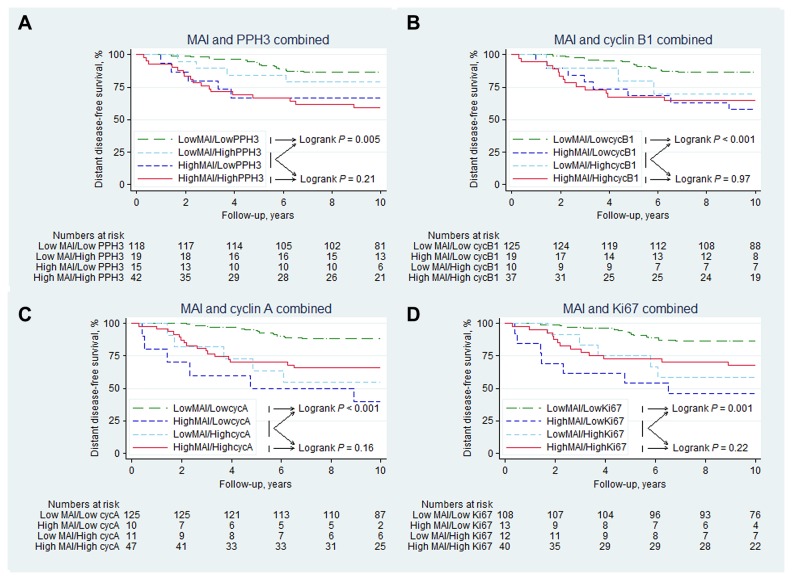
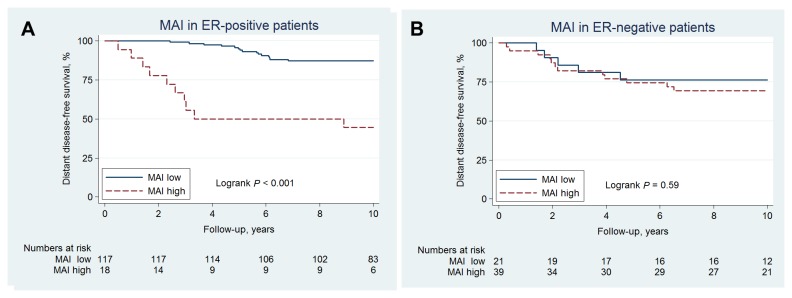
Proliferation, either as the main common denominator in genetic profiles, or in the form of single factors such as Ki67, is recommended for clinical use especially in estrogen receptor-positive (ER) patients. However, due to high costs of genetic profiles and lack of reproducibility for Ki67, studies on other proliferation factors are warranted. The aim of the present study was to evaluate the prognostic value of the proliferation factors mitotic activity index (MAI), phosphohistone H3 (PPH3), cyclin B1, cyclin A and Ki67, alone and in combinations. In 222 consecutive premenopausal node-negative breast cancer patients (87% without adjuvant medical treatment), MAI was assessed on whole tissue sections (predefined cut-off ≥10 mitoses), and PPH3, cyclin B1, cyclin A, and Ki67 on tissue microarray (predefined cut-offs 7th decile). In univariable analysis (high versus low) the strongest prognostic proliferation factor for 10-year distant disease-free survival was MAI (Hazard Ratio (HR)=3.3, 95% Confidence Interval (CI): 1.8-6.1), followed by PPH3, cyclin A, Ki67, and cyclin B1. A combination variable, with patients with MAI and/or cyclin A high defined as high-risk, had even stronger prognostic value (HR=4.2, 95%CI: 2.2-7). When stratifying for ER-status, MAI was a significant prognostic factor in ER-positive patients only (HR=7.0, 95%CI: 3.1-16). Stratified for histological grade, MAI added prognostic value in grade 2 (HR=7.2, 95%CI: 3.1-38) and grade 1 patients. In multivariable analysis including HER2, age, adjuvant medical treatment, ER, and one proliferation factor at a time, only MAI (HR=2.7, 95%CI: 1.1-6.7), and cyclin A (HR=2.7, 95%CI: 1.2-6.0) remained independently prognostic. In conclusion this study confirms the strong prognostic value of all proliferation factors, especially MAI and cyclin A, in all patients, and more specifically in ER-positive patients, and patients with histological grade 2 and 1. Additionally, by combining two proliferation factors, an even stronger prognostic value may be found.
增殖,无论是作为遗传特征的主要共同特征,还是作为 Ki67 等单一因素的形式,都被推荐用于临床,特别是在雌激素受体阳性(ER)患者中。然而,由于遗传特征的高成本和 Ki67 的可重复性缺乏,因此有必要对其他增殖因素进行研究。本研究的目的是评估增殖因子有丝分裂活动指数(MAI)、磷酸组蛋白 H3(PPH3)、细胞周期蛋白 B1、细胞周期蛋白 A 和 Ki67 的预后价值,单独和联合使用。在 222 例连续的绝经前淋巴结阴性乳腺癌患者(87%未接受辅助药物治疗)中,在整个组织切片上评估 MAI(定义的临界值≥10 个有丝分裂),并在组织微阵列上评估 PPH3、细胞周期蛋白 B1、细胞周期蛋白 A 和 Ki67(定义的第 7 个十分位数的临界值)。在单变量分析(高 versus 低)中,10 年远处无病生存的最强预后增殖因子是 MAI(风险比(HR)=3.3,95%置信区间(CI):1.8-6.1),其次是 PPH3、细胞周期蛋白 A、Ki67 和细胞周期蛋白 B1。一个组合变量,定义为 MAI 和/或细胞周期蛋白 A 高的患者为高危,具有更强的预后价值(HR=4.2,95%CI:2.2-7)。当按 ER 状态分层时,MAI 仅在 ER 阳性患者中是一个显著的预后因素(HR=7.0,95%CI:3.1-16)。按组织学分级分层时,MAI 在 2 级(HR=7.2,95%CI:3.1-38)和 1 级患者中增加了预后价值。在包括 HER2、年龄、辅助药物治疗、ER 和一次一个增殖因子的多变量分析中,只有 MAI(HR=2.7,95%CI:1.1-6.7)和细胞周期蛋白 A(HR=2.7,95%CI:1.2-6.0)仍然是独立的预后因素。总之,本研究证实了所有增殖因子,特别是 MAI 和细胞周期蛋白 A,在所有患者中的强大预后价值,特别是在 ER 阳性患者和组织学分级为 2 级和 1 级的患者中。此外,通过结合两种增殖因子,可能会发现更强的预后价值。