• 文献检索
  • 文档翻译
  • 深度研究
  • 学术资讯
  • Suppr Zotero 插件Zotero 插件
  • 邀请有礼
  • 套餐&价格
  • 历史记录
应用&插件
Suppr Zotero 插件Zotero 插件浏览器插件Mac 客户端Windows 客户端微信小程序
定价
高级版会员购买积分包购买API积分包
服务
文献检索文档翻译深度研究API 文档MCP 服务
关于我们
关于 Suppr公司介绍联系我们用户协议隐私条款
关注我们

Suppr 超能文献

核心技术专利:CN118964589B侵权必究
粤ICP备2023148730 号-1Suppr @ 2026

文献检索

告别复杂PubMed语法,用中文像聊天一样搜索,搜遍4000万医学文献。AI智能推荐,让科研检索更轻松。

立即免费搜索

文件翻译

保留排版,准确专业,支持PDF/Word/PPT等文件格式,支持 12+语言互译。

免费翻译文档

深度研究

AI帮你快速写综述,25分钟生成高质量综述,智能提取关键信息,辅助科研写作。

立即免费体验

猩猩(Pongo pygmaeus)记得老相识。

Orangutans (Pongo pygmaeus) remember old acquaintances.

机构信息

Department of Psychology, Graduate School of Letters, Chuo University, 742-1 Higashi-nakano, Hachioji, Tokyo, Japan.

出版信息

PLoS One. 2013 Dec 4;8(12):e82073. doi: 10.1371/journal.pone.0082073. eCollection 2013.

DOI:10.1371/journal.pone.0082073
PMID:24324746
原文链接:https://pmc.ncbi.nlm.nih.gov/articles/PMC3852890/
Abstract

Many social animals can discriminate between familiar and unfamiliar faces. Orangutans, however, lead a semi-solitary life and spend much of the day alone. As such, they may be less adept at recognizing conspecifics and are a good model for determining how social structure influences the evolution of social cognition such as facial recognition. The present study is the first report of whether orangutans can distinguish among individual faces. We adopted a preferential looking method and found that orangutans used facial discrimination to identify known conspecifics. This suggests that frequent and intense social interaction is not necessary for facial discrimination, although our findings were limited by the small number of stimuli and the unequal numbers of male and female orangutans depicted in the stimuli.

摘要

许多社会性动物能够区分熟悉和陌生的面孔。然而,猩猩过着半独居的生活,大部分时间都是独自度过的。因此,它们可能不太擅长识别同种个体,是研究社会结构如何影响社会认知(如人脸识别)进化的良好模型。本研究首次报告了猩猩是否能够区分个体的面孔。我们采用了偏好性注视法,发现猩猩可以通过面部识别来辨别已知的同种个体。这表明,频繁和强烈的社会互动并非面部识别所必需的,尽管我们的研究结果受到刺激物数量较少以及刺激物中雄性和雌性猩猩数量不均的限制。
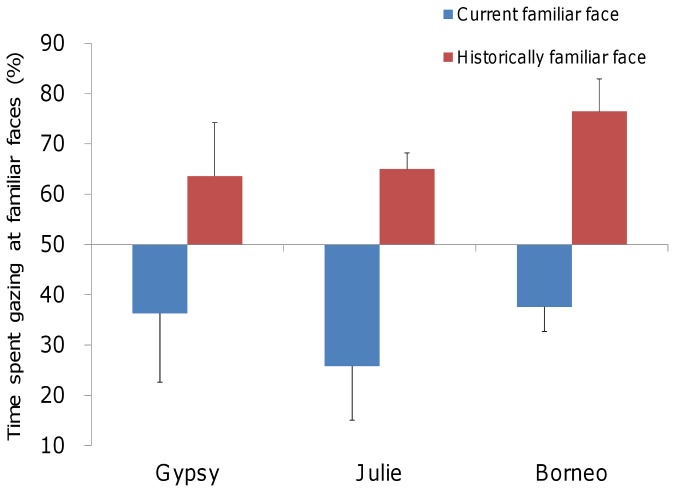
https://cdn.ncbi.nlm.nih.gov/pmc/blobs/7ab6/3852890/6bd53d750614/pone.0082073.g002.jpg
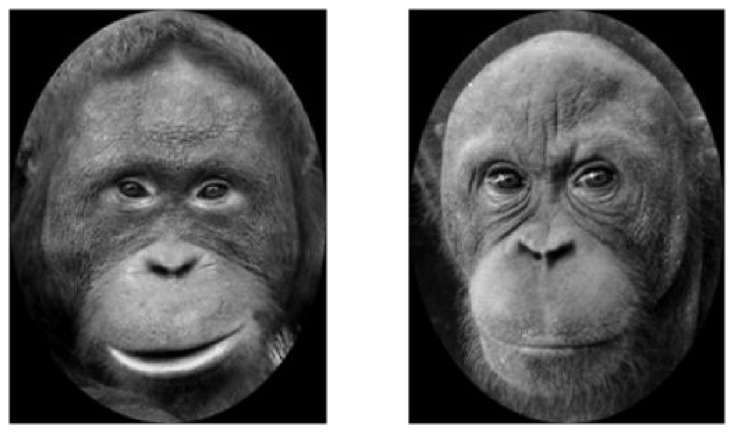
https://cdn.ncbi.nlm.nih.gov/pmc/blobs/7ab6/3852890/993d8c7efa68/pone.0082073.g001.jpg
https://cdn.ncbi.nlm.nih.gov/pmc/blobs/7ab6/3852890/6bd53d750614/pone.0082073.g002.jpg
https://cdn.ncbi.nlm.nih.gov/pmc/blobs/7ab6/3852890/993d8c7efa68/pone.0082073.g001.jpg
https://cdn.ncbi.nlm.nih.gov/pmc/blobs/7ab6/3852890/6bd53d750614/pone.0082073.g002.jpg

相似文献

1
Orangutans (Pongo pygmaeus) remember old acquaintances.猩猩(Pongo pygmaeus)记得老相识。
PLoS One. 2013 Dec 4;8(12):e82073. doi: 10.1371/journal.pone.0082073. eCollection 2013.
2
Orangutans (Pongo spp.) do not spontaneously share benefits with familiar conspecifics in a choice paradigm.在选择范式中,红毛猩猩(婆罗洲猩猩属)不会主动与熟悉的同种个体分享利益。
Primates. 2015 Apr;56(2):193-200. doi: 10.1007/s10329-015-0460-8. Epub 2015 Mar 5.
3
Nonaggressive interventions by third parties in conflicts among captive Bornean orangutans (Pongo pygmaeus).第三方对圈养婆罗洲猩猩(婆罗洲猩猩)冲突的非攻击性干预。
Primates. 2010 Apr;51(2):179-82. doi: 10.1007/s10329-009-0180-z. Epub 2010 Jan 6.
4
Feeding behavior, diet, and the functional consequences of jaw form in orangutans, with implications for the evolution of Pongo.猩猩的进食行为、饮食以及颌骨形态的功能后果及其对红毛猩猩进化的影响。
J Hum Evol. 2006 Apr;50(4):377-93. doi: 10.1016/j.jhevol.2005.10.006. Epub 2006 Jan 18.
5
Low relationship quality predicts scratch contagion during tense situations in orangutans (Pongo pygmaeus).低关系质量预测了在猩猩(Pongo pygmaeus)紧张情况下抓挠行为的传染。
Am J Primatol. 2020 Jul;82(7):e23138. doi: 10.1002/ajp.23138. Epub 2020 Apr 24.
6
Do orangutans (Pongo pygmaeus) know when they do not remember?红毛猩猩(婆罗洲猩猩)知道自己何时失忆吗?
Anim Cogn. 2008 Jan;11(1):21-42. doi: 10.1007/s10071-007-0082-7. Epub 2007 Apr 17.
7
Rapid facial mimicry in orangutan play.猩猩玩耍时的快速面部模仿。
Biol Lett. 2008 Feb 23;4(1):27-30. doi: 10.1098/rsbl.2007.0535.
8
Mother-offspring proximity maintenance as an infanticide avoidance strategy in bornean orangutans (Pongo pygmaeus wurmbii).母婴近距离接触以避免在婆罗洲猩猩(Pongo pygmaeus wurmbii)中发生杀婴行为。
Am J Primatol. 2023 Jun;85(6):e23482. doi: 10.1002/ajp.23482. Epub 2023 Mar 5.
9
Why do orangutans leave the trees? Terrestrial behavior among wild Bornean orangutans (Pongo pygmaeus wurmbii) at Tuanan, Central Kalimantan.红毛猩猩为什么离开树木?加里曼丹中部图阿南野生婆罗洲红毛猩猩(Pongo pygmaeus wurmbii)的陆地行为。
Am J Primatol. 2015 Nov;77(11):1216-29. doi: 10.1002/ajp.22460. Epub 2015 Aug 28.
10
Rhesus monkeys show greater habituation to repeated computer-generated images than do orangutans.恒河猴对重复的计算机生成图像比猩猩表现出更强的习惯化。
Behav Processes. 2024 Mar;216:105011. doi: 10.1016/j.beproc.2024.105011. Epub 2024 Feb 28.

引用本文的文献

1
Rhesus monkeys show greater habituation to repeated computer-generated images than do orangutans.恒河猴对重复的计算机生成图像比猩猩表现出更强的习惯化。
Behav Processes. 2024 Mar;216:105011. doi: 10.1016/j.beproc.2024.105011. Epub 2024 Feb 28.
2
Bonobos and chimpanzees remember familiar conspecifics for decades.倭黑猩猩和黑猩猩能记住几十年前熟悉的同类。
Proc Natl Acad Sci U S A. 2023 Dec 26;120(52):e2304903120. doi: 10.1073/pnas.2304903120. Epub 2023 Dec 18.
3
Orangutans () recognize their own past actions.红毛猩猩能识别自己过去的行为。

本文引用的文献

1
LIFE HISTORY VARIATION IN PRIMATES.灵长类动物的生活史变异
Evolution. 1985 May;39(3):559-581. doi: 10.1111/j.1558-5646.1985.tb00395.x.
2
Visual discrimination in an orangutan (Pongo pygmaeus): measuring visual preference.猩猩(Pongo pygmaeus)的视觉辨别能力:测量视觉偏好。
Percept Mot Skills. 2012 Apr;114(2):429-32. doi: 10.2466/22.24.PMS.114.2.429-432.
3
Cognition: Your face looks familiar.认知:你看起来面熟。
R Soc Open Sci. 2018 Dec 12;5(12):181497. doi: 10.1098/rsos.181497. eCollection 2018 Dec.
4
Familiar face + novel face = familiar face? Representational bias in the perception of morphed faces in chimpanzees.熟悉面孔 + 新面孔 = 熟悉面孔?黑猩猩对变形面孔感知中的表征偏差。
PeerJ. 2016 Aug 4;4:e2304. doi: 10.7717/peerj.2304. eCollection 2016.
5
Enduring voice recognition in bonobos.倭黑猩猩的持久语音识别
Sci Rep. 2016 Feb 25;6:22046. doi: 10.1038/srep22046.
Nature. 2012 Jan 11;481(7380):154-5. doi: 10.1038/481154a.
4
Long-term visual recognition of familiar persons, peers, and places by young monkeys (Macaca fuscata).年轻恒河猴(Macaca fuscata)对熟悉的人、同伴和地点的长期视觉识别。
Dev Psychobiol. 2011 Nov;53(7):732-7. doi: 10.1002/dev.20548. Epub 2011 Mar 22.
5
Visual kin recognition in nonhuman primates: (Pan troglodytes and Macaca mulatta): inbreeding avoidance or male distinctiveness?非人类灵长类动物(黑猩猩和猕猴)的视觉亲属识别:是避免近亲繁殖还是雄性独特性?
J Comp Psychol. 2010 Nov;124(4):343-50. doi: 10.1037/a0020545.
6
Electrophysiological Studies of Face Perception in Humans.人类面部感知的电生理研究
J Cogn Neurosci. 1996 Nov;8(6):551-565. doi: 10.1162/jocn.1996.8.6.551.
7
Discrimination of human and dog faces and inversion responses in domestic dogs (Canis familiaris).家犬(Canis familiaris)对人脸和倒置面孔的辨别与反应。
Anim Cogn. 2010 May;13(3):525-33. doi: 10.1007/s10071-009-0303-3. Epub 2009 Dec 18.
8
Orangutans.猩猩
Curr Biol. 2009 Nov 3;19(20):R925-7. doi: 10.1016/j.cub.2009.08.009.
9
Face recognition in capuchin monkeys (Cebus apella).卷尾猴(僧帽猴)的面部识别。
J Comp Psychol. 2009 May;123(2):151-60. doi: 10.1037/a0014073.
10
Individual recognition in domestic cattle (Bos taurus): evidence from 2D-images of heads from different breeds.家牛(Bos taurus)的个体识别:来自不同品种牛头二维图像的证据。
PLoS One. 2009;4(2):e4441. doi: 10.1371/journal.pone.0004441. Epub 2009 Feb 12.