Department of Biological Sciences, University of Alberta Edmonton, AB, T6G 2E9, Canada.
Ecol Evol. 2013 Oct;3(12):4149-60. doi: 10.1002/ece3.785. Epub 2013 Sep 23.
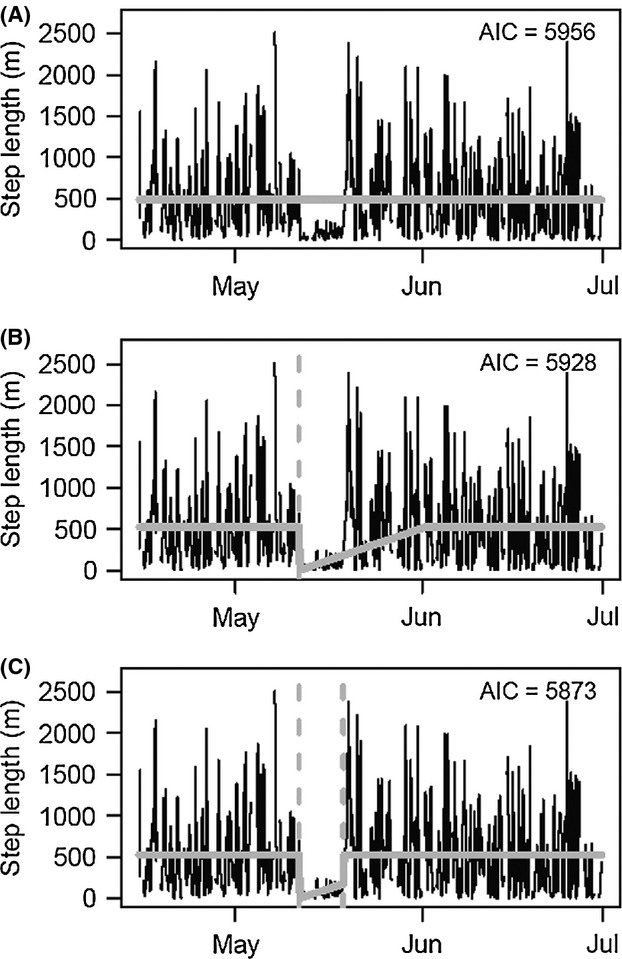
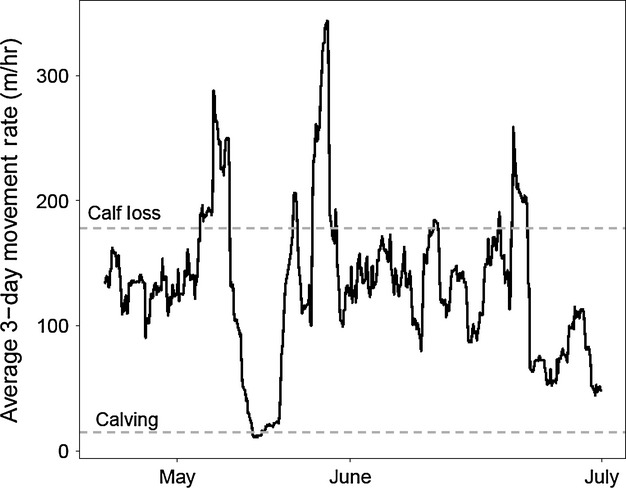
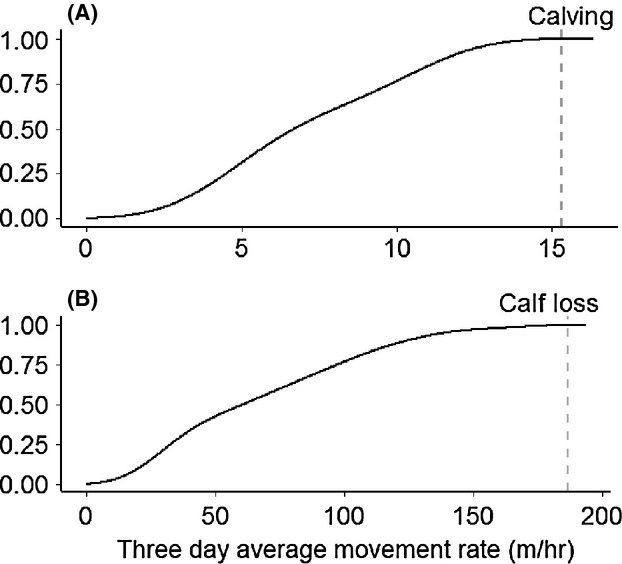
Analyses of animal movement data have primarily focused on understanding patterns of space use and the behavioural processes driving them. Here, we analyzed animal movement data to infer components of individual fitness, specifically parturition and neonate survival. We predicted that parturition and neonate loss events could be identified by sudden and marked changes in female movement patterns. Using GPS radio-telemetry data from female woodland caribou (Rangifer tarandus caribou), we developed and tested two novel movement-based methods for inferring parturition and neonate survival. The first method estimated movement thresholds indicative of parturition and neonate loss from population-level data then applied these thresholds in a moving-window analysis on individual time-series data. The second method used an individual-based approach that discriminated among three a priori models representing the movement patterns of non-parturient females, females with surviving offspring, and females losing offspring. The models assumed that step lengths (the distance between successive GPS locations) were exponentially distributed and that abrupt changes in the scale parameter of the exponential distribution were indicative of parturition and offspring loss. Both methods predicted parturition with near certainty (>97% accuracy) and produced appropriate predictions of parturition dates. Prediction of neonate survival was affected by data quality for both methods; however, when using high quality data (i.e., with few missing GPS locations), the individual-based method performed better, predicting neonate survival status with an accuracy rate of 87%. Understanding ungulate population dynamics often requires estimates of parturition and neonate survival rates. With GPS radio-collars increasingly being used in research and management of ungulates, our movement-based methods represent a viable approach for estimating rates of both parameters.
对动物运动数据的分析主要集中于理解空间利用模式及其背后的行为过程。在这里,我们分析了动物运动数据,以推断个体适应性的组成部分,特别是分娩和新生幼仔的生存情况。我们预测,分娩和新生幼仔损失事件可以通过雌性运动模式的突然和显著变化来识别。利用来自林地驯鹿(Rangifer tarandus caribou)雌性个体的 GPS 无线电遥测数据,我们开发并测试了两种新的基于运动的方法来推断分娩和新生幼仔的生存情况。第一种方法从群体水平的数据中估计指示分娩和新生幼仔损失的运动阈值,然后将这些阈值应用于个体时间序列数据的移动窗口分析中。第二种方法使用基于个体的方法,区分了三种先验模型,分别代表非分娩雌性、有存活后代的雌性和失去后代的雌性的运动模式。这些模型假设步长(连续 GPS 位置之间的距离)呈指数分布,并且指数分布的尺度参数的突然变化表示分娩和后代损失。这两种方法都能以近乎确定的概率(>97%的准确率)预测分娩,并产生适当的分娩日期预测。两种方法的新生儿存活率预测都受到数据质量的影响;然而,当使用高质量的数据(即,GPS 位置丢失较少)时,基于个体的方法表现更好,预测新生儿存活状态的准确率为 87%。了解有蹄类动物的种群动态通常需要估计分娩率和新生幼仔存活率。随着 GPS 无线电项圈在有蹄类动物的研究和管理中越来越多地被使用,我们基于运动的方法代表了一种估计这两个参数的可行方法。