Hollings Cancer Center, Medical University of South Carolina, Charleston, SC 29425, USA.
Exp Hematol Oncol. 2013 Dec 10;2(1):33. doi: 10.1186/2162-3619-2-33.
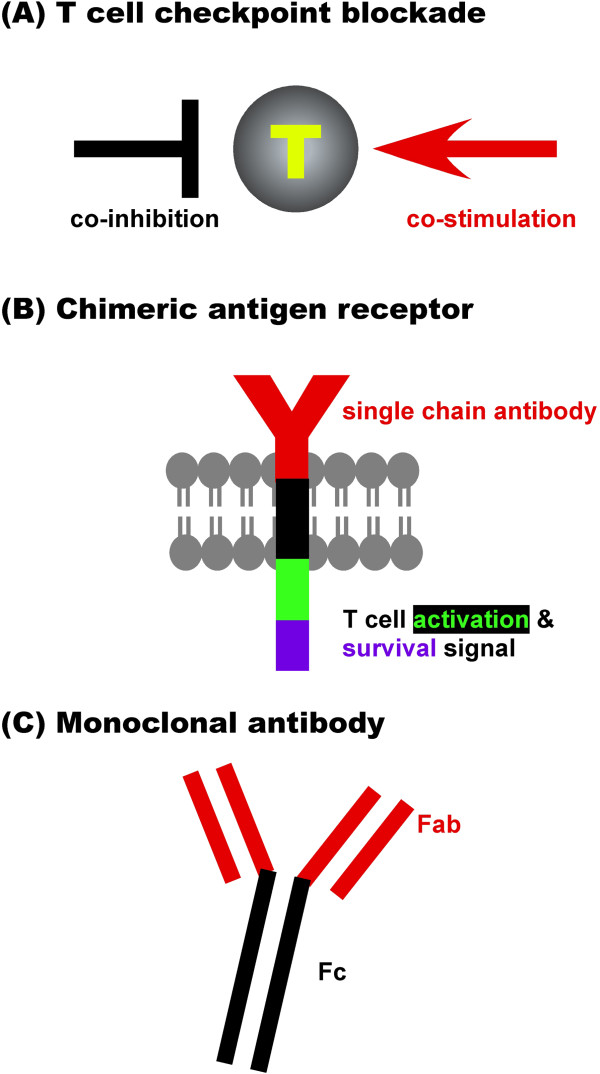
The immune system is the built-in host defense mechanism against infectious agents as well as cancer. Protective immunity against cancer was convincingly demonstrated in the 1940s with syngeneic animal models (JNCI 18:769-778, 1976; Cancer Immun 1:6, 2001). Since then, the last century's dream has been to effectively prevent and cure cancers by immunological means. This dream has slowly but surely become a reality (Nature 480:480-489, 2011). The successful examples of immunoprophylaxis and therapy against cancers include: (i) targeted therapy using monoclonal antibodies (Nat Rev Cancer 12:278-287, 2012); (ii) allogeneic hematopoietic stem cell transplantion to elicit graft-versus-cancer effect against a variety of hematopoietic malignancies (Blood 112:4371-4383, 2008); (iii) vaccination for preventing cancers with clear viral etiology such as hepatocellular carcinoma and cervical cancer (Cancer J Clin 57:7-28, 2007; NEJM 336:1855-1859, 1997); (iv) T cell checkpoint blockade against inhibitory pathways including targeting CTLA-4 and PD-1 inhibitory molecules for the treatment of melanoma and other solid tumors (NEJM 363:711-723, 2010; NEJM 366:2443-2454, 2012; NEJM 369:122-133, 2013; NEJM 366:2455-2465, 2012); (v) antigen-pulsed autologous dendritic cell vaccination against prostate cancer (NEJM 363:411-422, 2010); and (vi) the transfer of T cells including those genetically engineered with chimeric antigen receptors allowing targeting of B cell neoplasms (NEJM 365:725-733, 2011; NEJM 368:1509-1518, 2013; Blood 118:4817-4828, 2013; Sci Transl Med 5:177ra138, 2013).This article provides an overview on the exciting and expanding immunological arsenals against cancer, and discusses critical remaining unanswered questions of cancer immunology. The inherent specificity and memory of the adaptive immune response towards cancer will undoubtedly propel cancer immunotherapy to the forefront of cancer treatment in the immediate near future. Study of the fundamental mechanisms of the immune evasion of cancer shall also advance the field of immunology towards the development of effective immunotherapeutics against a wide spectrum of human diseases.
免疫系统是针对感染因子和癌症的内置宿主防御机制。20 世纪 40 年代,在同基因动物模型中令人信服地证明了针对癌症的保护性免疫(JNCI 18:769-778,1976;Cancer Immun 1:6,2001)。从那时起,上个世纪的梦想就是通过免疫学手段有效预防和治疗癌症。这个梦想已经慢慢地、但确实地变成了现实(Nature 480:480-489,2011)。针对癌症的免疫预防和治疗的成功范例包括:(i)使用单克隆抗体的靶向治疗(Nat Rev Cancer 12:278-287,2012);(ii)同种异体造血干细胞移植以引发针对各种血液恶性肿瘤的移植物抗癌症效应(Blood 112:4371-4383,2008);(iii)针对具有明确病毒病因的癌症的疫苗接种,如肝癌和宫颈癌(Cancer J Clin 57:7-28,2007;NEJM 336:1855-1859,1997);(iv)针对抑制途径的 T 细胞检查点阻断,包括针对 CTLA-4 和 PD-1 抑制分子的靶向治疗,用于治疗黑色素瘤和其他实体瘤(NEJM 363:711-723,2010;NEJM 366:2443-2454,2012;NEJM 369:122-133,2013;NEJM 366:2455-2465,2012);(v)针对前列腺癌的抗原脉冲自体树突状细胞疫苗接种(NEJM 363:411-422,2010);以及(vi)包括用嵌合抗原受体基因工程改造的 T 细胞的转移,从而靶向 B 细胞肿瘤(NEJM 365:725-733,2011;NEJM 368:1509-1518,2013;Blood 118:4817-4828,2013;Sci Transl Med 5:177ra138,2013)。本文概述了针对癌症的令人兴奋且不断扩大的免疫学武器库,并讨论了癌症免疫学中仍然存在的关键未解决的问题。适应性免疫反应针对癌症的固有特异性和记忆无疑将推动癌症免疫疗法成为癌症治疗的最前沿,在不久的将来。对癌症免疫逃逸的基本机制的研究也将推动免疫学领域朝着针对广泛的人类疾病开发有效的免疫治疗方法的方向发展。