Department of Dermatology, Skin Diseases Research Center, University of Alabama at Birmingham, Birmingham, Alabama, USA.
Department of Dermatology, Skin Diseases Research Center, University of Alabama at Birmingham, Birmingham, Alabama, USA; Veteran Affairs Medical Center, Birmingham, Alabama, USA; Comprehensive Cancer Center, University of Alabama at Birmingham, Birmingham, Alabama, USA.
J Invest Dermatol. 2014 Jun;134(6):1710-1717. doi: 10.1038/jid.2013.530. Epub 2013 Dec 10.
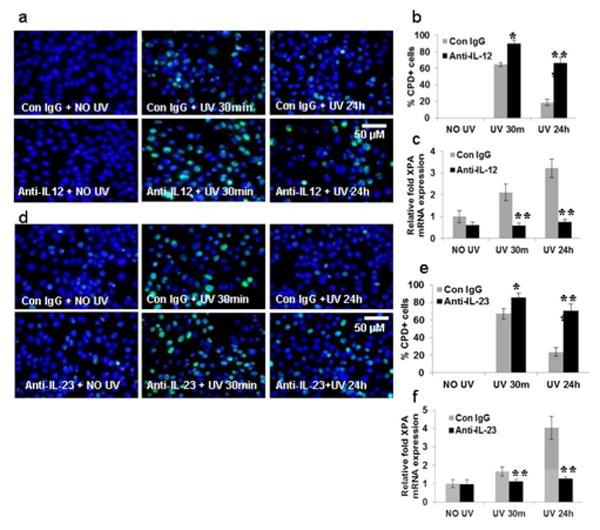
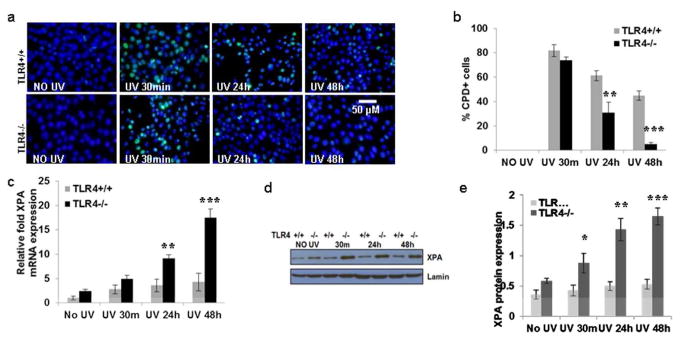
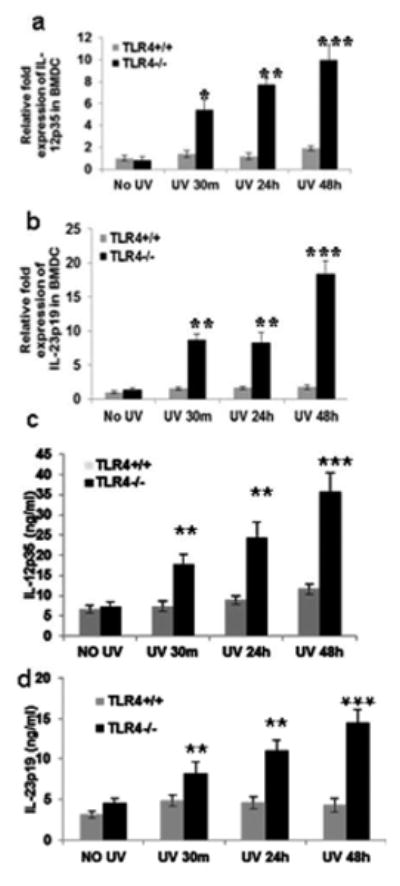
UVB-induced DNA damage has a critical role in the development of photoimmunosuppression. The purpose of this study was to determine whether repair of UVB-induced DNA damage is regulated by Toll-like receptor-4 (TLR4). When TLR4 gene knockout (TLR4(-/-)) and TLR4-competent (TLR4(+/+)) mice were subjected to 90 mJ cm(-2) UVB radiation locally, DNA damage in the form of cyclobutane pyrimidine dimers (CPDs) was repaired more efficiently in the skin and bone marrow-derived dendritic cells (BMDCs) of TLR4(-/-) mice in comparison to TLR4(+/+) mice. Expression of DNA repair gene XPA (xeroderma pigmentosum complementation group A) was significantly lower in skin and BMDCs of TLR4(+/+) mice than TLR4(-/-) mice after UVB exposure. When cytokine levels were compared in these strains after UVB exposure, BMDCs from UV-irradiated TLR4(-/-) mice produced significantly more interleukin (IL)-12 and IL-23 cytokines (P<0.05) than BMDCs from TLR4(+/+) mice. Addition of anti-IL-12 and anti-IL-23 antibodies to BMDCs of TLR4(-/-) mice (before UVB exposure) inhibited repair of CPDs, with a concomitant decrease in XPA expression. Addition of TLR4 agonist to TLR4(+/+) BMDC cultures decreased XPA expression and inhibited CPD repair. Thus, strategies to inhibit TLR4 may allow for immunopreventive and immunotherapeutic approaches for managing UVB-induced cutaneous DNA damage and skin cancer.
UVB 诱导的 DNA 损伤在光免疫抑制的发展中起着关键作用。本研究旨在确定 TLR4 是否调节 UVB 诱导的 DNA 损伤的修复。当 TLR4 基因敲除(TLR4(-/-))和 TLR4 功能正常(TLR4(+/+))的小鼠局部接受 90 mJ/cm(-2) 的 UVB 辐射时,TLR4(-/-) 小鼠的皮肤和骨髓来源树突状细胞(BMDCs)中的 DNA 损伤以环丁烷嘧啶二聚体(CPD)的形式修复得比 TLR4(+/+) 小鼠更有效。与 TLR4(-/-) 小鼠相比,TLR4(+/+) 小鼠皮肤和 BMDCs 中 DNA 修复基因 XPA(着色性干皮病互补组 A)的表达在 UVB 暴露后显著降低。与 UVB 暴露后的这些菌株中的细胞因子水平进行比较后发现,来自 UV 照射的 TLR4(-/-) 小鼠的 BMDCs 比 TLR4(+/+) 小鼠的 BMDCs 产生更多的白细胞介素(IL)-12 和 IL-23 细胞因子(P<0.05)。在 TLR4(-/-) 小鼠的 BMDC 中添加抗 IL-12 和抗 IL-23 抗体(在 UVB 暴露之前)抑制了 CPD 的修复,同时 XPA 表达也降低。TLR4 激动剂添加到 TLR4(+/+) BMDC 培养物中可降低 XPA 表达并抑制 CPD 修复。因此,抑制 TLR4 的策略可能为管理 UVB 诱导的皮肤 DNA 损伤和皮肤癌提供免疫预防和免疫治疗方法。