Iachettini Sara, Stevens Malcolm Fg, Frigerio Mark, Hummersone Marc G, Hutchinson Ian, Garner Thomas P, Searle Mark S, Wilson David W, Munde Manoj, Nanjunda Rupesh, D'Angelo Carmen, Zizza Pasquale, Rizzo Angela, Cingolani Chiara, De Cicco Federica, Porru Manuela, D'Incalci Maurizio, Leonetti Carlo, Biroccio Annamaria, Salvati Erica
J Exp Clin Cancer Res. 2013 Sep 19;32(1):68. doi: 10.1186/1756-9966-32-68.
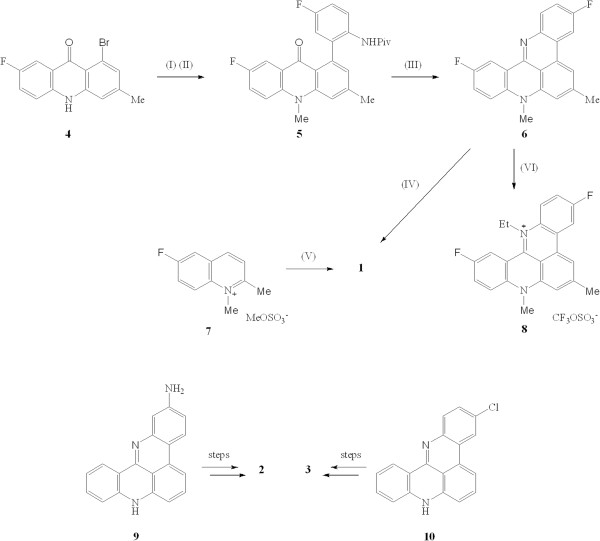
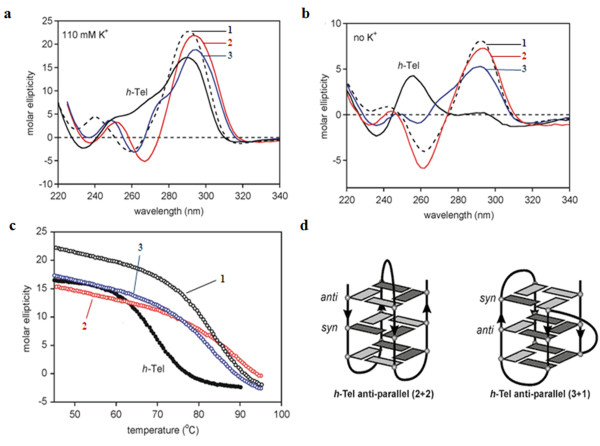
Quadruplexes DNA are present in telomeric DNA as well as in several cancer-related gene promoters and hence affect gene expression and subsequent biological processes. The conformations of G4 provide selective recognition sites for small molecules and thus these structures have become important drug-design targets for cancer treatment. The DNA G-quadruplex binding pentacyclic acridinium salt RHPS4 (1) has many pharmacological attributes of an ideal telomere-targeting agent but has undesirable off-target liabilities. Notably a cardiovascular effect was evident in a guinea pig model, manifested by a marked and sustained increase in QTcB interval. In accordance with this, significant interaction with the human recombinant ß2 adrenergic receptor, and M1, M2 and M3 muscarinic receptors was observed, together with a high inhibition of the hERG tail current tested in a patch clamp assay. Two related pentacyclic structures, the acetylamines (2) and (3), both show a modest interaction with ß2 adrenergic receptor, and do not significatively inhibit the hERG tail current while demonstrating potent telomere on-target properties comparing closely with 1. Of the two isomers, the 2-acetyl-aminopentacycle (2) more closely mimics the overall biological profile of 1 and this information will be used to guide further synthetic efforts to identify novel variants of this chemotype, to maximize on-target and minimize off-target activities. Consequently, the improvement of toxicological profile of these compounds could therefore lead to the obtainment of suitable molecules for clinical development offering new pharmacological strategies in cancer treatment.
四链体DNA存在于端粒DNA以及一些与癌症相关的基因启动子中,因此会影响基因表达及后续的生物学过程。G4构象为小分子提供了选择性识别位点,因此这些结构已成为癌症治疗重要的药物设计靶点。DNA G-四链体结合性五环吖啶盐RHPS4(1)具有理想的端粒靶向剂的许多药理学特性,但存在不良的脱靶效应。值得注意的是,在豚鼠模型中明显出现了心血管效应,表现为QTcB间期显著且持续增加。与此一致的是,观察到其与人重组β2肾上腺素能受体以及M1、M2和M3毒蕈碱受体有显著相互作用,同时在膜片钳试验中对hERG尾电流有高度抑制作用。两个相关的五环结构,即乙酰胺(2)和(3),与β2肾上腺素能受体均表现出适度相互作用,且在显示出与1相近的有效端粒靶向特性时,对hERG尾电流没有显著抑制作用。在这两种异构体中,2-乙酰氨基五环化合物(2)更接近1的整体生物学特征,该信息将用于指导进一步的合成工作,以鉴定这种化学类型的新变体,从而最大限度地提高靶向活性并最小化脱靶活性。因此,改善这些化合物的毒理学特性可能会获得适合临床开发的分子,为癌症治疗提供新的药理学策略。