Laboratoire de Radiopathologie, Institut de Radiobiologie Cellulaire et Moléculaire, CEA, 18 route du Panorama, BP6, 92265, Fontenay-aux-Roses, France.
Cell Mol Life Sci. 2012 Feb;69(4):629-40. doi: 10.1007/s00018-011-0767-6. Epub 2011 Jul 20.
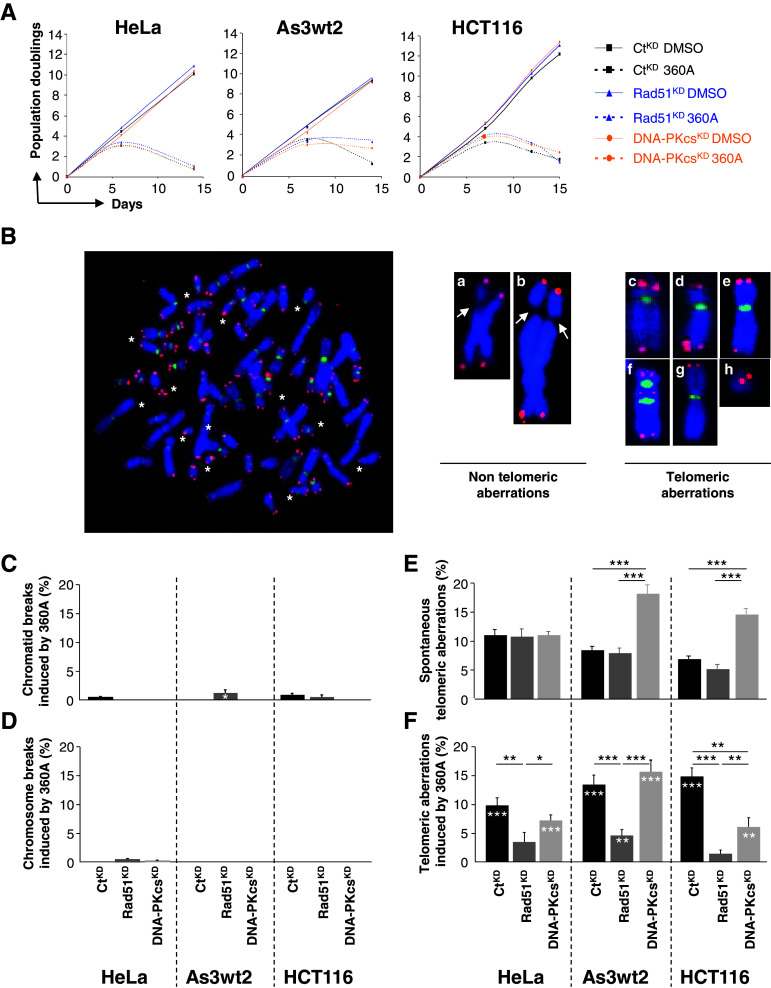
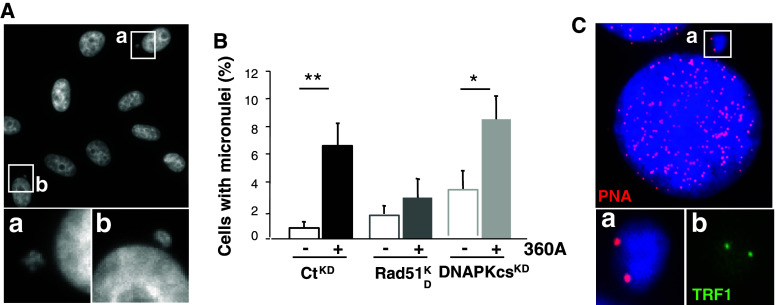
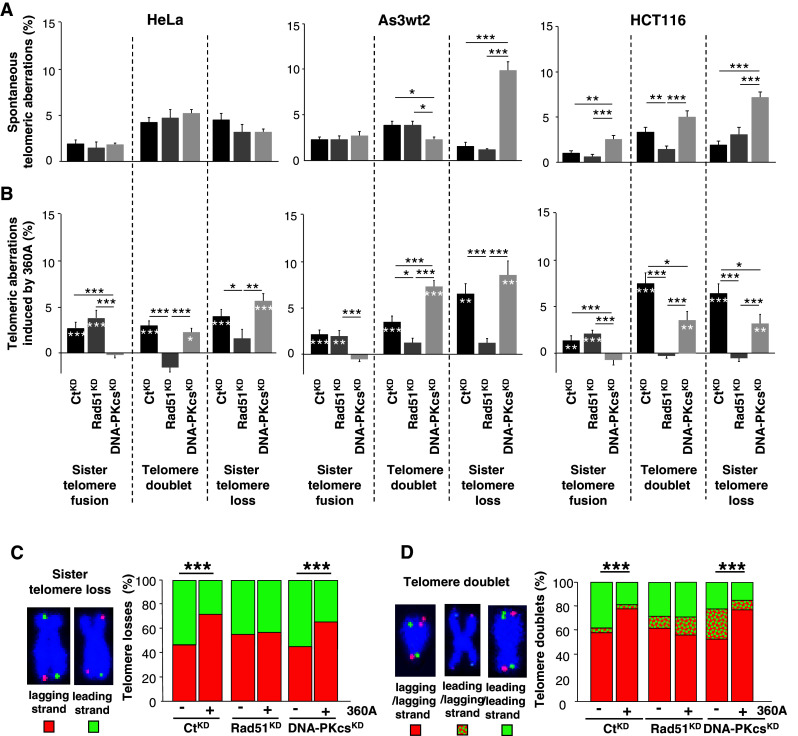
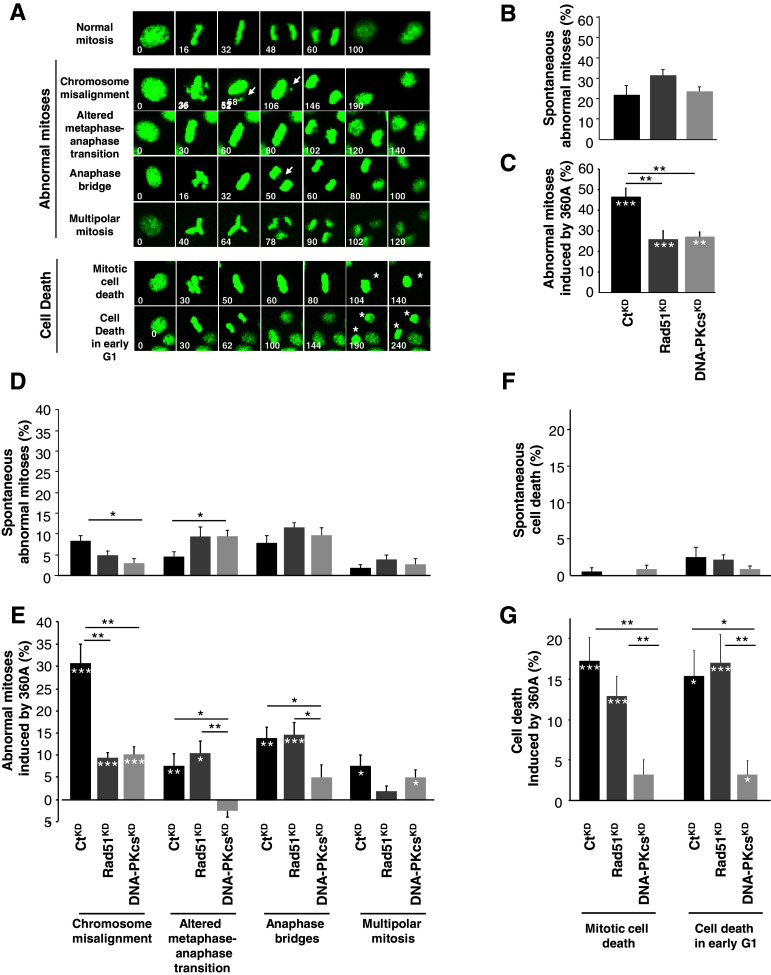
Functional telomeres are protected from non-homologous end-joining (NHEJ) and homologous recombination (HR) DNA repair pathways. Replication is a critical period for telomeres because of the requirement for reconstitution of functional protected telomere conformations, a process that involves DNA repair proteins. Using knockdown of DNA-PKcs and Rad51 expression in three different cell lines, we demonstrate the respective involvement of NHEJ and HR in the formation of telomere aberrations induced by the G-quadruplex ligand 360A during or after replication. HR contributed to specific chromatid-type aberrations (telomere losses and doublets) affecting the lagging strand telomeres, whereas DNA-PKcs-dependent NHEJ was responsible for sister telomere fusions as a direct consequence of G-quadruplex formation and/or stabilization induced by 360A on parental telomere G strands. NHEJ and HR activation at telomeres altered mitotic progression in treated cells. In particular, NHEJ-mediated sister telomere fusions were associated with altered metaphase-anaphase transition and anaphase bridges and resulted in cell death during mitosis or early G1. Collectively, these data elucidate specific molecular and cellular mechanisms triggered by telomere targeting by the G-quadruplex ligand 360A, leading to cancer cell death.
功能端粒受到非同源末端连接 (NHEJ) 和同源重组 (HR) DNA 修复途径的保护。由于需要重新构建功能性保护端粒构象,复制是端粒的一个关键时期,这个过程涉及到 DNA 修复蛋白。通过在三种不同的细胞系中敲低 DNA-PKcs 和 Rad51 的表达,我们证明了 NHEJ 和 HR 分别参与了 G-四链体配体 360A 在复制过程中或之后诱导的端粒畸变的形成。HR 有助于特定的染色单体型畸变(端粒缺失和双链体),影响滞后链端粒,而依赖于 DNA-PKcs 的 NHEJ 则是由于 G-四链体的形成和/或 360A 对亲本端粒 G 链的稳定化直接导致姐妹端粒融合。端粒处的 NHEJ 和 HR 激活改变了处理细胞的有丝分裂进程。特别是,NHEJ 介导的姐妹端粒融合与中期-后期转变和后期桥的改变有关,并导致有丝分裂或早期 G1 期间的细胞死亡。总的来说,这些数据阐明了 G-四链体配体 360A 靶向端粒所触发的特定分子和细胞机制,导致癌细胞死亡。