School of Physiotherapy, Health Sciences, Curtin University, GPO Box U1987, Perth 6845, WA, Australia.
BMC Public Health. 2013 Dec 13;13:1174. doi: 10.1186/1471-2458-13-1174.
Screen-based media (SBM) occupy a considerable portion of young peoples' discretionary leisure time. The aim of this paper was to investigate whether distinct clusters of SBM use exist, and if so, to examine the relationship of any identified clusters with other activity/sedentary behaviours and physical and mental health indicators.
The data for this study come from 643 adolescents, aged 14 years, who were participating in the longitudinal Western Australian Pregnancy Cohort (Raine) Study through May 2003 to June 2006. Time spent on SBM, phone use and reading was assessed using the Multimedia Activity Recall for Children and Adults. Height, weight, muscle strength were measured at a clinic visit and the adolescents also completed questionnaires on their physical activity and psychosocial health. Latent class analysis (LCA) was used to analyse groupings of SBM use.
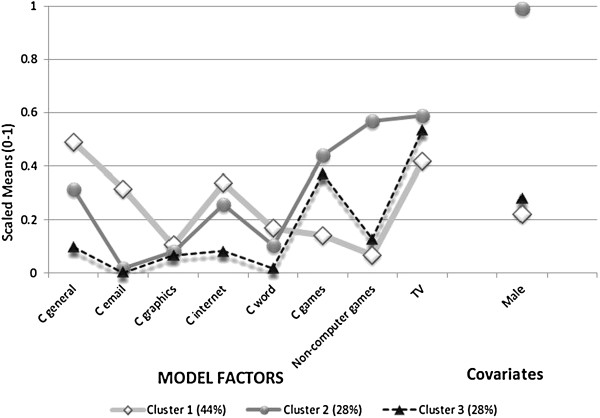
Three clusters of SBM use were found; C1 'instrumental computer users' (high email use, general computer use), C2 'multi-modal e-gamers' (both high console and computer game use) and C3 'computer e-gamers' (high computer game use only). Television viewing was moderately high amongst all the clusters. C2 males took fewer steps than their male peers in C1 and C3 (-13,787/week, 95% CI: -4619 to -22957, p = 0.003 and -14,806, 95% CI: -5,306 to -24,305, p = 0.002) and recorded less MVPA than the C1 males (-3.5 h, 95% CI: -1.0 to -5.9, p = 0.005). There was no difference in activity levels between females in clusters C1 and C3.
SBM use by adolescents did cluster and these clusters related differently to activity/sedentary behaviours and both physical and psychosocial health indicators. It is clear that SBM use is not a single construct and future research needs to take consideration of this if it intends to understand the impact SBM has on health.
屏幕媒体(SBM)占据了年轻人相当一部分闲暇时间。本文旨在调查 SBM 使用是否存在不同的聚类,如果存在,那么研究这些聚类与其他活动/久坐行为以及身体和心理健康指标之间的关系。
本研究的数据来自于 2003 年 5 月至 2006 年 6 月期间参加西澳大利亚妊娠队列(Raine)纵向研究的 643 名 14 岁青少年。使用儿童和成人多媒体活动回忆法评估 SBM、电话使用和阅读时间。在诊所就诊时测量身高、体重和肌肉力量,青少年还完成了关于身体活动和心理社会健康的问卷。使用潜在类别分析(LCA)分析 SBM 使用的分组。
发现 SBM 使用存在三个聚类;C1“工具性计算机使用者”(电子邮件使用量大、一般计算机使用量大)、C2“多模式电子游戏玩家”(同时使用游戏机和电脑游戏)和 C3“电脑电子游戏玩家”(仅使用电脑游戏)。所有聚类的电视观看量都偏高。C2 男性比 C1 和 C3 中的男性同龄人少走的步数多(-13787/周,95%CI:-4619 至-22957,p=0.003 和-14806,95%CI:-5306 至-24305,p=0.002),且比 C1 男性记录的中高强度体力活动(MVPA)少(-3.5 小时,95%CI:-1.0 至-5.9,p=0.005)。C1 和 C3 女性的活动水平没有差异。
青少年的 SBM 使用确实存在聚类,这些聚类与活动/久坐行为以及身体和心理社会健康指标的关系不同。显然,SBM 使用不是一个单一的构念,如果未来的研究打算了解 SBM 对健康的影响,就需要考虑这一点。