Division of Intensive Care Unit, Huashan Hospital, Fudan University, 12 Wulumuqi Road (middle), Shanghai, China.
BMC Anesthesiol. 2013 Dec 15;13(1):48. doi: 10.1186/1471-2253-13-48.
Procalcitonin (PCT) is a reliable biomarker of sepsis and infection. The level of PCT associated with sepsis and infection in patients with traumatic brain injury is currently unknown. The purpose of this study was to investigate the value of PCT and C-reactive protein (CRP) as diagnostic markers of sepsis and to evaluate the prognostic value of these markers related to the severity of injury, sepsis and mortality.
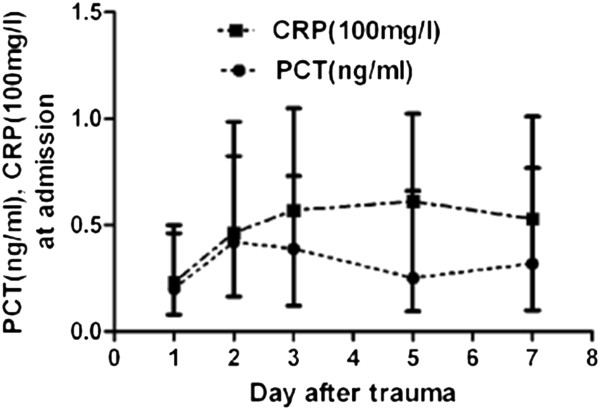
105 adult patients with neurotrauma were enrolled in this study from June 2011 to February 2013. PCT and CRP were measured at admission and 2, 3, 5 and 7 days after admission. The sepsis criteria established by American College of Chest Physicians /Society of Critical Care Medicine Consensus Conference were used to identify patients. Injury Severity Score (ISS) and Glasgow Coma Score (GCS) were used to assess the severity of the injury. All these patients were monitored for 28 days.
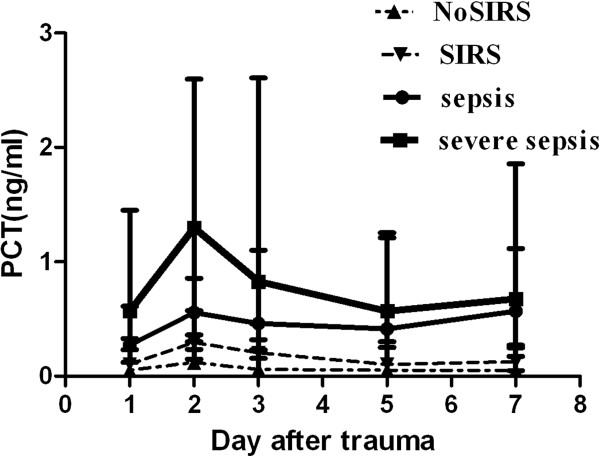
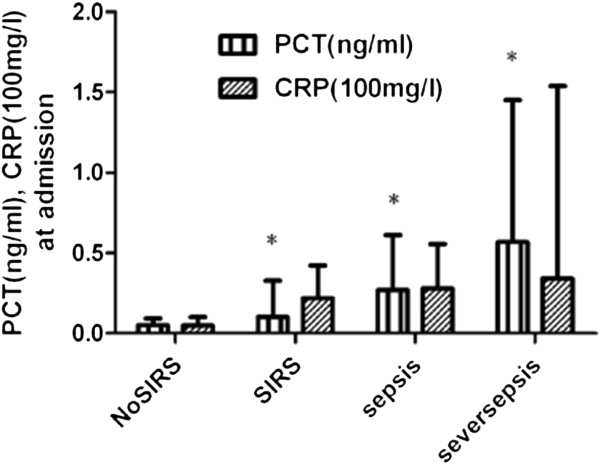
At admission, the median level of PCT was consistent with the severity of brain injury as follows: mild 0.08 ng/ml (0.05 - 0.13), moderate 0.25 ng/ml (0.11 - 0.55) and severe 0.31 ng/ml (0.17 - 0.79), but the range of CRP levels varied greatly within the given severity of brain injury. Seventy-one (67.6%) patients developed sepsis. The initial levels of PCT at admission were statistically higher in patients with sepsis, compared with patients with systemic inflammatory response syndrome (SIRS), but there were no differences in the initial concentration of CRP between sepsis and SIRS. After adjusting for these parameters, multivariate logistic regression analysis revealed that PCT was an independent risk factor for septic complications (p < 0.05). The areas under the ROCs at admission for the prediction of mortality were 0.76 (p < 0.05) and 0.733 for PCT and CRP, respectively.
Increased levels of PCT during the course of the ICU stay could be an important indicator for the early diagnosis of sepsis after neurotrauma. In addition, high serum levels of PCT in patients with neurotrauma at admission indicate an increased risk of septic complications, and the daily measurement of PCT assists in guiding antibiotic therapy in neurotrauma patients.
降钙素原(PCT)是脓毒症和感染的可靠生物标志物。目前尚不清楚外伤性脑损伤患者中与脓毒症和感染相关的 PCT 水平。本研究的目的是探讨 PCT 和 C 反应蛋白(CRP)作为脓毒症诊断标志物的价值,并评估这些标志物与损伤严重程度、脓毒症和死亡率相关的预后价值。
本研究纳入了 2011 年 6 月至 2013 年 2 月期间的 105 名成年神经外伤患者。在入院时以及入院后第 2、3、5 和 7 天测量 PCT 和 CRP。采用美国胸科医师学院/危重病医学会共识会议制定的脓毒症标准来识别患者。损伤严重程度评分(ISS)和格拉斯哥昏迷评分(GCS)用于评估损伤严重程度。所有这些患者均进行了 28 天的监测。
入院时,PCT 的中位数水平与脑损伤的严重程度一致,如下所示:轻度 0.08ng/ml(0.05-0.13),中度 0.25ng/ml(0.11-0.55)和重度 0.31ng/ml(0.17-0.79),但 CRP 水平在给定的脑损伤严重程度范围内差异很大。71(67.6%)名患者发生脓毒症。与全身炎症反应综合征(SIRS)患者相比,脓毒症患者入院时的 PCT 初始水平更高,差异具有统计学意义,但脓毒症和 SIRS 患者的 CRP 初始浓度无差异。在校正这些参数后,多变量逻辑回归分析显示 PCT 是脓毒症并发症的独立危险因素(p<0.05)。入院时预测死亡率的 ROCs 曲线下面积分别为 0.76(p<0.05)和 0.733 用于 PCT 和 CRP。
在 ICU 期间 PCT 水平升高可能是外伤性脑损伤后早期诊断脓毒症的重要指标。此外,外伤性脑损伤患者入院时血清 PCT 水平升高提示发生脓毒症并发症的风险增加,每日测量 PCT 有助于指导外伤性脑损伤患者的抗生素治疗。