Cellular and Molecular Nutrition Department, School of Nutritional Science and Dietetics, Tehran University of Medical Sciences, Tehran, Iran.
Diabetol Metab Syndr. 2013 Dec 12;5(1):79. doi: 10.1186/1758-5996-5-79.
Peroxisome proliferator-activated receptor gamma (PPARγ) has direct and indirect function in adipokines production process. We aimed to assess the possible influence of circulating PPARγ on relative risk of metabolic syndrome and also examine the association between circulating PPARγ and adipokines levels among obese subjects.
A total of 96 obese subjects (body mass index (BMI) ≥30) were included in the current cross-sectional study. We assessed the body composition with the use of Body Composition Analyzer BC-418MA - Tanita. The MetS (metabolic syndrome) was defined based on the National Cholesterol Education Program Adult Treatment Panel III. All baseline blood samples were obtained following an overnight fasting. Serum concentrations of adipokines including Retinol binding protein 4 (RBP4), omentin-1, vaspin, progranulin, nesfatin-1 and circulating PPARγ was measured with the use of an enzyme-linked immunosorbent assay method. Statistical analyses were performed using software package used for statistical analysis (SPSS).
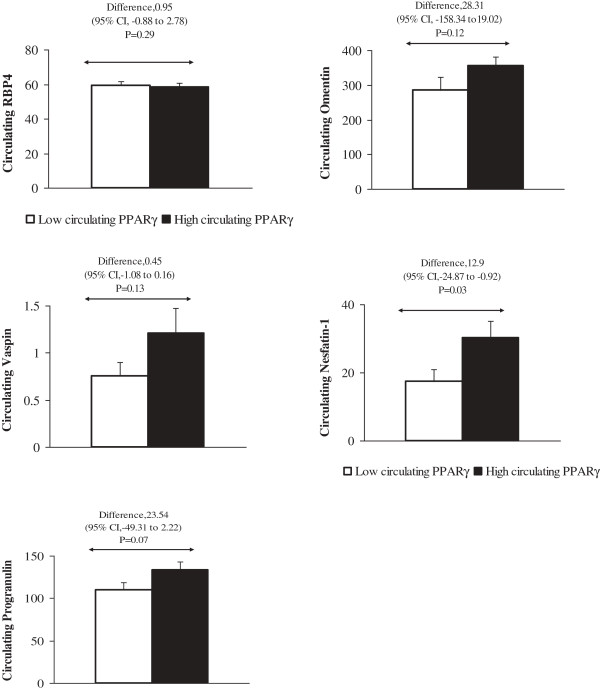
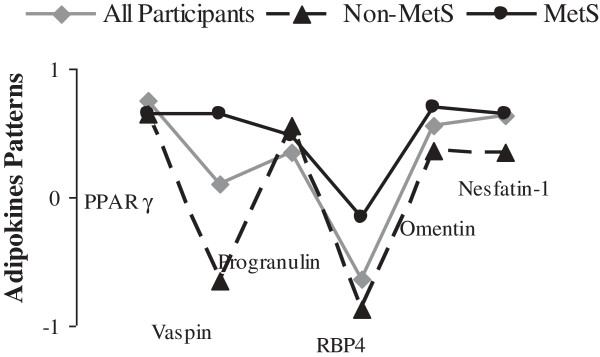
We found main association between circulating PPARγ and body composition in obese population. The risk of metabolic syndrome in subjects with higher concentration of PPARγ was 1.9 fold in compared with lower concentration of PPARγ after adjustment for age, sex and BMI. There was significant association between PPARγ and adipokines, specially nesfatin-1 and progranulin. Defined adipokines pattern among participants demonstrated the markedly higher concentration of vaspin, RBP4 and nesfatin-1 in participants with MetS compared to non-MetS subjects.
It appears all of studied adipokines might have association with PPARγ level and might simultaneously be involve in some common pathway to make susceptible obese subjects for MetS.
过氧化物酶体增殖物激活受体 γ(PPARγ)在脂肪因子的产生过程中具有直接和间接的功能。我们旨在评估循环 PPARγ 对代谢综合征相对风险的可能影响,同时检查肥胖患者中循环 PPARγ 与脂肪因子水平之间的关联。
本横断面研究共纳入 96 名肥胖患者(体重指数(BMI)≥30)。我们使用 Body Composition Analyzer BC-418MA-Tanita 评估身体成分。代谢综合征(MetS)根据国家胆固醇教育计划成人治疗小组 III 定义。所有基线血液样本均在禁食过夜后采集。使用酶联免疫吸附测定法测量血清中脂肪因子的浓度,包括视黄醇结合蛋白 4(RBP4)、网膜素-1、vaspin、颗粒蛋白前体、nesfatin-1 和循环 PPARγ。使用统计分析软件包(SPSS)进行统计分析。
我们发现肥胖人群中循环 PPARγ 与身体成分之间存在主要关联。在调整年龄、性别和 BMI 后,PPARγ 浓度较高的患者发生代谢综合征的风险是浓度较低的患者的 1.9 倍。PPARγ 与脂肪因子,特别是 nesfatin-1 和颗粒蛋白前体之间存在显著关联。参与者中定义的脂肪因子模式表明,患有 MetS 的参与者的 vaspin、RBP4 和 nesfatin-1 浓度明显高于非 MetS 参与者。
似乎所有研究的脂肪因子都可能与 PPARγ 水平相关,并且可能同时参与某些共同途径,使肥胖患者易患 MetS。