Division of Cardiology, Department of Internal Medicine, Cardiac and Vascular Center, Samsung Medical Center, Sungkyunkwan University School of Medicine, 81 Irwon-ro, Gangnam-gu, Seoul 135-710, Korea.
Yonsei Med J. 2014 Jan;55(1):37-45. doi: 10.3349/ymj.2014.55.1.37.
Our study aims to analyze prognosis after implantable cardioverter-defibrillator (ICD) implantation in Korean patients with Brugada syndrome (BrS).
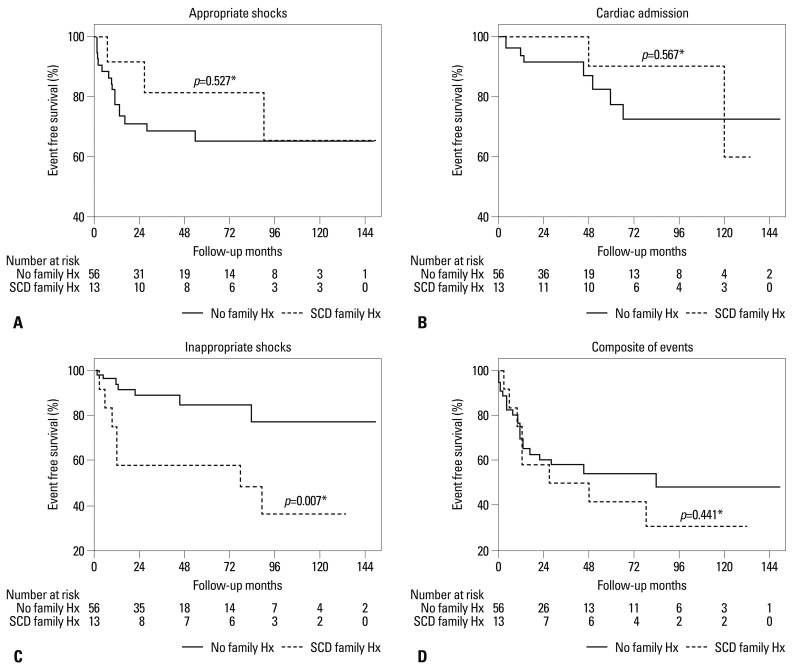
This was a retrospective study of BrS patients implanted with an ICD at one of four centers in Korea between January 1998 and April 2012. Sixty-nine patients (68 males, 1 female) were implanted with an ICD based on aborted cardiac arrest (n=38, 55%), history of syncope (n=17, 25%), or induced ventricular tachyarrhythmia on electrophysiologic study in asymptomatic patients (n=14, 20%). A family history of sudden cardiac death and a spontaneous type 1 electrocardiography (ECG) were noted in 13 patients (19%) and 44 patients (64%), respectively.
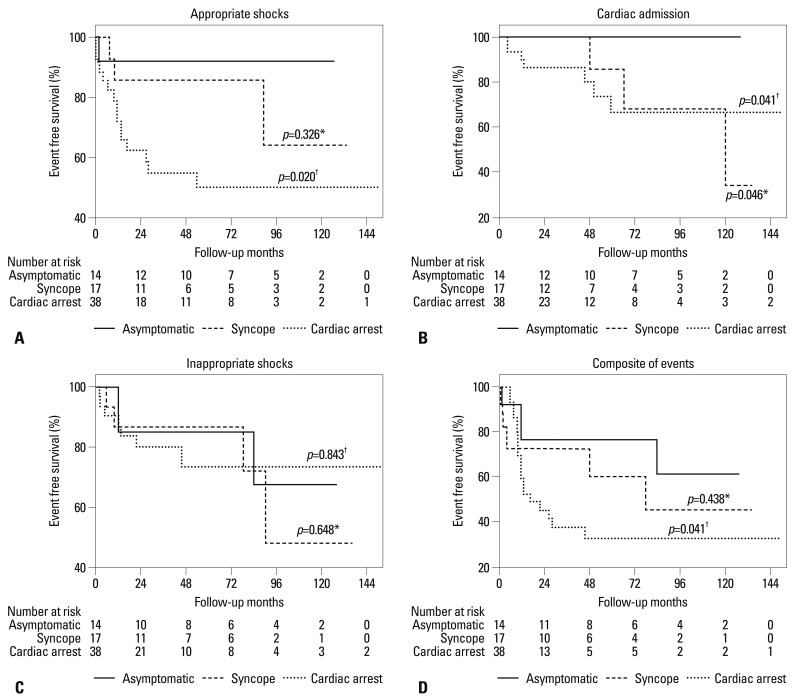
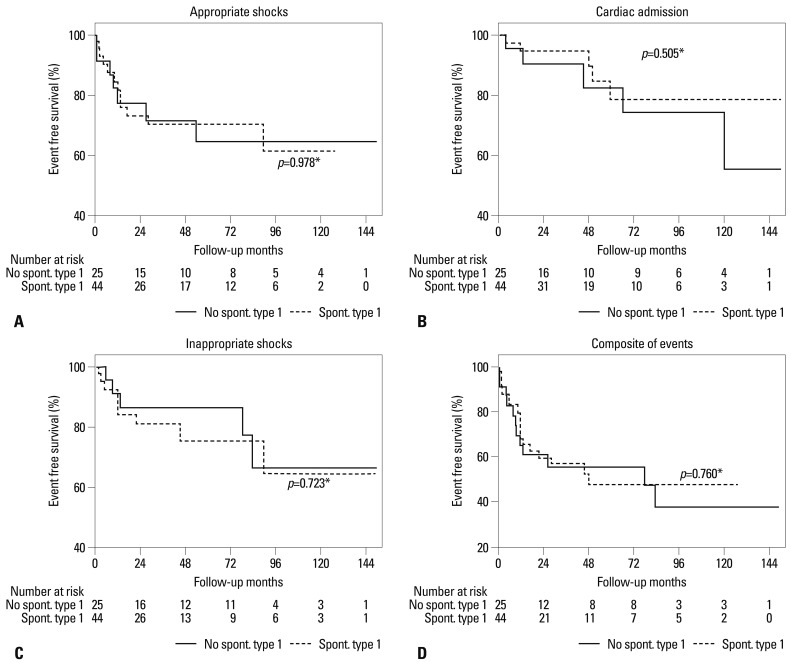
During a mean follow-up of 59±46 months, 4.6±5.5 appropriate shocks were delivered in 19 patients (28%). Fourteen patients (20%) experienced 5.2±8.0 inappropriate shocks caused by supraventricular arrhythmia, lead failure, or abnormal sensing. Six patients were admitted for cardiac causes during follow-up, but no cardiac deaths occurred. An episode of aborted cardiac arrest was a significant predictor of appropriate shock, and the composite of cardiac events in the Cox proportional hazard model [hazard ratio (95% confidence interval) was 11.34 (1.31-97.94) and 4.78 (1.41-16.22), respectively]. However, a spontaneous type 1 ECG was not a predictor of cardiac events.
Appropriate shock (28%) and inappropriate shock (20%) were noted during a mean follow-up of 59±46 months in Korean BrS patients implanted with an ICD. An episode of aborted cardiac arrest was the most powerful predictor of cardiac events.
本研究旨在分析韩国布鲁加达综合征(BrS)患者植入植入式心律转复除颤器(ICD)后的预后。
这是一项回顾性研究,纳入了 1998 年 1 月至 2012 年 4 月期间在韩国的四个中心植入 ICD 的 BrS 患者。69 名患者(68 名男性,1 名女性)因心脏骤停(n=38,55%)、晕厥史(n=17,25%)或无症状患者电生理研究诱发的室性心动过速而植入 ICD(n=14,20%)。13 名患者(19%)和 44 名患者(64%)分别有家族性心源性猝死和自发性 1 型心电图(ECG)记录。
在平均 59±46 个月的随访中,19 名患者(28%)接受了 4.6±5.5 次适当电击。14 名患者(20%)因室上性心律失常、导联故障或异常感知而经历了 5.2±8.0 次不适当电击。6 名患者在随访期间因心脏原因入院,但无心脏死亡发生。心脏骤停发作是适当电击的显著预测因素,Cox 比例风险模型中的心脏事件复合终点[风险比(95%置信区间)分别为 11.34(1.31-97.94)和 4.78(1.41-16.22)]。然而,自发性 1 型 ECG 不是心脏事件的预测因素。
在平均 59±46 个月的随访中,韩国 BrS 患者植入 ICD 后出现适当电击(28%)和不适当电击(20%)。心脏骤停发作是心脏事件的最强预测因素。