Saliou Philippe, Le Gac Gérald, Mercier Anne-Yvonne, Chanu Brigitte, Guéguen Paul, Mérour Marie-Christine, Gourlaouen Isabelle, Autret Sandrine, Le Maréchal Cédric, Rouault Karen, Nousbaum Jean-Baptiste, Férec Claude, Scotet Virginie
Inserm, UMR 1078, Brest, France ; Université de Bretagne Occidentale, Brest, France ; Etablissement Français du Sang - Bretagne, Brest, France ; CHRU Brest, Hôpital Morvan, Laboratoire d'hygiène et de santé publique, Brest, France.
PLoS One. 2013 Dec 5;8(12):e81128. doi: 10.1371/journal.pone.0081128. eCollection 2013.
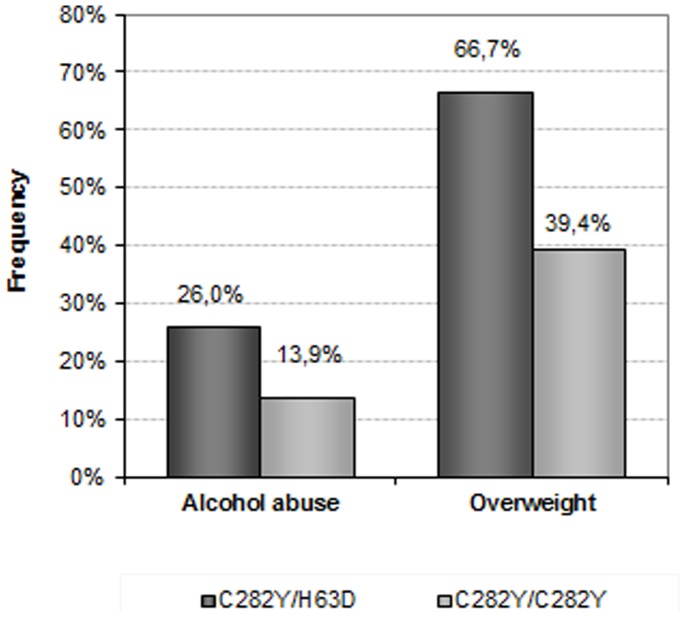
Despite type I haemochromatosis (HC) is mainly associated with the HFE C282Y/C282Y genotype, a second genotype -C282Y/H63D- has mostly been described in other patients. Its association with HC, apart from any associated co-morbid factors, remains unclear and complex to interpret for physicians. This study assesses the weight of this genotype and the role of co-morbid factors in the occurrence of iron overload. This prospective study included the C282Y/C282Y (n = 172) and C282Y/H63D (n = 58) patients enrolled in a phlebotomy program between 2004 and 2007 in a blood centre of western Brittany (Brest, France), where HC is frequent. We compared prevalence of these two genotypes, as well as patients' profile regarding degree of iron overload and prevalence of co-morbid factors. First, we confirmed the obvious deficit of C282Y/H63D compound heterozygotes among patients cared by phlebotomies. This genotype was 3.0 times less frequent than the C282Y/C282Y genotype among those patients (18.9% vs. 56.0%) whereas it was 4.9 times more frequent in the general population (4.3% vs. 0.9%; p<0.0001). Despite a similar level of hyperferritinaemia, the C282Y/H63D patients who came to medical attention had a milder plasma iron overload, reflected by a lower transferrin saturation median (52.0% vs. 84.0%; p<0.0001). They also exhibited more frequently co-morbid factors, as heavy drinking (26.0% vs. 13.9%; p = 0.0454), overweight (66.7% vs. 39.4%; p = 0.0005) or both (21.3% vs. 2.6%; p<0.0001). Ultimately, they required a lower amount of iron removed to reach depletion (2.1 vs. 3.4 g; p<0.0001), clearly reflecting their lower tissue iron. This study confirms that H63D is a discrete genetic susceptibility factor whose expression is most visible in association with other co-factors. It highlights the importance of searching for co-morbidities in these diagnostic situations and of providing lifestyle and dietary advice.
尽管I型血色素沉着症(HC)主要与HFE C282Y/C282Y基因型相关,但另一种基因型——C282Y/H63D——大多在其他患者中被描述。除了任何相关的合并症因素外,其与HC的关联对医生来说仍不清楚且难以解释。本研究评估了该基因型的影响程度以及合并症因素在铁过载发生中的作用。这项前瞻性研究纳入了2004年至2007年期间在布列塔尼西部(法国布雷斯特)一个血中心参加放血计划的C282Y/C282Y(n = 172)和C282Y/H63D(n = 58)患者,该地HC较为常见。我们比较了这两种基因型的患病率,以及患者在铁过载程度和合并症因素患病率方面的情况。首先,我们证实了在接受放血治疗的患者中,C282Y/H63D复合杂合子明显不足。在这些患者中,该基因型的频率比C282Y/C282Y基因型低3.0倍(18.9%对56.0%),而在普通人群中则高4.9倍(4.3%对0.9%;p<0.0001)。尽管高铁蛋白血症水平相似,但前来就医的C282Y/H63D患者的血浆铁过载较轻,这表现为较低的转铁蛋白饱和度中位数(52.0%对84.0%;p<0.0001)。他们还更频繁地出现合并症因素,如大量饮酒(26.0%对13.9%;p = 0.0454)、超重(66.7%对39.4%;p = 0.0005)或两者皆有(21.3%对2.6%;p<0.0001)。最终,他们达到铁耗竭所需去除的铁量较少(2.1克对3.4克;p<0.0001),这清楚地反映了他们较低的组织铁含量。本研究证实H63D是一个离散的遗传易感性因素,其表达在与其他协同因素相关时最为明显。它强调了在这些诊断情况下寻找合并症以及提供生活方式和饮食建议的重要性。