de Graaf Marlies, Totte Joan, Breugem Corstiaan, van Os-Medendorp Harmieke, Pasmans Suzanne
Wilhelmina Children's Hospital, Department of Pediatric Dermatology and Allergology, University Medical Center Utrecht, Utrecht, Netherlands.
JMIR Res Protoc. 2013 Dec 17;2(2):e54. doi: 10.2196/resprot.2897.
Infantile hemangiomas (IH) are common benign vascular tumors in children. Recognition and timely referral of high risk IH to specialized centers is important. This might be achieved by involving parents in the care for IH by means of an eHealth intervention.
The objective of our study was to evaluate parent compliance, acceptance, and usability of an open access, Web-based eHealth intervention (including e-learning and e-consult) designed to increase parents' knowledge and (risk) evaluation of IH.
A cross-sectional study of parents who completed the eHealth intervention between October 2010 and November 2012 was carried out. All parents were sent a study questionnaire. Questions to evaluate compliance (to the advice given by a dermatologist during e-consultation) were asked. Acceptance and usability were evaluated by using the modified Technology Acceptance Model.
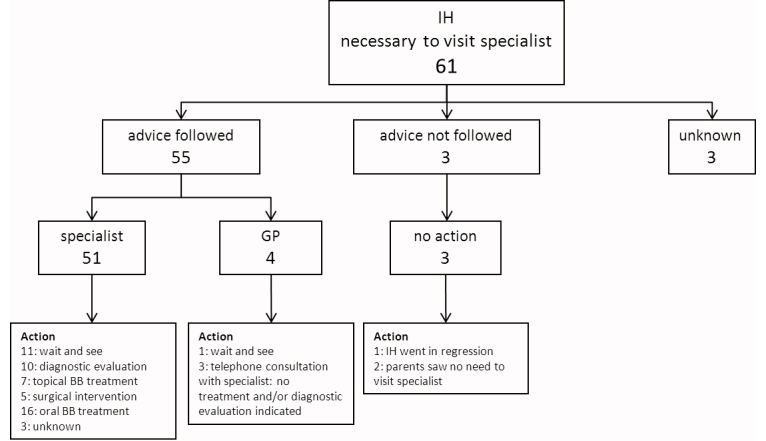
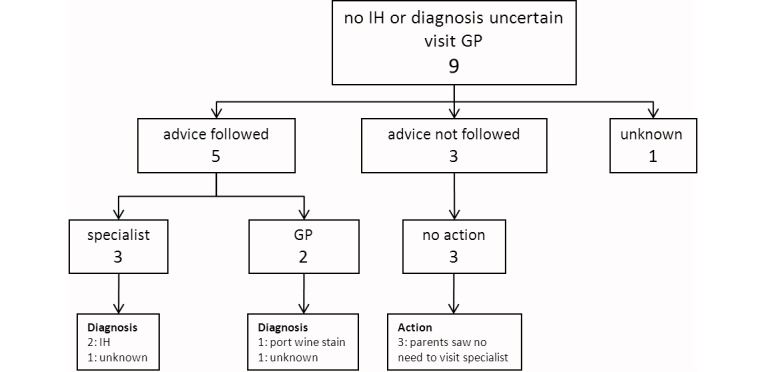
A total of 224 parents completed the eHealth intervention and received the questionnaire, 135/224 parents responded (response rate was 60.3%). There were 128/135 questionnaires that were completed and included. A total of 110/128 (85.9%) parents were compliant to the advice of the dermatologist. There were 116.8/128 (91.3%) that perceived the eHealth intervention as useful and almost all parents (98.4%, 126/128) found the information in the e-learning clear. There were 29/128 (22.7%) that experienced technical problems. The majority of the parents (94.5%, 121/128) found the eHealth intervention reliable and most of them (98.4%, 126/128) would recommend the eHealth intervention to other parents. Noncompliant parents judged the eHealth intervention significantly less reliable compared to compliant parents (71%, 10/14 versus 97.3%, 107/110; P=.003).
Parents of children with an IH showed a high compliance (85.9%, 110/128) to the advice of the dermatologist given via our Web-based eHealth intervention. This high compliance might be positively influenced by the good acceptance and usability of the eHealth intervention and might result in timely presentation and treatment of children with high risk IH in specialized centers.
婴儿血管瘤(IH)是儿童常见的良性血管肿瘤。识别高危IH并及时转诊至专科中心很重要。这可以通过借助电子健康干预措施让家长参与IH护理来实现。
我们研究的目的是评估一种开放获取、基于网络的电子健康干预措施(包括电子学习和电子咨询)的家长依从性、接受度和可用性,该干预措施旨在增加家长对IH的知识和(风险)评估。
对2010年10月至2012年11月期间完成电子健康干预的家长进行了一项横断面研究。向所有家长发送了一份研究问卷。询问了评估依从性(对皮肤科医生在电子咨询期间给出的建议的依从性)的问题。使用改良的技术接受模型评估接受度和可用性。
共有224名家长完成了电子健康干预并收到问卷,135/224名家长做出了回应(回应率为60.3%)。其中128/135份问卷填写完整并纳入研究。共有110/128(85.9%)名家长依从皮肤科医生的建议。116.8/128(91.3%)名家长认为电子健康干预有用,几乎所有家长(98.4%,126/128)都觉得电子学习中的信息清晰明了。有29/128(22.7%)名家长遇到了技术问题。大多数家长(94.5%,121/128)认为电子健康干预可靠,其中大多数(98.4%,126/128)会向其他家长推荐该电子健康干预措施。与依从的家长相比,不依从的家长认为电子健康干预的可靠性明显更低(71%,10/14对97.3%,107/110;P = 0.003)。
患有IH的儿童的家长对通过我们基于网络的电子健康干预措施给出的皮肤科医生建议表现出较高的依从性(85.9%,110/128)。这种高依从性可能受到电子健康干预良好的接受度和可用性的积极影响,并可能导致高危IH儿童在专科中心得到及时诊治。