Moniuszko Marcin, Glowinska-Olszewska Barbara, Rusak Malgorzata, Jeznach Marta, Grubczak Kamil, Lipinska Danuta, Milewski Robert, Milewska Anna Justyna, Dabrowska Milena, Jablonska Ewa, Kretowski Adam, Gorska Maria, Bodzenta-Lukaszyk Anna, Bossowski Artur
Department of Regenerative Medicine and Immune Regulation, Medical University of Bialystok, 15-269 Bialystok, Poland ; Department of Allergology and Internal Medicine, University of Bialystok, 15-276 Bialystok, Poland.
Department of Pediatrics, Endocrinology, Diabetology with Cardiology Division, Medical University of Bialystok, 15-274 Bialystok, Poland.
Clin Dev Immunol. 2013;2013:459210. doi: 10.1155/2013/459210. Epub 2013 Nov 21.
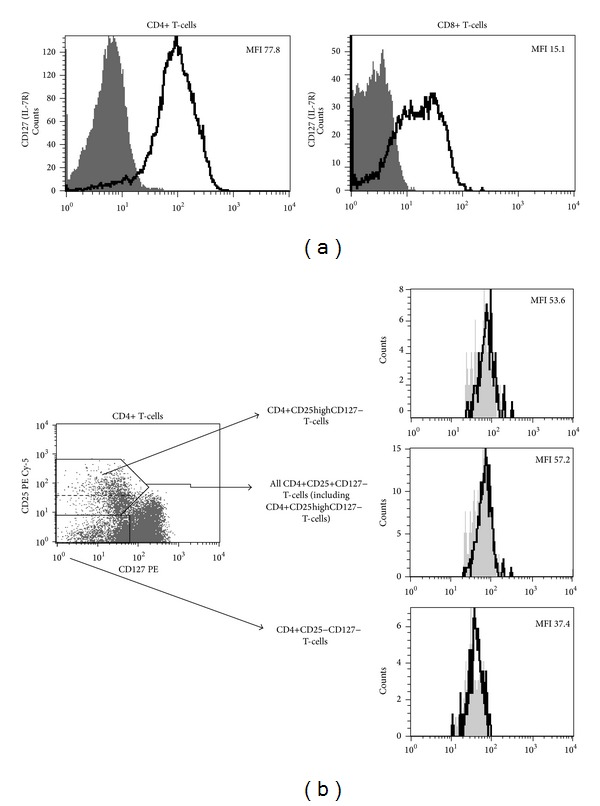
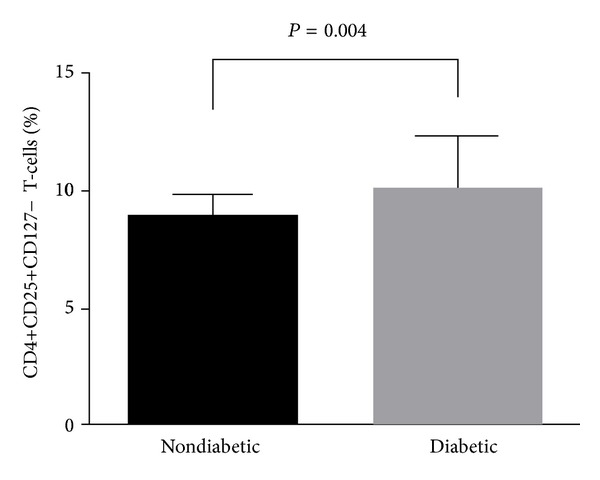
Pathobiology of type 1 diabetes (T1D) is predominantly associated with T-cell-related actions. Homeostasis of majority of T-cells is critically dependent on signals mediated by CD127 (interleukin-7 receptor, IL-7R). In contrast, regulatory T-cells express very little CD127 and thereby may be delineated by CD4+CD25+CD127- phenotype. Here we aimed to analyze CD127 expression on CD4+ and CD8+ T-cells and enumerate CD4+CD25+CD127- T-cells in long-lasting T1D. T-cells were analyzed by flow cytometry and immunologic data were correlated with vascular, metabolic, and inflammatory parameters. We demonstrated significantly decreased CD127 levels on CD4+, but not CD8+, T cells in T1D pediatric patients. Interestingly, frequencies of CD4+CD25+CD127- T-cells were significantly enhanced in T1D children and correlated well with frequencies of CD34+CD144+ endothelial progenitor cells and CD4+CD25- T-cells. Levels of CD127 on both CD4+ and CD8+ T-cells in T1D patients were not correlated to each other or HbA1C. Interestingly, however, CD127 levels on CD4+ T-cells were significantly correlated to frequencies of CD4+CD25+CD127- T-cells, whereas CD127 levels on CD8+ T-cells were significantly correlated to concentrations of VEGF and triglycerides. Our data indicate that CD127 expression is differentially modulated on CD4+ and CD8+ T-cells in the course of T1D. Moreover, we demonstrated that, in contrast to recent-onset T1D, long-lasting T1D is associated with enhancement of T-cells with regulatory phenotype.
1型糖尿病(T1D)的病理生物学主要与T细胞相关作用有关。大多数T细胞的稳态严重依赖于由CD127(白细胞介素-7受体,IL-7R)介导的信号。相比之下,调节性T细胞表达的CD127很少,因此可以通过CD4 + CD25 + CD127-表型来界定。在这里,我们旨在分析长期患T1D的患者中CD4 +和CD8 + T细胞上CD127的表达,并对CD4 + CD25 + CD127- T细胞进行计数。通过流式细胞术分析T细胞,并将免疫数据与血管、代谢和炎症参数相关联。我们证明,T1D儿科患者的CD4 + T细胞上的CD127水平显著降低,但CD8 + T细胞上的CD127水平没有降低。有趣的是,T1D儿童中CD4 + CD25 + CD127- T细胞的频率显著增加,并且与CD34 + CD144 +内皮祖细胞和CD4 + CD25- T细胞的频率密切相关。T1D患者CD4 +和CD8 + T细胞上的CD127水平彼此之间或与糖化血红蛋白(HbA1C)均无相关性。然而,有趣的是,CD4 + T细胞上的CD127水平与CD4 + CD25 + CD127- T细胞的频率显著相关,而CD8 + T细胞上的CD127水平与血管内皮生长因子(VEGF)浓度和甘油三酯显著相关。我们的数据表明,在T1D病程中,CD4 +和CD8 + T细胞上的CD127表达受到不同的调节。此外,我们证明,与新发病的T1D相比,长期患T1D与具有调节表型的T细胞增加有关。