Nagaya Ryo, Mizuno-Kamiya Masako, Takayama Eiji, Kawaki Harumi, Onoe Ippei, Tanabe Toshiichiro, Nagahara Kuniteru, Kondoh Nobuo
Department of Oral Implantology, Asahi University School of Dentistry, Mizuho-shi, Gifu 501-0296, Japan.
Department of Oral Biochemistry, Asahi University School of Dentistry, Mizuho-shi, Gifu 501-0296, Japan.
Exp Ther Med. 2014 Jan;7(1):17-22. doi: 10.3892/etm.2013.1382. Epub 2013 Nov 6.
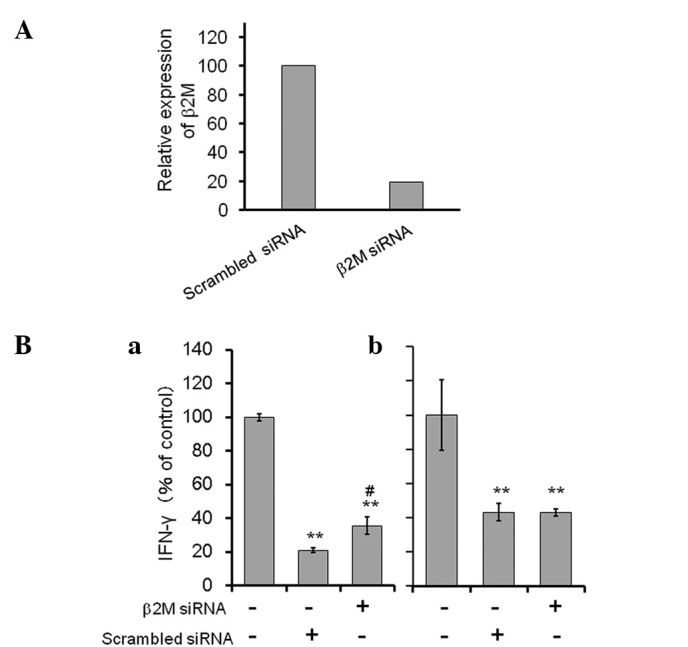
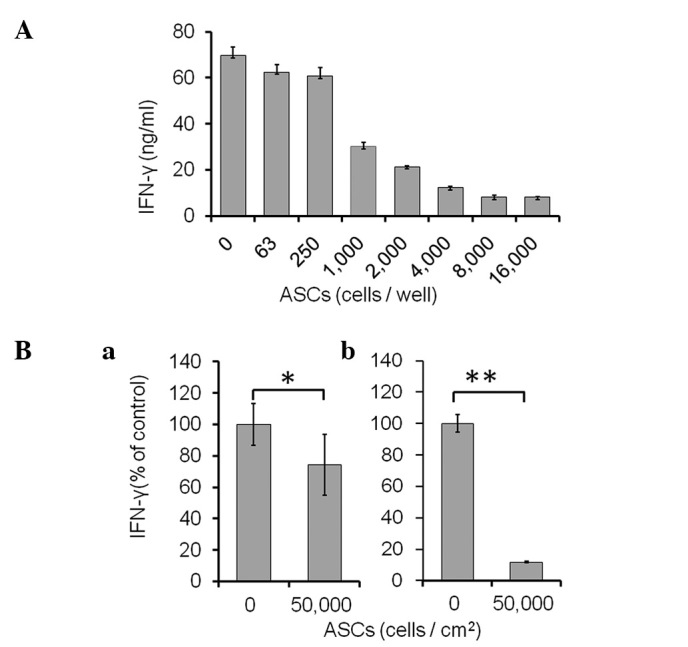
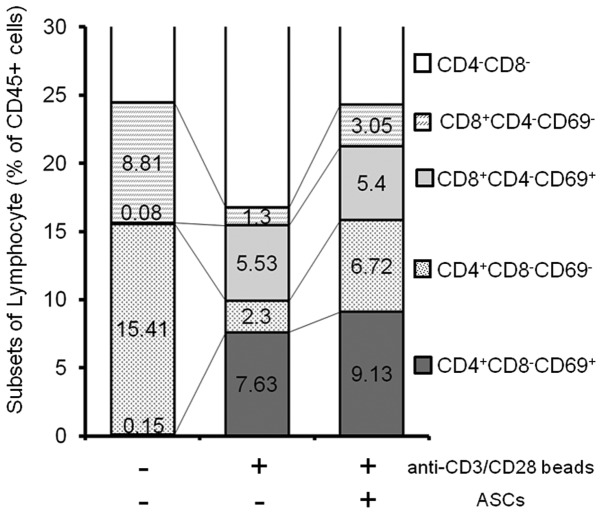
The mechanisms of immunomodulation by mesenchymal stromal cells remain poorly understood. In this study, the effects of mouse adipose tissue-derived mesenchymal stromal cells (ASCs) on mouse spleen cells alloreactively stimulated by anti-CD3 and anti-CD28 antibody-coated (anti-CD3/CD28) beads were observed. Production of interferon-γ by the anti-CD3/CD28 bead-stimulated spleen cells was significantly suppressed in co-culture with ASCs. However, an augmented intensity of CD69 on the stimulated spleen cells was not suppressed in the presence of ASCs. The immunosuppressive effects of ASCs were partially mediated by one or more soluble factors (26% suppression). However, the ASCs require cell-cell contact in order to maximally exert suppression (88%). The suppressive effect of ASCs mediated by direct cell contact was partially reversed following knockdown of β2 microglobulin, a component of the major histocompatibility complex (MHC) class I molecule, with siRNA. The results of the study demonstrated that ASCs have significant immune modulatory effects on alloreactively stimulated spleen cells. The effects of ASCs on spleen cells are dependent on soluble factor(s) and cell contact, which is mediated by the MHC class I complex on ASCs.
间充质基质细胞的免疫调节机制仍知之甚少。在本研究中,观察了小鼠脂肪组织来源的间充质基质细胞(ASC)对由抗CD3和抗CD28抗体包被(抗CD3/CD28)磁珠同种异体反应性刺激的小鼠脾细胞的影响。在与ASC共培养时,抗CD3/CD28磁珠刺激的脾细胞产生的干扰素-γ受到显著抑制。然而,在存在ASC的情况下,刺激的脾细胞上CD69强度的增强并未受到抑制。ASC的免疫抑制作用部分由一种或多种可溶性因子介导(抑制26%)。然而,ASC需要细胞间接触才能最大程度地发挥抑制作用(抑制88%)。在用小干扰RNA敲低主要组织相容性复合体(MHC)I类分子的一个组成部分β2微球蛋白后,由直接细胞接触介导的ASC的抑制作用部分逆转。该研究结果表明,ASC对同种异体反应性刺激的脾细胞具有显著的免疫调节作用。ASC对脾细胞的作用取决于可溶性因子和细胞接触,这是由ASC上的MHC I类复合体介导的。