Center for Tropical Forest Science, Smithsonian Tropical Research Institute, Ciudad de Panamá, República de Panamá
Center for Tropical Forest Science, Smithsonian Tropical Research Institute, Ciudad de Panamá, República de Panamá ; Yale School of Forestry and Environmental Studies, New Haven, Connecticut, United States of America.
PLoS One. 2013 Dec 11;8(12):e82433. doi: 10.1371/journal.pone.0082433. eCollection 2013.
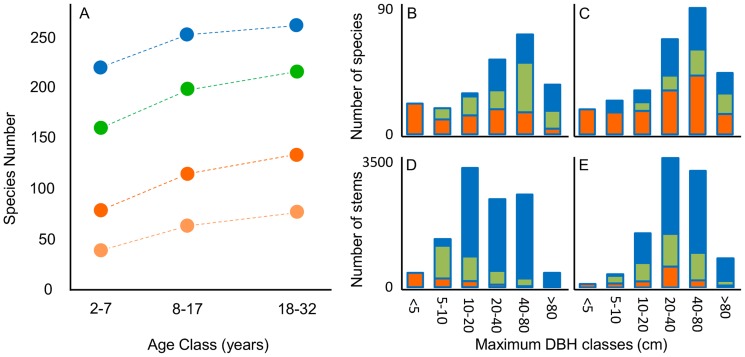
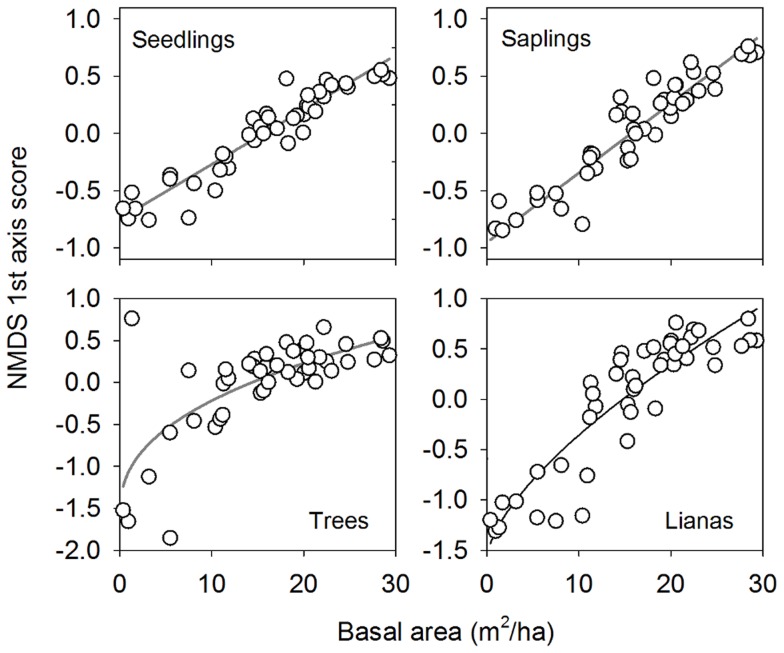
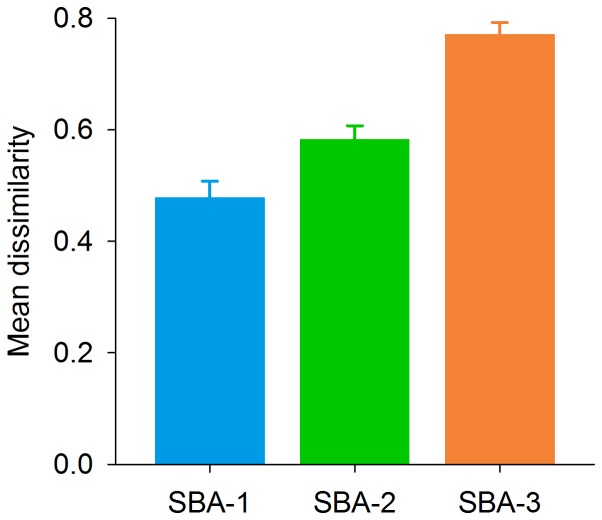
Both local- and landscape-scale processes drive succession of secondary forests in human-modified tropical landscapes. Nonetheless, until recently successional changes in composition and diversity have been predominantly studied at the patch level. Here, we used a unique dataset with 45 randomly selected sites across a mixed-use tropical landscape in central Panama to study forest succession simultaneously on local and landscape scales and across both life stages (seedling, sapling, juvenile and adult trees) and life forms (shrubs, trees, lianas, and palms). To understand the potential of these secondary forests to conserve tree species diversity, we also evaluated the diversity of species that can persist as viable metapopulations in a dynamic patchwork of short-lived successional forests, using different assumptions about the average relative size at reproductive maturity. We found a deterministic shift in the diversity and composition of the local plant communities as well as the metacommunity, driven by variation in the rate at which species recruited into and disappeared from the secondary forests across the landscape. Our results indicate that dispersal limitation and the successional niche operate simultaneously and shape successional dynamics of the metacommunity of these early secondary forests. A high diversity of plant species across the metacommunity of early secondary forests shows a potential for restoration of diverse forests through natural succession, when trees and fragments of older forests are maintained in the agricultural matrix and land is abandoned or set aside for a long period of time. On the other hand, during the first 32 years the number of species with mature-sized individuals was a relatively small and strongly biased sub-sample of the total species pool. This implies that ephemeral secondary forests have a limited role in the long-term conservation of tree species diversity in human-modified tropical landscapes.
本地和景观尺度的过程共同驱动了人类改造的热带景观中次生林的演替。尽管如此,直到最近,组成和多样性的演替变化主要在斑块尺度上进行研究。在这里,我们使用了一个独特的数据集,该数据集包含了中美洲巴拿马混合使用热带景观中 45 个随机选择的地点,同时在本地和景观尺度上以及两个生命阶段(幼苗、幼树、青少年和成年树木)和生命形式(灌木、树木、藤本植物和棕榈树)上研究森林演替。为了了解这些次生林保护树种多样性的潜力,我们还评估了在一个由短暂演替森林组成的动态斑块镶嵌体中作为可行的泛种群而持续存在的物种多样性,使用了关于在生殖成熟时平均相对大小的不同假设。我们发现,由于物种在景观上进入和离开次生林的速度变化,导致了当地植物群落以及元群落的多样性和组成的确定性变化。我们的研究结果表明,扩散限制和演替生态位同时作用,塑造了这些早期次生林元群落的演替动态。早期次生林元群落中植物物种的多样性表明,通过自然演替有可能恢复多样化的森林,只要在农业基质中保留树木和较老森林的碎片,并将土地闲置或闲置很长一段时间。另一方面,在前 32 年中,具有成熟个体的物种数量相对较少,并且是总物种库的一个高度偏向的子样本。这意味着短暂的次生林在人类改造的热带景观中保护树种多样性的长期方面的作用有限。