State Key Laboratory for Diagnosis and Treatment of Infectious Diseases, the First Affiliated Hospital, School of Medicine, Zhejiang University, Hangzhou, Zhejiang Province, China.
PLoS One. 2013 Dec 13;8(12):e82451. doi: 10.1371/journal.pone.0082451. eCollection 2013.
Female sex workers (FSWs) play an important role in transmitting HIV and syphilis from high-risk groups to the general population. However, the trends in HIV and syphilis epidemics in Chinese FSWs in the period after 2000 are unclear to date.
The Preferred Reporting Items for Systematic Reviews and Meta-Analyses Statement was followed. Seven databases were searched for published peer-reviewed articles. The incidence of HIV and syphilis in FSWs in different time periods, provinces and workplaces in China were separately pooled by meta-analysis. Correlation analysis was conducted between HIV and syphilis incidence and study time, respectively.
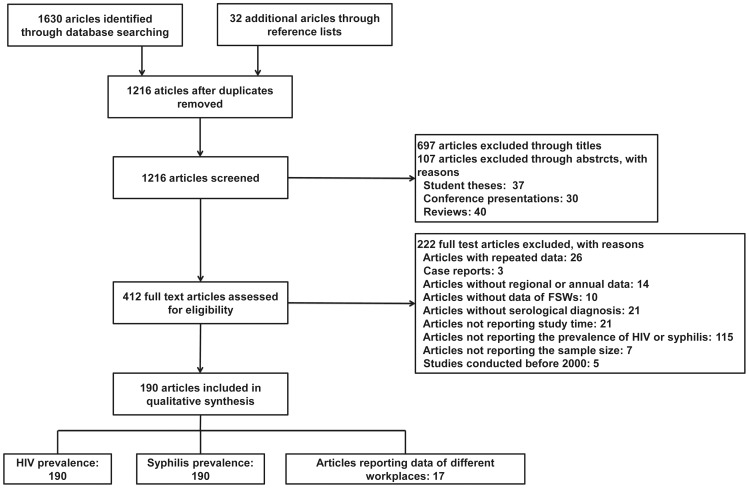
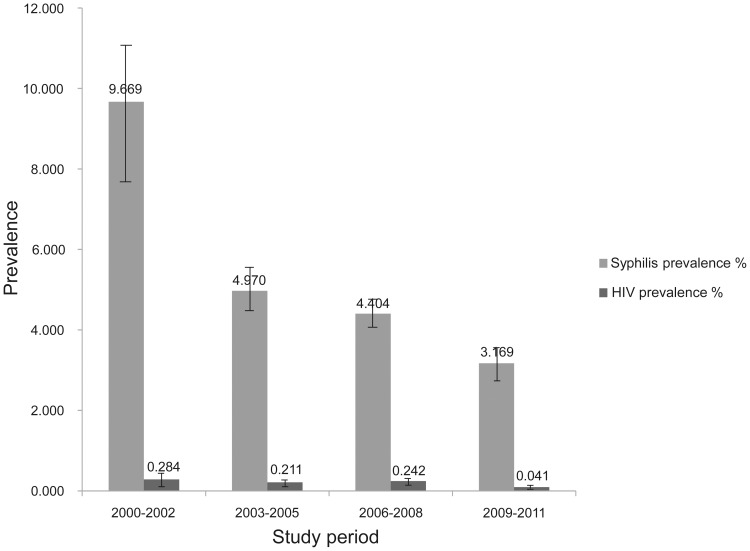
After 1,662 articles were screened, 190 published papers were included in the final analysis. Estimated HIV prevalence was 0.284% (95% CI: 0.080-0.488%) in the period 2000-2002, 0.211% (95% CI: 0.149-0.273%) in 2003-2005, 0.242% (95% CI: 0.190-0.294%) in 2006-2008 and 0.041% (95% CI: 0.024-0.058%) in 2009-2011. The corresponding syphilis prevalence was 9.669% (95% CI: 7.810-11.529%), 4.970% (95% CI: 4.384-5.556%), 4.404% (95% CI: 4.032-4.775%) and 3.169% (95% CI: 2.738-3.600%), respectively. Spearman rank correlation coefficients were -0.165 (p = 0.002) between HIV prevalence and study time, and -0.209 (p = 0.000) between syphilis prevalence and study time. The combined HIV prevalence was 0.318% (95% CI: 0.156-0.479%) in medium and high-tier workplaces and 0.393% (95% CI: 0.176-0.610%) in low-tier workplaces. The corresponding syphilis prevalence was 3.216% (95% CI: 2.192-4.240%) and 13.817% (95% CI: 10.589-17.044%), respectively.
Our data suggested a decline in HIV and syphilis epidemics in FSWs in China on a national level during the study period (2000-2011). FSWs in low-tier workplaces should be given more attention in the future to ensure they are included in prevention programs for HIV and sexually transmitted diseases.
性工作者(FSWs)在将艾滋病毒和梅毒从高危人群传播给普通人群方面发挥着重要作用。然而,截至目前,2000 年后中国 FSWs 中艾滋病毒和梅毒流行趋势尚不清楚。
遵循系统评价和荟萃分析的首选报告项目。在七个数据库中搜索已发表的同行评审文章。通过荟萃分析分别汇总了中国不同时期、不同省份和不同工作场所 FSWs 的 HIV 和梅毒发病率。分别对 HIV 和梅毒发病率与研究时间进行了相关性分析。
在筛选了 1662 篇文章后,最终有 190 篇已发表的论文纳入了最终分析。2000-2002 年期间,HIV 流行率估计为 0.284%(95%CI:0.080-0.488%),2003-2005 年为 0.211%(95%CI:0.149-0.273%),2006-2008 年为 0.242%(95%CI:0.190-0.294%),2009-2011 年为 0.041%(95%CI:0.024-0.058%)。相应的梅毒流行率分别为 9.669%(95%CI:7.810-11.529%)、4.970%(95%CI:4.384-5.556%)、4.404%(95%CI:4.032-4.775%)和 3.169%(95%CI:2.738-3.600%)。HIV 流行率与研究时间之间的 Spearman 秩相关系数为-0.165(p=0.002),梅毒流行率与研究时间之间的 Spearman 秩相关系数为-0.209(p=0.000)。中高等级工作场所的 HIV 合并流行率为 0.318%(95%CI:0.156-0.479%),低等级工作场所的 HIV 合并流行率为 0.393%(95%CI:0.176-0.610%)。相应的梅毒流行率分别为 3.216%(95%CI:2.192-4.240%)和 13.817%(95%CI:10.589-17.044%)。
我们的数据表明,2000-2011 年期间,中国全国性工作者中 HIV 和梅毒流行呈下降趋势。今后应更加关注低级别工作场所的性工作者,确保将其纳入艾滋病毒和性传播疾病预防规划。